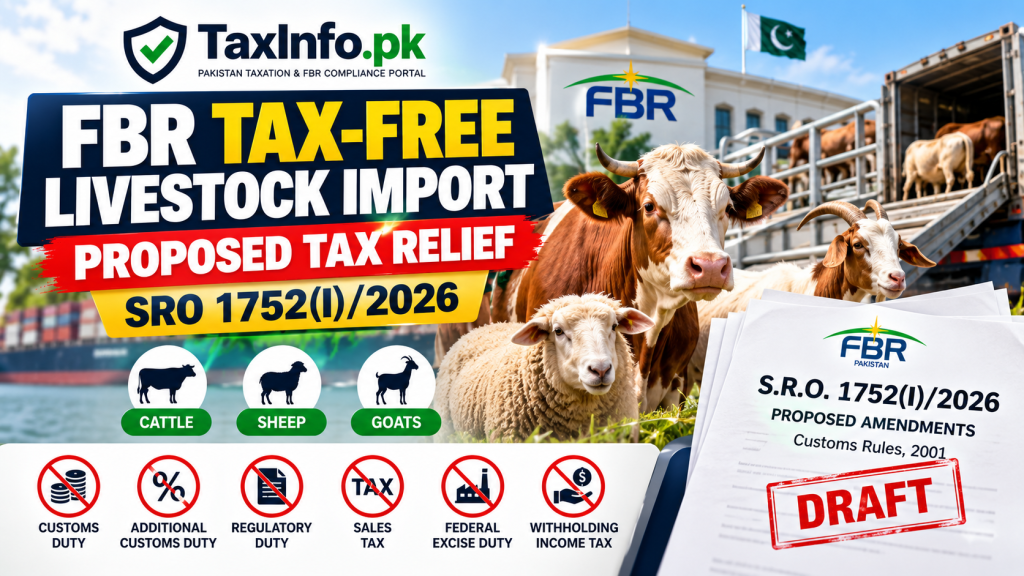
The FBR Tax-Free Livestock Import proposal for 2026 introduces major potential tax relief for Pakistan’s livestock and meat export industry. Through S.R.O. 1752(I)/2026, the Federal Board of Revenue (FBR) has proposed new procedures allowing eligible businesses to import cattle, sheep and goats under the Export Facilitation Scheme (EFS), subject to strict export and regulatory conditions.
The proposed changes could benefit livestock importers, feedlot operators, meat processors and exporters by reducing the upfront tax and duty burden on qualifying imports.
Important Update: SRO 1752(I)/2026 contains draft amendments. As of October 10, 2026, the proposals are subject to stakeholder feedback and finalisation. Businesses should not assume that all livestock imports are already exempt from taxes.
Table of Contents
What Is FBR SRO 1752(I)/2026?
S.R.O. 1752(I)/2026, dated October 7, 2026, proposes amendments to Pakistan’s Customs Rules, 2001, relating to the import and subsequent export of live animals and meat products under the Export Facilitation Scheme.
The proposed framework is designed for businesses importing livestock for fattening and subsequent export, rather than for ordinary domestic livestock trading.
The notification is listed on the official FBR website.
Which Animals Qualify for FBR Tax-Free Livestock Import?
The proposed facility covers three main livestock categories:
- Cattle, including eligible bovine animals
- Sheep
- Goats
Purebred breeding animals are excluded from the proposed arrangement.
The scheme also does not apply to animals born in Pakistan.
Imported animals must be processed or exported in accordance with the approved scheme and its identification, health and customs requirements.
Which Taxes and Duties May Be Deferred?
Under the proposed rules, eligible businesses may receive relief from several import-related taxes and duties.
| Tax or duty | Proposed treatment |
|---|---|
| Customs Duty | Relief under approved EFS conditions |
| Additional Customs Duty | Relief under approved EFS conditions |
| Regulatory Duty | Relief under approved EFS conditions |
| Sales Tax | Relief under approved EFS conditions |
| Federal Excise Duty | Relief under approved EFS conditions |
| Withholding Income Tax | Relief under approved EFS conditions |
Important distinction: The proposed arrangement is based on conditional duty and tax deferment or relief. It should not be interpreted as a permanent, unconditional exemption for every importer.
If an importer fails to satisfy the applicable conditions, deferred duties and taxes may become recoverable under the relevant rules.
Two Proposed Export Tracks Under the New SRO
The proposed framework introduces two separate arrangements for livestock exporters.
Track A – Import, Fattening and Re-Export of Live Animals
Under Track A, approved businesses may import eligible live animals, keep them at authorised premises for fattening and subsequently export them as live animals.
The exported animals must retain their registered identity, and exporters must comply with the applicable veterinary, quarantine, export permit and customs requirements.
Track B – Import, Fattening and Meat Export
Track B is intended for businesses importing livestock for fattening, slaughtering and processing before exporting meat or meat products.
Slaughtering and processing must take place at registered export establishments under the required veterinary supervision.
This arrangement may be particularly relevant to commercial meat exporters and integrated livestock processing businesses.
Export Requirements Under SRO 1752(I)/2026
The proposed rules include an export-performance requirement of at least 80%.
| Export arrangement | Proposed requirement |
|---|---|
| Track A | Export at least 80% of imported animals by head |
| Track B | Export at least 80% of total production by value |
The requirement applies during the first full financial year of operations and must be maintained for the following four financial years.
These conditions are intended to ensure that the scheme supports genuine export activity rather than unrestricted domestic sales.
Time Limits for Livestock and Meat Exports
The proposed framework also establishes processing and export deadlines.
| Category | Proposed time limit |
|---|---|
| Cattle | 180 days after quarantine release |
| Sheep and goats | 120 days after quarantine release |
| Meat and meat products under Track B | 120 days after slaughter |
These deadlines are important because delays or non-compliance could affect an operator’s eligibility and tax obligations.
Who Can Apply for the Proposed Livestock Import Facility?
The scheme is intended for qualifying businesses operating approved livestock or meat export facilities.
An applicant would generally need:
- Registration under the Income Tax Ordinance, 2001, and Sales Tax Act, 1990
- Approved premises or a registered export establishment
- Relevant animal health and regulatory approvals
- An application specifying the proposed export track
- Details of animal species and annual import quotas
- Authorisation from the relevant customs authority
- Applicable security or indemnity arrangements
Applications are proposed to be submitted electronically to the Regulatory Collector.
The applicable registrations, licences and export authorisations would need to be completed before businesses could lawfully benefit from the arrangement.
Duty and Tax Relief for Animal Feed, Medicines and Machinery
The proposed framework is not limited to the import of live animals.
Eligible approved operators may also benefit from conditional duty and tax relief on certain inputs, including:
- Animal feed and nutritional supplements
- Veterinary medicines and vaccines
- Disinfectants
- Animal identification devices
- Approved plant, machinery and equipment
The facility may support the establishment or expansion of feedlots, quarantine facilities, slaughterhouses and meat processing plants.
For qualifying projects, the proposal provides a commissioning period of 24 months, potentially extendable by another 12 months with the required approval.
Plant and machinery must remain installed and operational at approved premises for the prescribed period, including the proposed five-year requirement.
Practical Example: Importing 500 Cattle for Export
Suppose a registered livestock export company plans to import 500 cattle for fattening and subsequent export.
Under the proposed Track A requirements:
- Total imported cattle: 500
- Minimum export requirement: 80%
- Minimum animals to export: 400
- Maximum number outside the 80% threshold: 100
The company would need to export at least 400 qualifying animals to satisfy the numerical export-performance threshold.
However, the remaining 100 animals would not automatically become tax-free domestic sales. Their treatment would depend on the applicable disposal, adjustment, duty-payment and other regulatory provisions.
The importer would also need to comply with identification, quarantine, export deadlines and authorisation requirements.
This is an illustrative example, not an approval or calculation of actual tax liability.
Can Pakistani Livestock Farmers Use This Scheme?
The proposed arrangement is specifically connected with imported livestock and export-oriented operations.
It does not automatically provide a tax exemption to every local livestock farmer, animal trader or cattle market operator.
A domestic farmer selling locally raised animals would not qualify merely because livestock is covered by the notification.
However, approved export businesses may create commercial opportunities for related sectors, including feed suppliers, veterinary services and meat-processing operators.
How Will Pakistan Single Window Be Used?
The proposed rules refer to export permits and animal health certification through Pakistan Single Window (PSW), including the relevant Licences, Permits, Certificates and Other Documents (LPCO) procedures.
Exporters should review the Pakistan Single Window official portal for applicable trade documentation and regulatory processes.
They should also consult the Federal Board of Revenue for customs notifications and the FBR SRO database for the latest notification status.
Is FBR Tax-Free Livestock Import Already Effective?
As of October 10, 2026, the available notification is a draft amendment inviting objections and suggestions.
Stakeholders have been given seven days from publication in the official Gazette to provide feedback.
Therefore, importers should verify whether the amendments have been finalised and brought into effect before relying on the proposed facility.
The final notification may contain changes to eligibility, documentation, deadlines or compliance requirements.
Frequently Asked Questions
1. What is SRO 1752(I)/2026?
It is an FBR notification proposing amendments to the Customs Rules, 2001, to facilitate qualifying livestock imports and subsequent exports under the Export Facilitation Scheme.
2. Is livestock import completely tax-free in Pakistan?
No. The proposal provides conditional relief for approved export-oriented operations. It does not establish an unconditional exemption for all livestock imports.
3. Which animals are covered?
Eligible cattle, sheep and goats are covered, subject to the proposed exclusions and scheme conditions.
4. Can imported animals be sold in Pakistan?
Domestic disposal cannot be assumed to be exempt from taxes. Any such transaction must comply with the applicable rules and may involve payment or recovery of duties and taxes.
5. What is the minimum export requirement?
The proposed requirement is generally 80% by animal headcount under Track A and 80% by production value under Track B.
6. Can a meat processing company benefit?
Potentially yes. Eligible registered businesses operating approved export establishments may qualify under Track B, subject to authorisation and compliance.
7. Where can businesses verify the official notification?
Businesses should consult the FBR’s official SRO database and the relevant Customs notifications before making import decisions.
Final Words
The FBR Tax-Free Livestock Import proposal under SRO 1752(I)/2026 could introduce important facilities for Pakistan’s export-oriented livestock and meat industry.
The proposed framework covers eligible live animals, related inputs and certain plant and machinery, while imposing strict conditions on registration, animal traceability, processing, export performance and regulatory compliance.
For importers and exporters, the key step is to review the final notified rules before making commercial commitments or claiming any tax relief.
For more updates on Pakistan taxation, FBR notifications and compliance requirements, visit TaxInfo.pk.