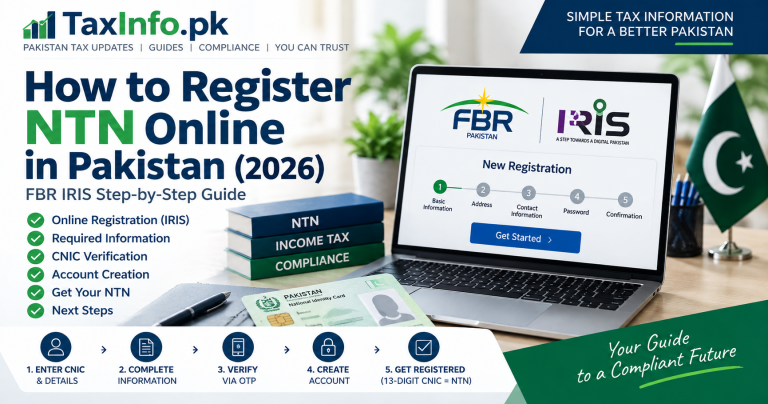

Becoming a filer in Pakistan may seem complicated if you are unfamiliar with NTN, FBR registration, IRIS and the Active Taxpayer List (ATL). However, the process becomes much easier once you understand the correct sequence.
In simple terms, you first register with the Federal Board of Revenue (FBR), obtain access to IRIS, file the required income tax return and Wealth Statement, and then meet the applicable requirements for inclusion in the Active Taxpayer List.
This guide explains the complete process step by step.
What Does “Filer” Mean in Pakistan?
The term filer is commonly used in Pakistan for a taxpayer who has filed the required income tax return and meets the applicable requirements for inclusion in FBR’s Active Taxpayer List (ATL).
The ATL is FBR’s official list used to identify active taxpayers.
An important point to remember is:
Getting an NTN or registering with FBR does not automatically mean that you are active on the ATL.
NTN vs Filer Status – What Is the Difference?
Many new taxpayers confuse NTN registration with filer status.
For an individual, after registration with FBR, the 13-digit CNIC is used as the NTN or Registration Number.
In simple terms:
| Status | What It Means |
|---|---|
| NTN / FBR Registration | You are registered with FBR |
| ATL Status | You meet the applicable requirements for appearing on the Active Taxpayer List |
Therefore, a person can be registered with FBR but still not be active on the ATL.
How to Become a Filer in Pakistan – Step by Step
The overall process is:
- Prepare the required information and documents.
- Register with FBR through IRIS.
- Access your IRIS account.
- Complete your income tax return.
- Complete the applicable Wealth Statement.
- Check and pay any tax payable.
- Submit the return successfully.
- Meet the applicable ATL requirements.
- Verify your ATL status.
Let’s go through each step.
Step 1: Prepare the Required Information and Documents
Before starting FBR registration, keep the required information and documents ready.
For online registration of an individual, FBR guidance includes requirements such as:
- Your valid CNIC
- A mobile SIM registered against your own CNIC
- Your personal email address
- Personal bank account information/documentation
- Details of your income or source of income
If you operate a business, additional information or documents may be required, such as evidence relating to your business premises and utility connection.
The exact requirements can differ depending on whether you are registering as an individual, business person, Association of Persons (AOP), or company.
Step 2: Register With FBR Through IRIS
FBR’s online income tax system is called IRIS.
You can access the official portal through FBR IRIS.
A person filing an income tax return for the first time normally needs to complete the applicable registration/e-enrollment process.
After successful registration, you can access IRIS and proceed with your tax filing.
What Is My NTN After Registration?
For an individual, the 13-digit CNIC is used as the NTN or Registration Number.
Companies and AOPs are assigned their applicable registration/NTN number through FBR’s registration system.
Step 3: Log In to Your IRIS Account
Once registration is complete, log in to your IRIS account.
IRIS is used for important income tax functions, including filing income tax returns and managing taxpayer information.
If you were already registered with FBR but do not have IRIS login credentials, the portal provides facilities for registered taxpayers to obtain/access their account.
Password recovery options are also available if you lose access to your credentials.
Step 4: File Your Income Tax Return
Registration alone is not enough to become an active filer.
You need to file the applicable income tax return for the relevant tax year.
Depending on your circumstances, the return may contain information relating to:
- Salary income
- Business income
- Property income
- Other taxable income
- Tax already deducted or paid
- Tax credits or adjustments
- Other information required by the applicable return
The figures entered in your return should be based on your actual financial records.
Avoid entering estimated or arbitrary figures merely for the purpose of obtaining filer status.
Step 5: Complete Your Wealth Statement
For taxpayers required to complete it, the Wealth Statement is an important part of the income tax return filing process.
It generally includes information about your:
- Assets
- Liabilities
- Personal expenses
- Receipts and other relevant financial information
What Is Wealth Reconciliation?
Your Wealth Statement needs to reconcile your change in wealth with your income, expenses and other relevant inflows/outflows.
If the figures do not reconcile correctly, you may not be able to complete the filing process successfully.
This is one of the areas where taxpayers should be particularly careful.
Step 6: Check and Pay Any Tax Payable
After entering the required information, check whether any income tax is payable.
Your actual tax liability depends on factors such as:
- Taxable income
- Applicable tax rates
- Tax already deducted
- Available tax credits or adjustments
- Your individual circumstances
If tax is payable, follow the applicable FBR payment procedure and retain the payment record.
Not every registered taxpayer necessarily has the same tax liability.
Step 7: Submit the Return Successfully
Before submitting your return, review all information carefully.
Make sure that the return has actually been submitted, rather than merely saved as a draft.
FBR guidance explains that successful filing can be confirmed through the relevant completed tasks/status within IRIS.
It is also advisable to retain copies of your submitted return and supporting records.
Step 8: Become Active on the ATL
After filing your return, the next important issue is your Active Taxpayer List status.
Remember:
NTN registration ≠ ATL status
If the applicable return is filed after the due date, FBR currently provides for an ATL surcharge for late filers seeking inclusion in the Active Taxpayer List.
| Taxpayer Type | ATL Surcharge |
|---|---|
| Individual | Rs. 1,000 |
| Association of Persons (AOP) | Rs. 10,000 |
| Company | Rs. 20,000 |
FBR states that late filers can become part of the ATL after payment of the applicable surcharge, subject to the relevant requirements.
Because tax rules and procedures can change, verify the current position with FBR before making a payment.
Step 9: Check Your Filer / ATL Status
Once the filing process is complete, verify whether your status is actually Active on the ATL.
TaxInfo.pk has a separate step-by-step guide explaining how to check your status online and through SMS:
→ How to Check ATL Status in Pakistan – FBR Filer Status by CNIC
Does Having an NTN Make You a Filer?
No, not automatically.
Having an NTN/FBR registration means you are registered with FBR.
Being active on the ATL depends on meeting the applicable return-filing and ATL requirements.
This distinction is particularly important for people who registered with FBR in the past but have not been filing their required income tax returns.
Can a Salaried Person Become a Filer?
Yes.
A salaried individual can file an income tax return through IRIS.
Having income tax deducted from your salary by your employer should not automatically be treated as a substitute for your own return-filing obligation where you are legally required to file a return.
Your filing requirement depends on the applicable tax law and your individual circumstances.
Can You Become a Filer Without Paying Income Tax?
Filing a return and having income tax payable are not necessarily the same thing.
Whether you actually owe tax depends on factors such as your taxable income, applicable tax rates, taxes already deducted, available credits and your individual circumstances.
Therefore, you should report your actual financial information and determine the liability according to the applicable tax rules.
Can You File an Income Tax Return After the Due Date?
Yes, an income tax return can generally still be filed after the applicable due date.
However, late filing can have consequences, including the applicable ATL surcharge for late inclusion and potentially other consequences depending on the taxpayer’s circumstances and applicable law.
It is therefore better to file within the applicable deadline whenever possible.
How Long Does It Take to Become a Filer?
There is no single guaranteed time that applies to every taxpayer.
FBR registration and preparation of a straightforward return may be completed relatively quickly when all required information is available.
However, ATL status depends on successful filing, applicable ATL requirements, any required surcharge and FBR’s system processing.
Instead of relying on claims such as “become a filer within 24 hours,” verify your actual status through FBR’s official ATL verification system after completing the process.
Common Mistakes to Avoid
New taxpayers should avoid these common mistakes:
- Assuming NTN registration automatically means active filer status
- Entering incorrect or estimated financial figures
- Leaving the return saved as Draft instead of submitting it
- Ignoring Wealth Statement reconciliation
- Providing incorrect registration information
- Forgetting to check ATL status after filing
- Paying an ATL surcharge without first confirming whether it applies
- Providing false information merely to obtain filer status
Information submitted to FBR should reflect your actual financial position and supporting records.
Frequently Asked Questions
What is required to become a filer in Pakistan?
Generally, you need to complete the applicable FBR registration, obtain IRIS access, file the required income tax return and related statements, and meet the requirements for inclusion in the Active Taxpayer List.
Is CNIC my NTN?
For an individual registered with FBR, the 13-digit CNIC is used as the NTN or Registration Number.
Is FBR registration free?
FBR registration itself does not mean that you must pay an agent to register. However, any actual tax liability, applicable ATL surcharge or fee charged by a professional tax consultant is a separate matter.
Do I need a tax consultant to become a filer?
Not every individual is required to hire a tax consultant simply to file a return.
However, professional assistance can be useful where a taxpayer has business income, multiple sources of income, significant assets, capital gains, property transactions or other complicated tax matters.
I filed my return. Why am I still not an active filer?
Possible reasons can include late filing where the applicable ATL surcharge has not been dealt with, an issue with the relevant tax year, processing status, or another ATL requirement.
Check your filing details and verify your current status through FBR’s official ATL system.
Can I check filer status using my CNIC?
Yes. Individuals can check their ATL status through FBR’s official verification methods.
See our complete guide: Check FBR ATL Status by CNIC.
Final Words
Becoming a filer in Pakistan is not simply a matter of obtaining an NTN.
The complete process can involve FBR registration, IRIS access, accurate income tax return filing, completion of the applicable Wealth Statement, payment of any applicable tax or charges, and meeting the requirements for Active Taxpayer List status.
After completing the process, always verify your ATL status instead of assuming that you have become an active filer.
Tax laws, return forms, deadlines and FBR procedures can change, so always check the latest official guidance before filing or making a payment.
Official FBR Sources
- FBR – Register for Income Tax
- FBR – File Income Tax Return
- FBR – Active Taxpayer List Information
- FBR IRIS Portal
Disclaimer: This article is for general information and educational purposes only and should not be treated as personalized tax, legal or financial advice. Tax requirements depend on individual circumstances and may change. Always verify the latest rules and procedures from FBR or consult a qualified tax professional where necessary.