Received an FBR Notice in IRIS? Do not panic, but do not ignore it either. An FBR notice is an official communication that may ask you to provide information, explain a transaction, submit documents, file a missing statement, or respond to a tax-related proceeding.
The most important first steps are to identify the section of law, understand exactly what FBR is asking for, note the response deadline, and prepare a complete reply supported by relevant records.
This 2026 guide explains how to check an FBR Notice in IRIS, understand common notices, prepare an online response, upload supporting documents, and avoid mistakes that may lead to further proceedings or penalties.
Table of Contents
What Is an FBR Notice in IRIS?
An FBR Notice in IRIS is an electronic communication issued through the Federal Board of Revenue’s online system in connection with a taxpayer’s registration, return, statement, information, audit, assessment or another compliance matter.
The purpose of every notice is not necessarily the same.
One notice may simply require certain information or documents, while another may relate to an ongoing assessment or audit proceeding.
Therefore, never respond to a notice merely on the basis of its subject line.
Read the complete document and identify:
- Relevant tax year
- Section of the Income Tax Ordinance
- Information or explanation required
- Documents requested
- Response deadline
- Taxpayer’s particulars
- Issuing authority
- Any previous proceeding referenced in the notice
The latest official text of the law can be checked through the FBR Income Tax Ordinance page. FBR currently provides the Income Tax Ordinance, 2001 amended up to 30 June 2026.
Why Does FBR Issue Notices?
There is no single reason for every FBR notice.
Depending on the taxpayer and proceeding, FBR may require clarification or compliance relating to matters such as:
- Non-filing of a return
- Missing Wealth Statement
- Information required by the tax authority
- Differences in reported information
- Audit proceedings
- Supporting records
- Registration information
- Withholding obligations
- Assets or transactions
- Income reported in a tax return
- Previous compliance requirements
Receiving a notice does not automatically establish that the taxpayer has committed an offence or that a penalty has already been imposed.
The actual legal effect depends on the section under which the notice has been issued and what happens during the relevant proceedings.
How to Check FBR Notice in IRIS
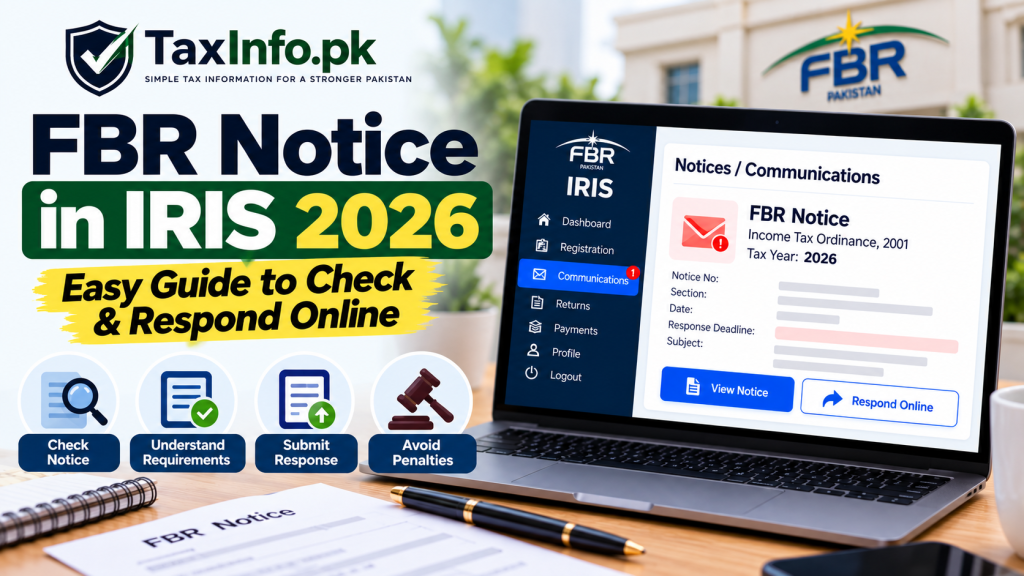
To check an FBR Notice in IRIS, access your taxpayer account through the official FBR IRIS system.
FBR identifies IRIS as its online portal for Income Tax filing and related taxpayer functions.
After logging in, review the relevant inbox, communications, tasks or available notices/assignments associated with your account.
The exact menu names and interface may change as FBR updates IRIS, so do not rely entirely on screenshots from older versions of the portal.
When you find the notice:
- Open the notice.
- Read the complete document.
- Download or save a copy.
- Check the tax year.
- Identify the legal section.
- Note the response date.
- Determine what information or documents are required.
Do not wait until the final day before preparing the response.
Do FBR Notices Also Come by SMS or Email?
FBR has stated that IRIS was upgraded to send SMS and email notifications when a tax officer issues a notice or creates an assignment.
However, an SMS or email should not replace checking the taxpayer’s actual IRIS account.
The official FBR information on IRIS notifications explains that these notifications were introduced to make taxpayers aware of notices and assignments more efficiently.
For practical compliance, regularly checking IRIS is safer than depending entirely on a message reaching your phone or email account.
How to Read an FBR Notice Correctly
Before drafting a response, identify five important things.
1. Tax Year
Confirm which tax year the notice concerns.
Do not accidentally submit records for a different year.
2. Section of Law
Look for the section of the Income Tax Ordinance mentioned in the notice.
The section helps identify the nature of the proceeding and your legal obligations.
3. Information Required
Determine exactly what the officer is asking you to explain or provide.
Separate each question if the notice contains multiple requirements.
4. Supporting Documents
Check whether specific evidence has been requested.
For example, depending on the issue, supporting records could include bank statements, salary certificates, withholding evidence, property documents or business records.
5. Deadline
Note the compliance date shown in the notice.
Treat this as an important deadline rather than an approximate date.
Common Types of FBR Notices
The Income Tax Ordinance contains different powers and proceedings, so there is no universal response that works for every notice.
Some notices commonly relate to information requirements, audit, return filing, Wealth Statements or assessment matters.
The following sections explain several important categories.
Section 176 Notice – Information or Evidence
Section 176 is an important information-gathering provision under the Income Tax Ordinance.
If you receive a notice requiring information or evidence under section 176, read each requirement carefully and provide the information that actually relates to the notice.
Do not ignore it.
FBR’s current Section 182 penalties guidance states that failure to furnish information required, or to comply with another term of a notice served under section 176 or 108, may attract a penalty of:
Rs. 25,000 for the first default, and
Rs. 50,000 for each subsequent default.
This does not mean that receiving the notice itself creates that penalty. The issue is non-compliance with the relevant requirement.
Audit-Related Notices
A taxpayer may also receive communications requiring production of records in connection with audit proceedings.
The documents required will depend on the taxpayer’s circumstances and the scope of the proceeding.
FBR’s current section 182 material provides penalties where a taxpayer, without reasonable cause, fails to produce records or documents under section 177 after notices.
The listed amounts are:
- First notice: Rs. 25,000
- Second notice: Rs. 50,000
- Third notice: Rs. 100,000
Therefore, an audit-related communication should be handled carefully and within the applicable time.
Keep the response factual and provide records relevant to what has actually been requested.
Return and Wealth Statement Issues
Some compliance matters may relate to a missing Income Tax Return or Wealth Statement.
FBR’s section 182 currently prescribes penalties for failure to furnish a return by the due date and separately for failure to furnish a Wealth Statement or Wealth Reconciliation Statement.
For Wealth Statements, the current section 182 page states a penalty of:
0.1% of taxable income per week or Rs. 100,000, whichever is higher
for failure to furnish the required Wealth Statement or Wealth Reconciliation Statement.
The rules for late Income Tax Returns differ and depend on the circumstances.
If your issue involves correcting an already-filed Wealth Statement rather than failing to file one, read our How to Revise Wealth Statement in FBR IRIS guide.
How to Respond to FBR Notice in IRIS
Once you understand the FBR Notice in IRIS, prepare your response systematically.
The exact submission workflow can vary depending on the notice or assignment, but the following approach is useful.
Step 1: Read the Entire Notice
Do not respond after reading only the first paragraph.
Identify every question, requirement and attachment requested by FBR.
Step 2: Collect Supporting Records
Gather documents relevant to the issue.
These may include:
- Bank statements
- Salary certificates
- Tax deduction certificates
- CPRs / tax payment evidence
- Property documents
- Vehicle documents
- Business records
- Invoices
- Receipts
- Agreements
- Loan documents
- Evidence of remittances
- Previously filed returns
- Wealth Statements
Only submit documents relevant to the matter.
Step 3: Reconcile the Information
Compare the notice with the return, Wealth Statement and supporting documents for the relevant tax year.
If FBR refers to a particular amount, identify where that amount appears in your records.
Step 4: Prepare a Point-by-Point Reply
If the notice contains five questions, answering them individually is usually clearer than writing one long general paragraph.
Use headings such as:
Point 1 – Bank Transaction
Your explanation and supporting evidence.
Point 2 – Salary Income
Your explanation and supporting evidence.
Point 3 – Property
Your explanation and supporting evidence.
This makes it easier to demonstrate that each requirement has been addressed.
Step 5: Attach Supporting Documents
Upload clear and readable files.
Avoid uploading blurred photographs or unrelated documents.
Where possible, use meaningful filenames such as:
Bank-Statement-TY2026.pdf
rather than:
IMG00025.pdf
Step 6: Review Before Submission
Before submitting your response, verify:
- Tax year
- Notice reference
- Amounts
- Dates
- Attachments
- Explanations
- Any calculations
Step 7: Submit and Retain Evidence
After submitting the response through IRIS, retain evidence of submission.
Save or download the response and acknowledgement where available.
What Should You Write in an FBR Notice Response?
Your response should normally be:
- Clear
- Factual
- Relevant
- Consistent with your records
- Supported by documents where necessary
Avoid emotional arguments or unnecessarily lengthy explanations.
For example, if FBR asks about a particular bank credit, explain:
- Amount
- Date
- Source
- Nature of transaction
- Tax treatment, where relevant
- Supporting document attached
Do not describe a transaction as a gift, loan, remittance or business receipt merely because that classification produces a better tax result.
The explanation should match what actually happened.
Example of a Simple Response Structure
Suppose the notice asks for an explanation of Rs. 500,000 credited to your bank account.
A structured response could explain that the amount represents a documented transfer from another account belonging to the taxpayer, followed by references to both relevant bank statements.
The key principle is that the explanation should be supported by evidence.
If the Rs. 500,000 was actually salary, business income, a loan or another receipt, describe it according to its true nature.
What Happens After You Submit the Response?
Submitting your reply does not necessarily close the matter immediately.
The tax authority may:
- Review your explanation
- Examine documents
- Accept the response
- Request additional information
- Continue the relevant proceeding
- Issue another communication or order where legally applicable
Continue checking your IRIS account after submission.
Do not assume that no SMS or email means the proceeding has ended.
Can an FBR Notice Lead to a Penalty?
Potentially, yes—but an important distinction is necessary.
Receiving an FBR Notice in IRIS does not itself mean that a penalty has already been imposed.
Section 182 of the Income Tax Ordinance sets out penalties for specified defaults.
FBR’s current official section 182 guidance also states that penalties under the section are not payable unless an order in writing is passed by the Commissioner, Commissioner (Appeals) or Appellate Tribunal after providing the person concerned an opportunity of being heard.
There is also a provision concerning a taxpayer who admits a default and voluntarily pays the penalty due.
Therefore, distinguish between:
Notice → proceeding/compliance requirement
and
Penalty order → legal consequence after the applicable process
Do not treat the two as identical.
Important Penalties Under Section 182
The following examples illustrate why timely compliance matters.
Failure to Furnish a Wealth Statement
Current FBR guidance lists:
0.1% of taxable income per week or Rs. 100,000, whichever is higher.
Failure to Notify Material Registration Changes
Section 182 currently lists a penalty of:
Rs. 5,000
for failure to notify changes of a material nature in registration particulars.
If your registration information has changed, see our How to Update FBR IRIS Profile guide.
Failure to Produce Records During Audit
Without reasonable cause, failure to produce records under section 177 may attract:
- Rs. 25,000 on first notice
- Rs. 50,000 on second notice
- Rs. 100,000 on third notice
Failure to Provide Information Under Section 176
The current section 182 guidance lists:
- Rs. 25,000 for first default
- Rs. 50,000 for each subsequent default
These are statutory penalty provisions. The actual application depends on the relevant facts and legal proceedings.
What If You Miss the Response Deadline?
Do not simply ignore the notice because the compliance date has passed.
Log in to IRIS and check the current status of the proceeding.
Depending on the circumstances, you may need to respond immediately, explain the delay, comply with an available assignment, or address any subsequent communication or order.
The appropriate action depends on:
- Type of notice
- Section involved
- Whether the proceeding is still open
- Whether another order has been issued
- Reason for delay
- Documents available
If the matter involves a significant tax demand, audit, assessment proceeding or expired legal deadline, consider obtaining professional tax advice promptly.
What If the Notice Is Wrong?
If you believe an FBR Notice in IRIS is based on incorrect information, do not ignore it.
Respond with a clear explanation and supporting evidence.
For example, if a transaction attributed to you is incorrect, identify the disputed amount and explain why the information does not apply, supported by relevant records.
A factual, documented response is generally more useful than simply stating:
“This notice is incorrect.”
Explain why it is incorrect.
Never Submit False or Misleading Information
This point is particularly important.
Section 182 contains penalties relating to false or misleading statements or information furnished to an Income Tax Authority.
FBR’s current section 182 material states that false or misleading statements or documents can attract a penalty of Rs. 25,000 or 100% of the tax shortfall, whichever is higher, subject to the statutory provisions and qualifications.
Therefore:
- Do not fabricate documents.
- Do not invent loans.
- Do not create artificial gifts.
- Do not alter bank statements.
- Do not hide material information required by the notice.
- Do not submit an explanation you know to be false.
If there is a genuine mistake in an earlier return or statement, determine the correct legal method for addressing that mistake.
Common Mistakes When Responding to an FBR Notice
1. Ignoring the Notice
Ignoring a notice can allow the proceeding to continue without your explanation and may expose you to consequences under the applicable provisions.
2. Replying Without Reading the Section
Different notices have different legal purposes.
3. Missing the Deadline
Record the compliance date immediately.
4. Giving a Generic Response
Address every material question raised in the notice.
5. Uploading Unrelated Documents
More documents do not necessarily mean a stronger response.
Submit relevant evidence.
6. Providing Unsupported Explanations
If you describe a large receipt as a loan, gift or transfer, supporting evidence may be important.
7. Forgetting to Save Submission Evidence
Keep copies of the notice, response and attachments.
8. Relying Only on SMS or Email
Regularly check IRIS directly.
Practical Checklist Before Submitting Your Response
Before responding to an FBR Notice in IRIS, confirm:
- Correct taxpayer account
- Correct tax year
- Notice reference checked
- Relevant section identified
- Deadline noted
- Every question answered
- Amounts verified
- Supporting documents attached
- Files readable
- Explanation consistent with records
- No false or unsupported statement included
- Final response reviewed
- Submission evidence retained
Taking a few extra minutes to review the response can prevent avoidable mistakes.
Frequently Asked Questions
What is an FBR Notice in IRIS?
It is an official electronic communication issued through FBR’s IRIS system relating to a taxpayer’s compliance, information, return, audit, assessment or another matter under the applicable tax law.
Does receiving an FBR notice mean I have been fined?
No. Receipt of a notice does not automatically mean a penalty has already been imposed. The nature and consequences depend on the relevant proceeding. Section 182 also contains procedural requirements for imposition of penalties.
How do I check an FBR Notice in IRIS?
Log in to your official IRIS account and review notices, communications, assignments or related items associated with your taxpayer account. Open the full document and check its section, tax year and response deadline.
Can I respond to an FBR notice online?
Many IRIS proceedings allow electronic compliance or response through the relevant notice/assignment workflow. Follow the options available against the particular notice and retain evidence after submission.
What documents should I attach?
Attach documents relevant to the questions raised. These may include bank statements, salary certificates, CPRs, property records, business documents, invoices or other supporting evidence depending on the notice.
What happens if I ignore a section 176 notice?
FBR’s current section 182 guidance provides penalties for failure to furnish information required or comply with another term of a notice under section 176 or 108: Rs. 25,000 for the first default and Rs. 50,000 for each subsequent default, subject to the applicable legal process.
Should I respond if I believe the notice is incorrect?
Yes. Explain the issue and provide supporting evidence rather than simply ignoring the notice.
Should I hire a tax consultant for every FBR notice?
Not necessarily. The complexity depends on the notice. However, professional assistance may be appropriate where the matter involves substantial amounts, audit, assessment proceedings, complicated unexplained transactions, expired deadlines or significant potential tax exposure.
Final Thoughts
An FBR Notice in IRIS should be taken seriously, but receiving one does not automatically mean that you have committed an offence or that a penalty has already been imposed.
Start by reading the complete notice, identifying the legal section and tax year, noting the deadline, and understanding exactly what FBR requires.
Then prepare a factual, point-by-point response supported by appropriate documents and submit it through the relevant IRIS workflow.
Most importantly, do not ignore an FBR Notice in IRIS, do not submit unsupported explanations, and keep evidence of everything you file.
Taxpayers who understand their filing obligations can also read Who Is Required to File Income Tax Return in Pakistan? for a broader understanding of Income Tax Return requirements.
Disclaimer
The information in this article is provided for general educational and informational purposes only and does not constitute legal, tax or professional advice. FBR procedures, penalties, forms, deadlines and the IRIS interface may change, and the correct response to a notice depends on its specific legal section and the taxpayer’s individual circumstances. Always read the actual notice, verify current requirements from the Federal Board of Revenue (FBR), and seek qualified professional advice where necessary.