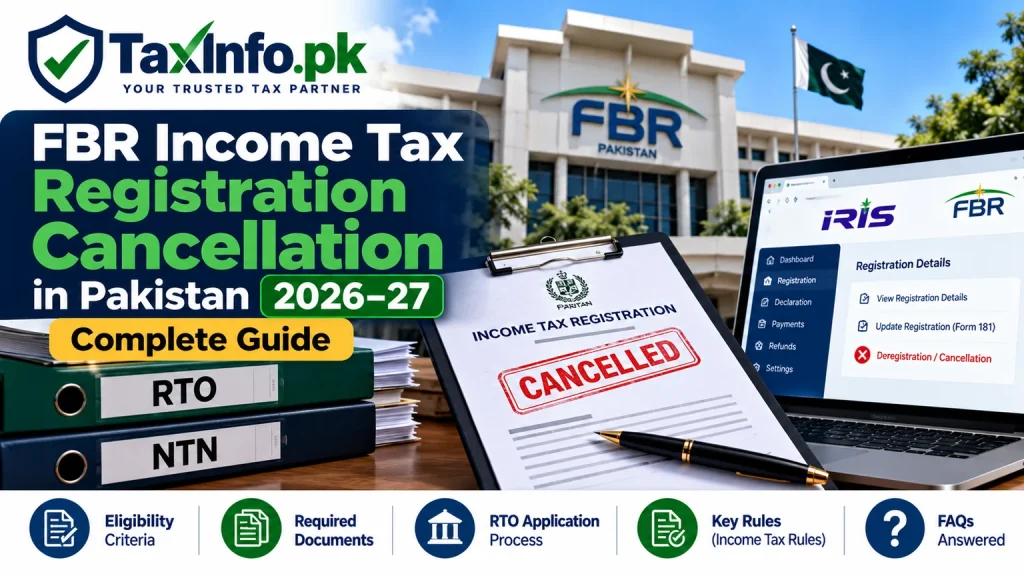
FBR Income Tax Registration Cancellation is the formal process through which the Federal Board of Revenue (FBR) may cancel a taxpayer’s income tax registration after reviewing the relevant records and outstanding liabilities. Cancellation requires a written order from the Commissioner Inland Revenue.
Taxpayers seeking cancellation generally need to contact their relevant Regional Tax Office (RTO). Simply closing a business, stopping income tax return filing, or becoming inactive on the Active Taxpayer List (ATL) does not automatically cancel income tax registration.
Table of Contents
What Is FBR Income Tax Registration Cancellation?
FBR Income Tax Registration Cancellation means formally ending a taxpayer’s income tax registration through the procedure prescribed under Pakistan’s income tax framework.
Under Rule 82 of the Income Tax Rules, 2002, the Commissioner may cancel a taxpayer’s registration after examining the available information, conducting any necessary inquiry, addressing outstanding liabilities, and providing a reasonable opportunity of being heard.
The cancellation is made through a written order.
Key points:
- Cancellation is not automatic.
- The Commissioner Inland Revenue has the relevant authority.
- Outstanding tax liabilities must be addressed.
- Supporting registration records may be examined.
- A written cancellation order is required.
Taxpayers should consult the official FBR Income Tax Registration guidance before applying.
Who Can Apply for Income Tax Registration Cancellation in Pakistan?
A taxpayer may seek cancellation when their circumstances justify ending an existing income tax registration.
For example, a business owner who has permanently discontinued business operations may need to approach the relevant RTO to determine whether cancellation is appropriate.
However, business closure does not automatically establish eligibility. The Commissioner must examine the taxpayer’s circumstances and registration records.
| Situation | Possible action |
|---|---|
| Business permanently discontinued | Contact RTO regarding discontinuance and possible cancellation |
| Business address changed | Modify registration details |
| Business ownership or structure changed | Seek appropriate registration modification or professional advice |
| Taxpayer temporarily has no income | Check continuing filing obligations; cancellation is not automatic |
| Taxpayer has outstanding tax liabilities | Resolve liabilities before cancellation can be considered |
| Taxpayer is no longer on ATL | Review filing and ATL status; this is not registration cancellation |
Important: A taxpayer should not assume that having no business income, closing a shop, or becoming a non-filer automatically removes their NTN or income tax obligations.
What Is the Difference Between NTN Cancellation, Registration Modification and Sales Tax Deregistration?
These procedures have different purposes and should not be confused.
| Procedure | Purpose | Main distinction |
|---|---|---|
| Income tax registration cancellation | Formally cancel an income tax registration | Requires examination and a written order |
| Registration modification | Update taxpayer information | Registration generally continues |
| Business discontinuance | Record that business activity has stopped | Does not itself guarantee cancellation |
| Sales tax deregistration | End sales tax registration where legally permitted | Governed by a separate sales tax framework |
| ATL status change | Reflect taxpayer’s Active Taxpayer List position | Does not cancel registration |
If you only need to change your address, business details or other registered particulars, read our How to Update FBR Registration Details in IRIS guide.
For sales tax registration matters, see Sales Tax Deregistration in Pakistan.
What Is the Legal Basis for FBR Income Tax Registration Cancellation?
Rule 82 of the Income Tax Rules, 2002 provides the regulatory framework for modification or cancellation of income tax registration.
Under the rule, the Commissioner may examine registration information, make necessary inquiries, provide an opportunity of being heard and issue a written cancellation order after outstanding liabilities have been discharged.
The rule also makes clear that cancellation is without prejudice to other liabilities a person may incur under the Income Tax Ordinance, 2001.
What Does This Mean for Taxpayers?
It means that a taxpayer cannot simply request cancellation and assume all previous tax responsibilities have ended.
FBR may review the taxpayer’s registration information, tax liabilities and other relevant circumstances before making a decision.
The official legal reference is available in the Income Tax Rules, 2002 — Rule 82.
How to Apply for FBR Income Tax Registration Cancellation Through an RTO?
To request income tax registration cancellation, contact your relevant Regional Tax Office, explain the reason for cancellation, provide the required supporting records and follow the Commissioner’s review process.
FBR’s published guidance identifies deregistration and discontinuance of business as matters requiring a visit to the relevant RTO.
Step 1: Identify Your Relevant Regional Tax Office
Find the RTO responsible for your income tax registration.
You can use the official FBR website to access taxpayer assistance and office information.
Step 2: Review Your Income Tax Record
Before approaching the RTO, review your registration particulars and any outstanding income tax matters.
Check whether you have:
- Unpaid tax demands or other outstanding liabilities.
- Unfiled returns for periods in which filing was required.
- Pending notices, assessments or related proceedings.
- Incorrect or outdated registration information.
- Unresolved matters connected with your discontinued business.
The exact position depends on your tax history and applicable legal obligations.
Step 3: Prepare Your Cancellation Request
Prepare a written explanation of why you are requesting cancellation.
Where applicable, explain when the business stopped operating and whether any related income tax matters remain outstanding.
Your application should clearly identify the taxpayer and the registration concerned.
Step 4: Collect Supporting Documents
Gather the records relevant to your circumstances.
The RTO may request identification, registration information, business closure evidence, tax records or other supporting material.
There is no single document checklist in the general FBR guidance that can be assumed to apply identically to every taxpayer.
Step 5: Submit the Request to the Relevant RTO
Visit the relevant RTO and follow its instructions for submitting the cancellation request and supporting documents.
Request an acknowledgment or other available record of submission.
Step 6: Respond to Any FBR Inquiry
The Commissioner may examine the information supplied and make further inquiries.
If additional records or explanations are requested, respond through the appropriate official channel.
Step 7: Obtain the Written Decision
Cancellation is not complete merely because an application has been submitted.
Where cancellation is approved, obtain the Commissioner’s written order and retain it with your tax records.
Official guidance: FBR — Change Your Personal Details.
Which Documents May Be Required for Income Tax Registration Cancellation?
The documents needed depend on the taxpayer’s legal status, reason for cancellation and the information requested by the RTO.
The following table is a practical preparation guide, not a universal mandatory document list.
| Document or record | Why it may be useful |
|---|---|
| CNIC or other relevant identification | To identify the taxpayer |
| NTN or registration details | To identify the registration |
| Written cancellation request | To explain the reason for cancellation |
| Business closure evidence, where applicable | To support a discontinuance claim |
| Relevant income tax returns | To review previous compliance |
| Tax payment records or CPRs | To support payment and liability checks |
| FBR notices or correspondence | To identify unresolved matters |
| Authorization documents, where applicable | For an authorized representative |
Before visiting, confirm the specific requirements with your relevant RTO.
Can You Cancel Your NTN Online Through FBR IRIS?
FBR’s published guidance directs taxpayers to the relevant RTO for income tax deregistration and business discontinuance. It does not establish a universal self-service IRIS button that automatically cancels an income tax registration.
The IRIS portal supports various registration and filing functions, including changes to specified registration details through Form 181.
However, registration modification should not be confused with cancellation.
For example:
- Changing a business address is a registration modification.
- Adding or updating certain business details may be handled through Form 181.
- Requesting deregistration requires following the applicable RTO and Commissioner process.
For guidance on online changes, read Update FBR Registration Details in IRIS.
What Happens If You Have Outstanding Tax Liabilities?
Outstanding liabilities are a major consideration in the cancellation process.
FBR’s registration guidance states that the Commissioner may cancel registration after ascertaining that no outstanding liability remains against the taxpayer and that the relevant records justify cancellation.
What Should You Check Before Applying?
- Review unpaid tax demands.
- Check outstanding notices and proceedings.
- Confirm relevant return-filing obligations.
- Reconcile payments with FBR records.
- Address any unresolved liability through the appropriate process.
For assistance with tax payments and records, see How to Pay FBR Tax Online Using PSID and CPR.
A pending or disputed tax matter should be evaluated according to its legal status rather than assumed to disappear upon cancellation.
Does Closing a Business Automatically Cancel Income Tax Registration?
No. Closing a business and cancelling its income tax registration are separate matters.
A business may cease operating while its registration information, previous filing requirements and tax liabilities remain relevant.
For example, consider a sole proprietor who closes a retail shop during 2026.
The shop may no longer generate business income, but the taxpayer should still determine:
- Whether the closure must be reported to FBR.
- Whether income tax returns remain due for relevant periods.
- Whether any tax demands or notices remain outstanding.
- Whether registration modification or cancellation is appropriate.
The taxpayer should contact the relevant RTO rather than assume the NTN has been cancelled.
Does NTN Cancellation Remove Previous Tax Returns, Penalties or Notices?
No. Income tax registration cancellation should not be treated as a waiver of previous tax liabilities or compliance obligations.
Rule 82 recognizes that cancellation does not eliminate other liabilities arising under the Income Tax Ordinance.
For this reason, taxpayers should review their outstanding matters before and after the cancellation process.
| Matter | Does cancellation automatically remove it? |
|---|---|
| Previous tax liability | No |
| Previously required income tax return | No |
| Outstanding FBR notice | No |
| Existing penalty or demand | No |
| Need to preserve relevant records | No |
For a better understanding of filing requirements, see FBR Section 114 — Income Tax Return Filing.
How Long Does FBR Income Tax Registration Cancellation Take?
There is no universal processing time that should be promised for every income tax registration cancellation request.
The time required may depend on:
- Completeness of the application.
- Accuracy of registration records.
- Outstanding liabilities.
- Further inquiries by FBR.
- The circumstances of the taxpayer’s case.
Do not confuse income tax registration cancellation with sales tax deregistration, which has its own rules and procedures.
Applicants should follow up with their relevant RTO using the acknowledgment or reference provided.
Can an Individual Cancel Their Income Tax Registration?
An individual may seek guidance from FBR about cancellation where the circumstances justify a request.
However, simply having no taxable income for a particular year does not automatically qualify a person for cancellation.
For individuals, particularly those registered using their CNIC, it is important to distinguish between the taxpayer’s identification, their business activity and their obligations under income tax law.
If an individual has stopped operating a business but continues to receive salary, rental income or other income, the applicable filing obligations may still need to be considered.
The correct treatment depends on the taxpayer’s full circumstances.
What Should You Do After Income Tax Registration Is Cancelled?
After receiving an official written cancellation order, maintain a complete record of the decision and related correspondence.
Post-Cancellation Checklist
- Keep a copy of the Commissioner’s written order.
- Preserve your cancellation application and acknowledgment.
- Retain relevant tax payment records.
- Keep previously filed returns and supporting documents.
- Review any remaining notices or correspondence.
- Confirm that the registration status reflects the official decision.
- Seek guidance if your circumstances later change.
Cancellation should not be treated as permission to disregard previous tax records or lawful requests from FBR.
What Are the Most Common Mistakes When Applying for NTN Cancellation?
Avoid these common mistakes:
- Assuming a closed business means automatic NTN cancellation.
- Confusing Form 181 modification with cancellation.
- Treating removal from ATL as registration cancellation.
- Ignoring outstanding tax demands or notices.
- Submitting an incomplete explanation of business discontinuance.
- Assuming cancellation is effective immediately upon application.
- Relying on unofficial claims of guaranteed online cancellation.
- Failing to retain the Commissioner’s written decision.
For broader guidance on taxpayer compliance, visit the TaxInfo.pk Tax Guides section.
Frequently Asked Questions About FBR Income Tax Registration Cancellation
1. How can I cancel my FBR income tax registration in Pakistan?
Contact your relevant RTO, explain the grounds for cancellation, provide supporting records and follow the Commissioner’s review process. A written order is required for cancellation.
2. Can I cancel my NTN online through IRIS?
FBR’s published guidance directs taxpayers to the relevant RTO for deregistration. Form 181 modifications through IRIS should not be mistaken for an automatic online registration cancellation facility.
3. Is income tax registration cancellation the same as sales tax deregistration?
No. Income tax registration cancellation and sales tax deregistration are governed by different procedures. A taxpayer registered under both regimes may need to address each registration separately.
4. Can I cancel my NTN if I have unpaid income tax?
Outstanding liabilities must be addressed as part of the cancellation review. FBR states that the Commissioner may cancel registration after confirming that no outstanding liability remains and the relevant records justify cancellation.
5. Does closing my business mean I no longer need to file income tax returns?
Not necessarily. Return-filing obligations depend on the applicable law and the taxpayer’s circumstances. Business closure does not automatically remove previously applicable filing requirements.
Final Thoughts
FBR Income Tax Registration Cancellation in Pakistan is a formal legal process, not simply an option to delete an NTN from IRIS.
The Commissioner Inland Revenue may cancel registration through a written order after reviewing the relevant information and outstanding liabilities. Taxpayers seeking cancellation should approach their relevant RTO, provide accurate supporting records and retain the official decision.
Before applying, determine whether your situation requires registration cancellation, registration modification or merely reporting the discontinuance of business.