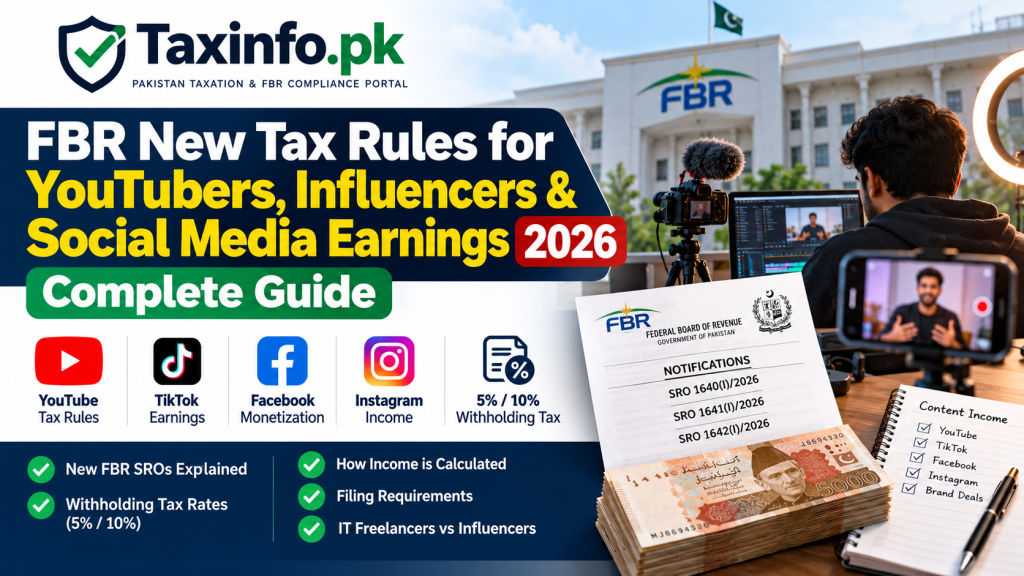
FBR Social Media Tax Rules 2026 have introduced a dedicated framework for taxing income earned through monetized content on YouTube, Facebook, TikTok, Instagram and other social media platforms in Pakistan.
The Federal Board of Revenue issued three important notifications on 22 September 2026: SRO 1640(I)/2026, SRO 1641(I)/2026 and SRO 1642(I)/2026.
These notifications establish special procedures for income generated through remunerative social media content.
The development is particularly important for Pakistani YouTubers, digital creators, influencers and individuals receiving payments through social media monetization.
Table of Contents
What Are the New FBR Social Media Tax Rules 2026?
The FBR framework deals with income earned from content that generates remuneration.
This can include income from:
- YouTube video monetization.
- Facebook content monetization.
- TikTok monetization.
- Instagram content and sponsored promotions.
- Brand sponsorships and advertising collaborations.
- Other monetized social media activities.
The applicable treatment depends on the nature of the payment, the taxpayer’s circumstances and the relevant legal provisions.
Importantly, these rules do not mean that every social media user must pay tax simply for having an account or uploading content.
FBR Issues Three Important SROs
The notifications issued on 22 September 2026 include:
| Notification | Subject |
|---|---|
| SRO 1640(I)/2026 | Specification of sector under Section 99C |
| SRO 1641(I)/2026 | Special procedure under Chapter IIA |
| SRO 1642(I)/2026 | Special procedure under Chapter VA |
These notifications are available through the official FBR SRO directory.
Withholding Tax on Social Media Earnings Under Section 154B
Section 154B of the Income Tax Ordinance, 2001 deals with withholding tax on revenues received from social media platforms.
Under the applicable withholding tax framework, banks and relevant financial institutions deduct tax on qualifying receipts.
The reported rates are:
| Taxpayer Status | Withholding Tax |
|---|---|
| Active Taxpayer (ATL) | 5% |
| Non-ATL Taxpayer | 10% |
These are withholding tax rates, not necessarily the taxpayer’s complete final annual income tax liability.
Example: YouTube Earnings of Rs. 200,000
Suppose a Pakistani content creator receives Rs. 200,000 in qualifying social media earnings.
Active Taxpayer:
- Gross earnings: Rs. 200,000
- Withholding tax at 5%: Rs. 10,000
- Amount after withholding: Rs. 190,000
Non-ATL Taxpayer:
- Gross earnings: Rs. 200,000
- Withholding tax at 10%: Rs. 20,000
- Amount after withholding: Rs. 180,000
This example assumes the entire payment falls within Section 154B and no other deductions apply.
How Will FBR Calculate YouTube and Social Media Income?
The special procedure includes a mechanism for determining remuneration from monetized social media content.
The framework considers actual remuneration and prescribed calculation methods involving content engagement and other relevant factors.
It also addresses allowable expenses, advance tax and declaration of income.
Content creators should maintain proper records of platform earnings, payments received, sponsorship agreements and related business expenses.
The exact application of any view-based benchmark must be checked against the applicable notified rules rather than relying solely on social media reports.
Are Freelancers and IT Exporters Covered by These Rules?
This is an important distinction.
A Pakistani freelancer providing software development, graphic design, programming or other services to foreign clients is not automatically treated as a social media influencer.
Income earned from exporting eligible IT or IT-enabled services may be governed by different provisions, including Section 154A where applicable.
For a detailed explanation, read our Income Tax for Freelancers in Pakistan guide.
However, if the same freelancer also earns money through YouTube monetization or social media sponsorships, those receipts may require separate consideration.
How Should Content Creators Declare Their Earnings?
Content creators should follow these basic compliance steps:
- Maintain records of YouTube, Facebook, TikTok and other platform earnings.
- Keep bank statements and payment receipts.
- Identify any tax deducted by banks or payment intermediaries.
- Separate social media monetization from other freelance or business income.
- Declare relevant income under the applicable return categories.
- Report bank balances and other personal assets accurately in the Wealth Statement.
- Reconcile income, expenses, assets and liabilities before submission.
The exact IRIS return fields may differ according to the tax year and applicable return form.
Why Accurate Wealth Statements Matter
Social media earnings may also affect a taxpayer’s personal wealth.
For example, if a YouTuber earns Rs. 1,500,000 during the year and retains part of that income in a bank account, the year-end bank balance should be reflected accurately in the Wealth Statement.
Read our related guide on Cash in Hand and Bank Balance in FBR Wealth Statement to understand the reporting process.
Frequently Asked Questions
Is YouTube income taxable in Pakistan in 2026?
Yes. Income earned through YouTube monetization can be taxable under Pakistani income tax law, subject to the applicable rules and taxpayer circumstances.
What is Section 154B?
Section 154B deals with withholding tax on qualifying revenues received from social media platforms through financial institutions.
Is the withholding tax rate 5% or 10%?
The applicable rate is generally 5% for taxpayers on the Active Taxpayers List and 10% for non-ATL persons under the relevant rate framework.
Do these rules apply to every freelancer?
No. Ordinary freelance service income and social media monetization income are not automatically subject to identical tax treatment.
Do influencers need to file income tax returns?
Filing obligations depend on the applicable statutory requirements and the taxpayer’s circumstances. Content creators should review their filing obligations even where withholding tax has already been deducted.
Are sponsorship payments also taxable?
Sponsorship and promotional earnings may constitute taxable income. Their precise tax treatment depends on the payment arrangement and relevant provisions.
Final Words
The FBR Social Media Tax Rules 2026 represent an important development for Pakistan’s digital content economy.
YouTubers, influencers and other monetized content creators should understand the new special procedures, maintain reliable earning records and distinguish social media income from other types of freelance or IT export receipts.
For official notifications and applicable withholding tax rates, consult the Federal Board of Revenue and its published SROs and withholding tax rate cards.