
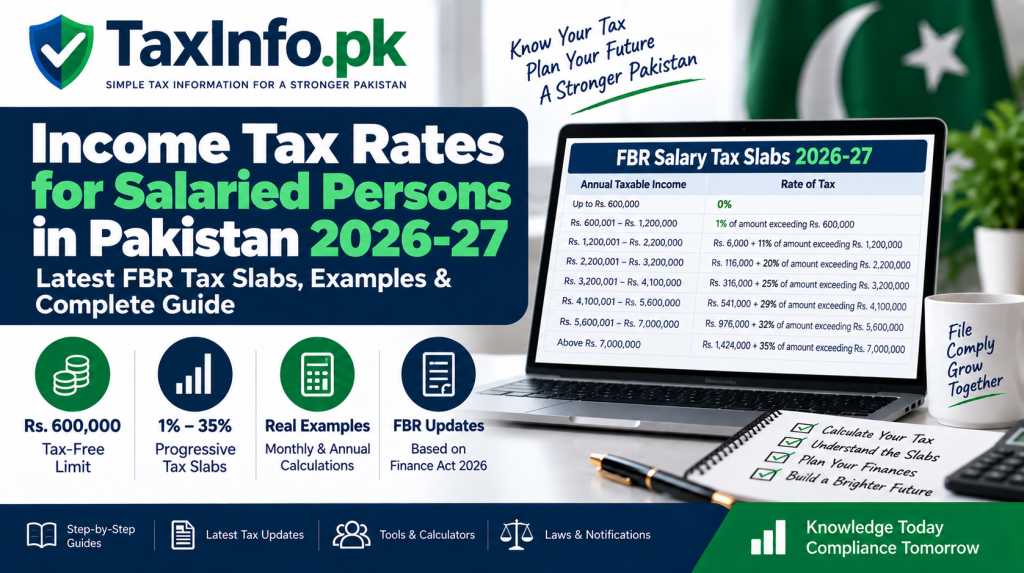
The income tax rates for salaried individuals in Pakistan have changed for 2026-27 following the Finance Act 2026.
The Federal Board of Revenue’s official Budget 2026-27 material states that tax rates for salaried taxpayers were reduced through a restructuring of the slabs. Additional intermediate slabs were introduced, while the threshold at which the maximum 35% rate applies was increased to Rs. 7 million.
If you earn a salary in Pakistan, understanding these slabs can help you estimate how much income tax may be deducted from your salary during the year.
This guide explains the 2026-27 salaried tax slabs, how progressive taxation works, and how to calculate tax through practical examples.
Salaried Income Tax Rates 2026-27 in Pakistan
The following slab structure applies to taxable salary income under the 2026-27 framework:
| Annual Taxable Income | Rate of Tax |
|---|---|
| Up to Rs. 600,000 | 0% |
| Rs. 600,001 – Rs. 1,200,000 | 1% of amount exceeding Rs. 600,000 |
| Rs. 1,200,001 – Rs. 2,200,000 | Rs. 6,000 + 11% of amount exceeding Rs. 1,200,000 |
| Rs. 2,200,001 – Rs. 3,200,000 | Rs. 116,000 + 20% of amount exceeding Rs. 2,200,000 |
| Rs. 3,200,001 – Rs. 4,100,000 | Rs. 316,000 + 25% of amount exceeding Rs. 3,200,000 |
| Rs. 4,100,001 – Rs. 5,600,000 | Rs. 541,000 + 29% of amount exceeding Rs. 4,100,000 |
| Rs. 5,600,001 – Rs. 7,000,000 | Rs. 976,000 + 32% of amount exceeding Rs. 5,600,000 |
| Above Rs. 7,000,000 | Rs. 1,424,000 + 35% of amount exceeding Rs. 7,000,000 |
These are progressive tax slabs. The higher percentage does not apply to your entire income simply because you enter a higher slab. FBR’s Budget 2026-27 material confirms the restructuring and the Rs. 7 million threshold for the maximum 35% rate.
What Is the Tax-Free Salary Limit for 2026-27?
Under the applicable slab structure:
Annual taxable income up to Rs. 600,000 → 0% income tax
That corresponds to approximately:
Rs. 50,000 per month
if annual taxable salary is simply divided into 12 equal months.
However, monthly gross salary and annual taxable income are not necessarily identical concepts in every case.
Allowances, exemptions, deductions, tax credits and other income can affect the final tax calculation depending on the taxpayer’s circumstances.
How Do Progressive Tax Slabs Work?
A common misunderstanding is that once your income reaches a particular slab, the stated percentage applies to your entire income.
That is not how these slabs work.
Suppose your taxable income is:
Rs. 1,500,000 per year
This falls within the Rs. 1.2 million to Rs. 2.2 million slab.
The applicable formula is:
Rs. 6,000 + 11% of the amount exceeding Rs. 1,200,000
Your excess income is:
Rs. 1,500,000 − Rs. 1,200,000 = Rs. 300,000
11% of Rs. 300,000:
Rs. 33,000
Add the fixed amount:
Rs. 6,000 + Rs. 33,000 = Rs. 39,000
So the estimated annual tax is:
Rs. 39,000
Not 11% of the entire Rs. 1.5 million.
Example 1: Salary of Rs. 100,000 Per Month
Suppose taxable salary is:
Monthly: Rs. 100,000
Annual taxable salary:
Rs. 100,000 × 12 = Rs. 1,200,000
The applicable rate is:
1% of amount exceeding Rs. 600,000
Taxable excess:
Rs. 1,200,000 − Rs. 600,000 = Rs. 600,000
Annual tax:
Rs. 600,000 × 1% = Rs. 6,000
Approximate monthly tax:
Rs. 500
This is a simplified illustration assuming the stated annual amount is the relevant taxable salary.
Example 2: Salary of Rs. 150,000 Per Month
Annual taxable salary:
Rs. 150,000 × 12 = Rs. 1,800,000
Applicable formula:
Rs. 6,000 + 11% of amount exceeding Rs. 1,200,000
Excess:
Rs. 600,000
Tax:
Rs. 6,000 + Rs. 66,000
Annual Tax = Rs. 72,000
Approximate monthly tax:
Rs. 6,000
Example 3: Salary of Rs. 200,000 Per Month
Annual taxable salary:
Rs. 2,400,000
Applicable formula:
Rs. 116,000 + 20% of amount exceeding Rs. 2,200,000
Excess:
Rs. 200,000
Tax on excess:
Rs. 40,000
Total estimated annual tax:
Rs. 156,000
Approximate monthly equivalent:
Rs. 13,000
Example 4: Salary of Rs. 300,000 Per Month
Annual taxable salary:
Rs. 3,600,000
Applicable formula:
Rs. 316,000 + 25% of amount exceeding Rs. 3,200,000
Excess:
Rs. 400,000
Tax on excess:
Rs. 100,000
Estimated annual tax:
Rs. 416,000
Approximate monthly equivalent:
Rs. 34,667
Example 5: Salary of Rs. 500,000 Per Month
Annual taxable salary:
Rs. 6,000,000
Applicable formula:
Rs. 976,000 + 32% of amount exceeding Rs. 5,600,000
Excess:
Rs. 400,000
Tax on excess:
Rs. 128,000
Estimated annual tax:
Rs. 1,104,000
Approximate monthly equivalent:
Rs. 92,000
Quick Salary Tax Examples 2026-27
Here is a simplified comparison:
| Monthly Taxable Salary | Annual Taxable Salary | Approx. Annual Tax | Approx. Monthly Tax |
|---|---|---|---|
| Rs. 50,000 | Rs. 600,000 | Rs. 0 | Rs. 0 |
| Rs. 100,000 | Rs. 1,200,000 | Rs. 6,000 | Rs. 500 |
| Rs. 150,000 | Rs. 1,800,000 | Rs. 72,000 | Rs. 6,000 |
| Rs. 200,000 | Rs. 2,400,000 | Rs. 156,000 | Rs. 13,000 |
| Rs. 300,000 | Rs. 3,600,000 | Rs. 416,000 | Rs. 34,667 |
| Rs. 500,000 | Rs. 6,000,000 | Rs. 1,104,000 | Rs. 92,000 |
These examples are simplified estimates based directly on the slab formulas and do not account for taxpayer-specific adjustments, exemptions, credits or other income.
What Does “Taxable Salary” Mean?
Your gross salary and taxable salary may not always be exactly the same.
The Income Tax Ordinance governs what amounts are included under salary and how particular benefits, allowances or exemptions are treated.
Therefore, simply multiplying the amount deposited into your bank account by 12 may not always produce the correct taxable salary.
The final calculation should be based on the applicable provisions of the Income Tax Ordinance and the taxpayer’s actual salary structure.
FBR currently provides the Income Tax Ordinance, 2001 amended up to 30 June 2026 through its official legal resources.
What Period Do the 2026-27 Rates Cover?
Pakistan’s normal tax year is a twelve-month period ending on 30 June.
FBR explains that a tax year is identified by the calendar year in which that period ends.
Therefore, the rates introduced through the Finance Act 2026 generally relate to income earned during the financial period beginning:
1 July 2026
and ending:
30 June 2027
This corresponds to:
Tax Year 2027
This distinction is important.
“Tax rates 2026-27” and “Tax Year 2027” generally refer to the same normal financial-year income period in this context.
Did Salary Tax Rates Change in Budget 2026-27?
Yes.
FBR’s official Budget 2026-27 salient features specifically describe a reduction in tax rates for salaried individuals through restructuring of the tax slabs.
FBR also states that additional intermediate slabs were introduced and the threshold for the maximum 35% tax rate was increased from Rs. 4.1 million to Rs. 7 million.
This means taxpayers should not use an old 2025-26 salary tax table when calculating tax for the 2026-27 period.
Salary Tax vs Tax Deducted by Employer
For salaried employees, tax is commonly deducted by the employer during the year under the applicable withholding provisions.
However, tax deducted from salary and the final income tax return are connected but not always identical calculations.
A taxpayer may also have:
- Other sources of income
- Tax already deducted elsewhere
- Applicable tax credits
- Exempt income
- Other adjustments
These can affect the final position reported in the income tax return.
FBR publishes current withholding tax information and has a dedicated Tax Year 2027 withholding tax rate card, updated to reflect Finance Act 2026.
Do Salaried Employees Still Need to File an Income Tax Return?
Being an employee and having tax deducted by an employer does not by itself answer whether a person has a return-filing obligation.
Return filing requirements depend on the applicable provisions of the Income Tax Ordinance and the taxpayer’s circumstances.
Where a person is required to file, tax already deducted from salary is generally relevant when completing the return.
Our step-by-step guide explains how to file an income tax return online in Pakistan.
Salary Tax and Wealth Statement
For individuals filing an income tax return, the filing process can also involve the Wealth Statement.
Your salary, expenses, assets, liabilities and other relevant financial information should make sense together.
If your Wealth Statement does not reconcile, simply changing salary figures to make the reconciliation zero is not the correct solution.
See our complete Wealth Statement in Pakistan guide for the reconciliation process.
Salary Tax and ATL Status
Paying or having tax deducted from your salary does not mean you should assume your ATL status without checking it.
FBR provides separate Active Taxpayer List verification facilities.
You can use our FBR ATL Status Check guide to verify your current status.
How to Calculate Your Salary Tax
For a basic estimate, the process is:
- Determine your annual taxable salary.
- Identify the correct 2026-27 slab.
- Take the fixed tax amount for that slab, if any.
- Calculate the percentage on income exceeding the slab’s specified threshold.
- Add the two amounts.
- Divide the annual figure by 12 if you only want an approximate monthly equivalent.
Your employer’s actual monthly withholding can differ because payroll calculations may account for tax already deducted and expected income over the remainder of the tax year.
Frequently Asked Questions
What is the income tax-free limit for salaried persons in Pakistan in 2026-27?
Under the applicable salaried slab structure, taxable income up to Rs. 600,000 per year falls in the 0% slab.
What is the maximum income tax rate for salaried persons in 2026-27?
The highest slab rate is 35%, applicable under the slab formula once taxable income exceeds Rs. 7 million. FBR specifically identifies Rs. 7 million as the new threshold for the maximum rate.
Is 35% charged on the entire salary above Rs. 7 million?
No. The slab formula consists of a fixed amount plus 35% of the amount exceeding Rs. 7 million. It is a progressive calculation.
What is the tax on Rs. 100,000 monthly taxable salary?
If annual taxable salary is exactly Rs. 1.2 million and no other adjustments apply, the simplified slab calculation gives approximately Rs. 6,000 annually, or Rs. 500 per month on an annual-tax-divided-by-12 basis.
What is the tax on Rs. 200,000 monthly taxable salary?
Using Rs. 2.4 million as annual taxable salary, the simplified calculation gives approximately Rs. 156,000 annual tax, equivalent to about Rs. 13,000 per month when divided evenly across 12 months.
Are 2026-27 rates the same as Tax Year 2027?
For Pakistan’s normal tax year, the period 1 July 2026 to 30 June 2027 is Tax Year 2027. FBR defines the normal tax year according to the calendar year in which the period ends.
Where can I check official FBR tax laws?
FBR provides the Finance Act 2026 and the Income Tax Ordinance amended up to 30 June 2026 through its official website.
Final Words
The 2026-27 salaried income tax structure introduces a more graduated set of tax slabs than the previous framework.
The first Rs. 600,000 of taxable annual income remains within the zero-rate slab, while subsequent income is taxed progressively according to the applicable formula. The highest 35% slab now begins above Rs. 7 million under the new structure.
When estimating your salary tax, always calculate using annual taxable income, not simply the slab percentage shown next to your income level.
For an exact tax position, your complete salary structure, other income, applicable exemptions, tax credits and taxes already deducted may also need to be considered.
Official FBR Sources
FBR – Budget 2026-27 Salient Features
FBR – Withholding Tax Rate Cards
Disclaimer
This article is for general educational and informational purposes only and does not constitute tax, legal or professional advice. Tax liability can vary according to the taxpayer’s salary structure, exemptions, deductions, credits, other income and individual circumstances. Tax laws and FBR guidance may also be amended. Verify the applicable law and current FBR guidance before making tax or financial decisions.