
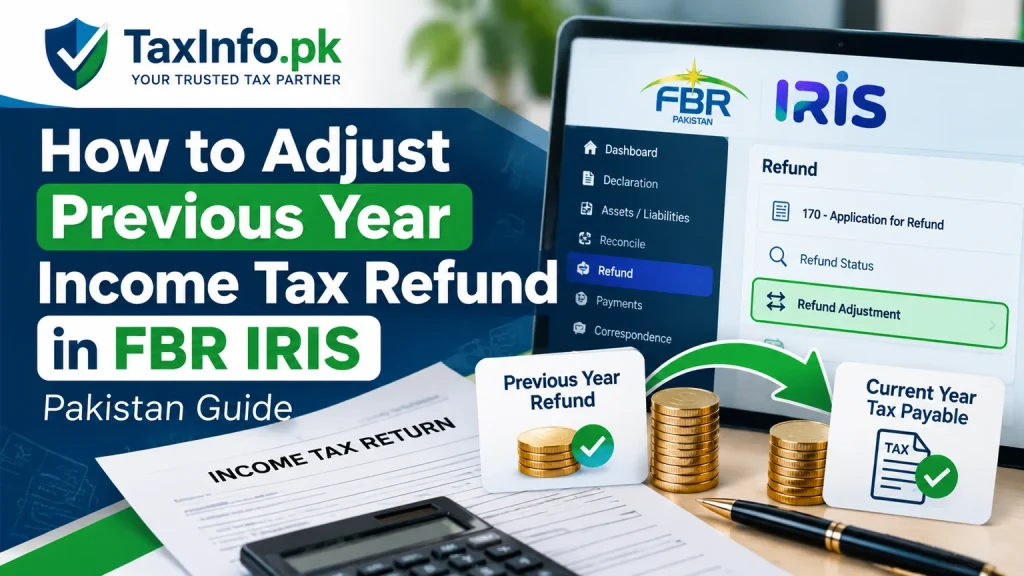
Can you adjust a previous year’s income tax refund against your current-year tax liability in Pakistan? Yes, FBR’s published IRIS guidance recognizes the adjustment of previous-year refunds against tax payable for the current year. However, the adjustment must comply with the applicable legal requirements and FBR procedures.
If your previous income tax return shows a refundable amount, you may be able to use an eligible portion against a later year’s outstanding tax liability instead of receiving that portion as a cash refund.
However, a refund shown in an earlier income tax return is not automatically an approved adjustment.
This guide explains how to adjust previous year income tax refund in IRIS, the relevant provisions of Section 170 of the Income Tax Ordinance, 2001, the difference between refund adjustment and refund claims, and the precautions taxpayers should follow.
Table of Contents
What Is Previous Year Income Tax Refund Adjustment?
Previous-year income tax refund adjustment means applying an eligible excess income tax amount from an earlier tax year against income tax payable for another tax year.
For example, suppose a taxpayer has:
- A refundable income tax balance of Rs. 80,000 for Tax Year 2025.
- An outstanding income tax liability of Rs. 50,000 for Tax Year 2026.
If the earlier refund qualifies for adjustment and the adjustment is accepted under the applicable FBR procedure, Rs. 50,000 may be applied against the later liability.
The remaining Rs. 30,000 continues to relate to the earlier tax year’s refund position.
Important: The refundable amount must be supported by tax records. An amount merely entered in a return does not establish that FBR has accepted it for adjustment.
Can You Adjust Previous Year Income Tax Refund in IRIS?
Yes. FBR’s published IRIS FAQs explain that a previous year’s refund may be adjusted against current-year tax payable.
The same guidance also explains that there is no general provision for simply carrying forward an unused previous-year refund as the next year’s refund.
This distinction is important.
Refund adjustment: Applying an eligible earlier-year refund against a tax liability.
Refund carry-forward: Adding an earlier-year refundable amount to a later year’s refundable balance without the applicable adjustment process.
These are not the same.
Did FBR Introduce a Refund Adjustment Facility in IRIS?
On 27 September 2022, FBR officially announced that it had enabled a refund adjustment tab in the income tax return forms for Tax Year 2022.
The facility was intended to help taxpayers adjust qualifying pending refund claims against their admitted Tax Year 2022 liabilities.
FBR specified eligibility conditions, including the submission of refund applications by the announced cutoff date.
The announcement established a documented adjustment facility for that particular tax year. It does not, by itself, establish that identical conditions or the same adjustment tab apply to Tax Year 2027.
Taxpayers should therefore confirm the facility available for their relevant tax year before attempting an adjustment.
Official source: FBR Announcement — Refund Adjustment Tab for Tax Year 2022
What Is the Legal Basis for Income Tax Refund Adjustment in Pakistan?
The principal legal framework is provided by Section 170 of the Income Tax Ordinance, 2001.
Section 170 deals with refunds of excess income tax and the treatment of qualifying excess tax payments.
Section 170(1): Applying for an Income Tax Refund
Section 170 provides a mechanism for a taxpayer who has paid income tax in excess of the amount properly chargeable to seek a refund.
The claim must be supported by the taxpayer’s tax position and the applicable legal requirements.
Section 170(2): Refund Application and Time Limits
Section 170 governs the submission and processing of refund applications.
FBR’s published income tax refund guidance states that a refund arising from an income tax return may be claimed within two years from:
- The date of filing the return, treated as the date of assessment for this purpose; or
- The date on which the tax was paid;
whichever is later.
Taxpayers should verify the applicable statutory requirements for their specific tax year and circumstances, particularly where an older claim or amended assessment is involved.
An old refundable balance should not be assumed to remain available indefinitely.
Official source: FBR Income Tax Refund Guidance
Section 170(3): Adjustment Against Outstanding Tax
Section 170(3) provides for the treatment of excess tax where the Commissioner is satisfied that an amount has been overpaid.
The statutory mechanism contemplates applying the excess against qualifying outstanding tax liabilities before dealing with any remaining amount as a refund.
This is an important legal basis for understanding refund adjustment.
However, Section 170 should not be interpreted as permission for taxpayers to enter an unsupported adjustment in any field of an income tax return.
The amount and procedure must comply with the applicable law and FBR requirements.
For the relevant legislation, consult the FBR Income Tax Ordinance, 2001.
What Is the Difference Between Refund Adjustment and Refund Claim?
Both procedures concern excess income tax, but they have different purposes.
| Feature | Refund Adjustment | Refund Claim |
|---|---|---|
| Main purpose | Reduce an eligible tax liability | Recover excess income tax |
| Treatment | Excess amount applied against tax due | Refund processed under applicable procedure |
| Relevant tax years | May involve an earlier refund and a later liability | Relates to the tax year of the excess payment |
| Legal framework | Section 170 | Section 170 |
| Cash payment | Not necessarily required for the adjusted amount | May result in payment after approval |
| Automatic approval | No | No |
For the complete refund application procedure, read our How to Claim Income Tax Refund from FBR in IRIS guide.
How to Adjust Previous Year Income Tax Refund in IRIS: Step-by-Step Guide
The correct approach is to verify the earlier refund, calculate the current liability, and use only the adjustment procedure officially available for the relevant tax year.
The following steps explain the process without assuming that a particular adjustment tab is available in every IRIS return.
Step 1: Log In to the Official FBR IRIS Portal
Visit the FBR IRIS Portal and sign in using your registered taxpayer credentials.
Confirm that you are accessing the correct taxpayer account.
Keep your previous-year and current-year income tax records available for reconciliation.
Step 2: Check Your Previous Year’s Income Tax Return
Open the filed income tax return for the year in which the excess tax arose.
Review the following:
- Total income tax liability for that year.
- Adjustable withholding tax.
- Advance income tax payments.
- Other eligible payments or credits.
- Final refundable amount shown in the return.
For example:
| Previous-Year Tax Details | Amount |
|---|---|
| Total income tax liability | Rs. 70,000 |
| Eligible tax already paid or deducted | Rs. 110,000 |
| Refundable amount | Rs. 40,000 |
In this example, the return indicates an excess tax amount of Rs. 40,000.
That figure is the starting point for verification. It should not automatically be treated as an approved adjustment.
Step 3: Verify Your Section 170 Refund Application
Check whether you have submitted a refund application for the relevant previous tax year.
FBR’s published IRIS guidance identifies the refund application as:
Refund → 170 (Application for Refund of Tax Paid in Excess)
Select the relevant tax period and review the available application details and correspondence.
The precise appearance of menus may differ as IRIS is updated.
A submitted refund application, its acknowledgment, and any FBR decision should be retained.
FBR’s historical Tax Year 2022 adjustment arrangement specifically referred to qualifying refund applications. The requirements for another tax year must be checked separately.
If you have not filed a refund application, review the applicable requirements and deadline before proceeding.
Step 4: Calculate Your Current-Year Income Tax Payable
Next, calculate the tax payable for the year against which you want the refund considered.
Suppose your current-year figures are:
| Particulars | Amount |
|---|---|
| Total income tax liability | Rs. 125,000 |
| Current-year adjustable withholding tax | Rs. 35,000 |
| Current-year advance income tax | Rs. 30,000 |
| Remaining tax payable | Rs. 60,000 |
The remaining liability is Rs. 60,000.
If a qualifying previous-year refund is available and an adjustment of Rs. 60,000 is accepted, the liability could be settled to that extent.
Do not enter the previous-year refund as current-year withholding tax or advance tax merely to reduce the amount payable.
For further information about actual advance tax payments, read How to Pay Advance Tax Online through FBR IRIS.
Step 5: Check the Applicable Refund Adjustment Facility
Review the current-year return and any official refund adjustment instructions available in IRIS.
Where FBR provides an adjustment facility for the relevant tax year:
- Verify that the earlier refund meets the stated eligibility requirements.
- Confirm that any required refund application has been submitted.
- Check whether the refund has already been paid or adjusted.
- Determine the amount eligible for adjustment.
- Use the officially designated adjustment facility, where available.
- Review the resulting tax computation carefully.
Do not use an unrelated payment, withholding tax or credit field to create an adjustment that FBR has not authorized.
If no appropriate adjustment facility is available, review your refund application and seek guidance from the relevant FBR office regarding the available procedure.
Step 6: Reconcile the Previous Refund and Current Tax Liability
Before treating an adjustment as completed, compare the relevant amounts.
| Reconciliation Item | Amount |
|---|---|
| Verified previous-year refundable amount | Rs. 90,000 |
| Current-year outstanding tax liability | Rs. 60,000 |
| Potential adjustment, subject to acceptance | Rs. 60,000 |
| Earlier-year refund balance remaining | Rs. 30,000 |
In this example, the potential adjustment is limited to the current liability of Rs. 60,000.
The remaining Rs. 30,000 does not automatically become a refund for the current year.
The taxpayer should retain the supporting record showing whether FBR accepted and applied the adjustment.
Step 7: Keep Evidence of the Adjustment
Maintain the records relevant to the transaction, including:
- Previous-year filed income tax return.
- Previous-year tax computation.
- Section 170 refund application, where applicable.
- FBR acknowledgment, order or correspondence.
- Current-year tax computation.
- Any official adjustment confirmation.
- Records of tax payments and CPRs.
An adjustment should be considered completed only to the extent supported by the applicable FBR processing records.
Can You Adjust the Entire Previous-Year Refund?
Only to the extent permitted by the applicable law, available refund amount, and tax liability against which adjustment is accepted.
Consider the following example.
A taxpayer has:
- Previous-year refund: Rs. 100,000.
- Current-year tax payable: Rs. 45,000.
If the entire earlier refund is eligible and FBR accepts the adjustment, Rs. 45,000 may be applied against the current liability.
The remaining Rs. 55,000 continues to relate to the earlier year’s refund position.
The taxpayer should not automatically add Rs. 55,000 to the following year’s income tax return as a new refundable amount.
What Happens to the Remaining Previous-Year Refund?
FBR’s published IRIS FAQs explain that an earlier year’s refund may be adjusted against current-year tax payable, but an excess previous-year refund is not generally carried forward as a refund for the next year.
For example:
| Particulars | Amount |
|---|---|
| Previous-year refund | Rs. 75,000 |
| Current-year tax payable | Rs. 25,000 |
| Eligible adjustment, if accepted | Rs. 25,000 |
| Earlier-year refund remaining | Rs. 50,000 |
The remaining Rs. 50,000 should continue to be tracked against the earlier tax year’s refund claim.
Its payment or further adjustment depends on the applicable law and FBR procedure.
This is different from treating the remaining amount as a fresh refund generated by the current-year return.
Is Previous-Year Refund Adjustment Available for Tax Year 2027?
The underlying concept of refund adjustment is recognized in FBR guidance.
However, the availability of a specific IRIS adjustment tab or workflow for Tax Year 2027 must be established from the applicable return and current official FBR instructions.
FBR’s September 2022 announcement concerned Tax Year 2022 and included specific eligibility conditions.
Those conditions should not automatically be applied to Tax Year 2027.
Taxpayers preparing Tax Year 2027 returns should therefore:
- Review the current IRIS return.
- Check applicable FBR notifications and instructions.
- Verify the status of earlier refund claims.
- Confirm whether a refund adjustment mechanism is available.
- Avoid making unsupported entries to reduce the declared tax payable.
Where the applicable process is unclear, seek clarification from the relevant FBR office before claiming that an earlier refund has settled a current liability.
Why Is My Previous-Year Refund Not Showing in IRIS?
Several issues may explain why an earlier refund is not available for adjustment.
The Refund Appears Only in the Filed Return
A refund calculated in a return may still require verification or processing under the applicable procedure.
The Refund Application Has Not Been Submitted
FBR’s published refund guidance requires a separate application to claim a refund arising from an income tax return.
The absence of a required application may affect the taxpayer’s ability to use a particular adjustment facility.
The Adjustment Facility Is Not Available for the Selected Tax Year
IRIS return forms and adjustment arrangements can differ between tax years.
A facility documented for an earlier year should not be assumed to exist in the same form for every subsequent year.
The Refund Has Already Been Paid or Adjusted
An amount previously settled should not be claimed again.
Tax Payment Records Do Not Reconcile
Differences between the filed return, withholding records, CPRs and FBR processing records may require correction or clarification.
The Refund Claim Is Outside the Applicable Time Limit
FBR’s published guidance refers to a two-year refund application period, measured from the relevant filing/assessment date or tax-payment date, whichever is later.
An older claim should be reviewed against the applicable statutory provisions and the taxpayer’s circumstances.
What Documents Are Needed for Previous-Year Refund Adjustment?
The following records can help establish the refund and support reconciliation:
| Document | Purpose |
|---|---|
| Previous-year income tax return | Shows the declared refundable amount |
| Previous-year tax computation | Explains how the excess arose |
| Withholding tax certificates | Support eligible deductions |
| Advance tax payment CPRs | Support tax already paid |
| Section 170 refund application | Records the formal refund claim |
| FBR orders or correspondence | Show processing or decisions |
| Current-year tax computation | Establishes the outstanding liability |
| Adjustment confirmation, if issued | Supports the amount actually applied |
The precise documentation requirements depend on the nature of the refund and the procedure applicable to the tax year.
What Is the Difference Between Advance Tax and Previous-Year Refund Adjustment?
Advance income tax and previous-year refund adjustment are different concepts.
Advance tax generally refers to income tax paid before the final determination of liability for the relevant tax year.
Previous-year refund adjustment concerns an eligible excess tax amount associated with an earlier year.
For example, a current-year advance tax payment supported by a CPR should be reconciled as a payment for the appropriate tax period.
A refund from an earlier year should not be entered as though it were a new advance tax payment.
For the statutory framework governing advance income tax, read Advance Tax in Pakistan under Section 147.
What Should You Do If FBR Does Not Allow the Adjustment?
If your expected refund adjustment is unavailable, rejected or not reflected in the relevant records, follow these steps:
- Verify the refundable amount in the earlier filed return.
- Check whether the required Section 170 refund application was submitted.
- Review any FBR correspondence, orders or processing records.
- Confirm that the refund has not already been paid or adjusted.
- Recalculate the outstanding current-year tax liability.
- Review the adjustment procedure applicable to the relevant tax year.
- Contact the relevant Regional Tax Office where clarification or processing is required.
Do not assume that a pending refund claim automatically suspends or discharges an otherwise payable current-year tax liability.
If an adjustment has not been accepted, the taxpayer must continue to consider the applicable payment requirements and deadlines.
Common Mistakes to Avoid When Adjusting a Previous-Year Refund
1. Treating a Refund Shown in the Return as an Approved Adjustment
A calculated refund and an accepted adjustment are not the same.
2. Entering the Refund as Current-Year Withholding Tax
An earlier-year refund should not be placed in an unrelated current-year tax credit field.
3. Applying an Old IRIS Procedure Without Verification
A procedure documented for Tax Year 2022 may not be available in identical form for Tax Year 2027.
4. Claiming an Amount That Has Already Been Paid
Taxpayers should reconcile prior refund payments and adjustments before making another claim.
5. Carrying Forward an Excess Refund Automatically
An unused earlier-year refund should remain associated with the appropriate original tax year unless the applicable law and procedure provide otherwise.
6. Ignoring Refund Application Deadlines
Taxpayers should check the applicable Section 170 time limit and avoid delaying a legitimate refund claim.
Previous-Year Refund Adjustment Checklist
Before treating an adjustment as complete, confirm that:
- The previous-year income tax return was filed.
- The refundable amount is supported by tax records.
- The applicable refund application requirements have been met.
- The refund has not already been paid or adjusted.
- The current-year tax liability has been correctly calculated.
- The adjustment is permitted under the applicable procedure.
- Any IRIS entry uses an officially supported facility.
- The amount adjusted does not exceed the eligible refund or relevant liability.
- The remaining earlier-year refund is separately tracked.
- Supporting acknowledgments and FBR records have been retained.
Frequently Asked Questions
Can I adjust my previous year’s income tax refund against current-year tax payable?
Yes, FBR’s published IRIS guidance recognizes the adjustment of previous-year refunds against current-year tax payable. However, the refund must qualify under the applicable legal and administrative requirements, and the adjustment must follow the procedure available for the relevant tax year.
Is the refund adjustment tab available in IRIS for Tax Year 2027?
FBR officially announced a refund adjustment tab for Tax Year 2022. That announcement does not confirm the availability of an identical facility for Tax Year 2027. Taxpayers should check the current IRIS return and official FBR instructions before attempting an adjustment.
Do I need a Section 170 application to adjust a previous-year refund?
Section 170 provides the framework for refund claims. FBR’s historical Tax Year 2022 adjustment arrangement required qualifying refund applications. The requirements for a particular adjustment depend on the applicable tax year and FBR procedure.
Can I carry forward my entire previous-year refund to the next tax year?
No general automatic carry-forward should be assumed. FBR’s published IRIS FAQs distinguish adjustment against current-year tax payable from carrying forward an earlier-year refund as a new refund balance.
What happens if my previous-year refund exceeds my current tax liability?
An adjustment against the current liability cannot exceed that liability. Any remaining eligible refund continues to relate to the earlier tax year and must be handled under the applicable refund rules.
How long do I have to apply for an FBR income tax refund?
FBR’s published guidance states that a refund may be claimed within two years from the date of filing the return/date of assessment or the date on which the tax was paid, whichever is later. Taxpayers should verify the statutory rules applicable to their circumstances.
Conclusion
Understanding how to adjust previous year income tax refund in IRIS is important for taxpayers who have excess tax from an earlier year and income tax payable for a later year.
FBR’s published guidance recognizes the concept of previous-year refund adjustment, while Section 170 provides the principal legal framework for excess income tax refunds.
However, a refundable amount shown in an earlier return does not automatically become an approved payment against a later tax liability.
The correct approach is to verify the refund, reconcile tax records, follow the procedure applicable to the relevant tax year, and retain evidence of any adjustment accepted by FBR.
For additional guidance, read our How to Claim Income Tax Refund from FBR in IRIS article.