
The terms filer and non-filer are commonly used in Pakistan, but they can oversimplify how the current FBR tax system actually works.
For many transactions, the more important question is:
Does your name appear on FBR’s Active Taxpayer List (ATL), and what taxpayer category applies to the particular transaction?
A person appearing on the ATL can generally benefit from lower withholding tax rates on several transactions, while a person who is not on the ATL may face higher rates.
FBR itself lists lower tax deduction on banking transactions, motor vehicles, property, securities, dividends and prize winnings among the benefits of appearing on the ATL.
However, the system has become more nuanced because certain provisions also distinguish late filers from other ATL taxpayers and persons who are not on the ATL.
This guide explains these differences in simple terms.
Table of Contents
What Is an Active Taxpayer in Pakistan?
An Active Taxpayer is generally a taxpayer whose name appears on FBR’s applicable Active Taxpayer List (ATL).
For Income Tax, FBR maintains the Active Taxpayer List (Income Tax).
As of 18 September 2026, FBR’s published Income Tax ATL shows an update dated 18 September 2026.
The ATL is not simply a list of everyone who has ever obtained an NTN.
It is linked to tax-return filing and the applicable ATL rules.
This distinction is important:
Having an NTN ≠ automatically being an Active Taxpayer
If you want to verify your current status, see our FBR ATL Status Check by CNIC in Pakistan.
What Is a Non-Active Taxpayer?
In practical terms, a person whose name does not appear on the relevant ATL at the time the applicable tax treatment is determined can face Non-ATL tax treatment.
This is commonly called being a non-filer.
However, “non-filer” and “Non-ATL” should not always be treated as perfect synonyms.
For example, a person may:
- already have an NTN;
- have an IRIS account;
- have filed a return in an earlier year;
but still not satisfy the requirements for the current applicable ATL status.
Therefore, checking actual ATL status is more reliable than simply saying:
“I have an NTN, so I am a filer.”
Filer vs Active Taxpayer – Are They the Same?
In everyday conversation, people usually call an ATL taxpayer a filer.
That terminology is convenient, but FBR’s tax rules are based on specific statutory categories and ATL status rather than the informal label alone.
A better way to understand the system is:
| Common Term | More Precise Meaning |
|---|---|
| Filer | Usually refers to a person appearing on ATL |
| Non-Filer | Commonly refers to a person receiving Non-ATL treatment |
| ATL | Active Taxpayer List |
| Non-ATL | Person not appearing on the applicable ATL |
| Late Filer | A separate category relevant to certain current tax provisions |
This distinction becomes particularly important when comparing withholding tax rates.
Active Taxpayer vs Non-Active Taxpayer – Main Differences
The biggest practical difference is generally the tax deducted or collected on various transactions.
FBR’s current Tax Year 2027 Withholding Tax Rate Card is updated through 30 June 2026 under Finance Act 2026.
Depending on the applicable section, the rate card can distinguish between ATL, Non-ATL and, in some cases, late-filer treatment.
A simplified comparison is:
| Area | Active / ATL | Non-ATL |
|---|---|---|
| Withholding Tax | Generally lower where differential rates apply | Generally higher |
| Property transactions | Preferential ATL treatment where applicable | Higher treatment may apply |
| Motor vehicles | Lower applicable withholding in relevant cases | Higher applicable tax may apply |
| Banking transactions | ATL benefits can apply | Higher/non-ATL treatment can apply |
| Dividends | Lower rate in applicable situations | Higher rate may apply |
| Securities | Preferential ATL treatment in applicable provisions | Higher treatment can apply |
| Prize winnings | Lower applicable withholding | Higher withholding may apply |
| Refund of excess tax | Overpaid withholding can be claimed subject to law | Return filing/compliance may be required |
The exact percentage should always be checked against the current FBR rate card and relevant section rather than assuming that every Non-ATL rate is simply double the ATL rate.
1. Withholding Tax Differences
One of the most important ATL benefits is lower withholding tax treatment.
FBR specifically lists reduced withholding tax as an ATL benefit across several categories.
For example, different rates can apply when a person:
buys or sells property
registers or transfers a motor vehicle
receives certain investment income
receives dividends
wins prize bonds
enters transactions covered by other withholding provisions
Our Withholding Tax in Pakistan – Complete Beginner’s Guide explains how withholding tax works before comparing individual sections.
2. Property Transactions
Property is one of the areas where ATL status can have a significant financial impact.
FBR identifies lower tax rates on buying and selling property as an ATL benefit.
Current tax law can distinguish among applicable taxpayer categories, and the rate can also depend on factors such as:
whether the property is being bought or sold
property value
applicable section
ATL/late-filer/Non-ATL status
Therefore, property tax should not be calculated merely by asking:
“What is the filer rate?”
The exact transaction and current rate card must be checked.
3. Motor Vehicle Transactions
ATL status can also affect tax on motor vehicle registration and transfer.
FBR lists a reduction in withholding tax when registering and transferring motor vehicles among ATL benefits.
The actual amount can depend on the applicable vehicle-related tax provision and vehicle details.
A Non-ATL taxpayer can therefore face a higher tax cost than an ATL taxpayer for the same type of transaction where differential rates apply.
4. Banking Transactions
FBR also identifies lower tax deduction at source by banks on applicable transactions as an ATL benefit.
This makes ATL status relevant even for taxpayers who are not regularly buying property or vehicles.
However, banking taxation has changed repeatedly over different Finance Acts, so an old “filer vs non-filer” percentage found online should not automatically be applied in 2026-27.
Always use the current FBR rate card.
5. Dividend Income
ATL status can also affect withholding on dividends.
FBR specifically identifies lower charges on dividends as one of the benefits available to taxpayers appearing on ATL.
The exact rate depends on the applicable dividend category and current law.
6. Capital Gains on Securities
FBR lists lower withholding tax on capital gains from the sale of securities among ATL benefits.
Again, the actual taxation of securities can depend on factors beyond ATL status, so ATL should be viewed as one part of the tax calculation rather than the only factor.
7. Prize Bond Winnings
Prize winnings are another common example.
According to FBR, taxpayers appearing on ATL benefit from a lower withholding tax rate on prize bond winnings.
A person receiving a large prize can therefore experience a meaningful difference in tax deduction depending on the applicable status.
What Is a Late Filer?
This is where the old “filer vs non-filer” explanation becomes incomplete.
Pakistan’s tax framework now recognizes late-filer treatment for certain purposes.
FBR’s explanatory material confirms that changes introduced through Finance Act 2024 broadened the relevant framework to distinguish persons who filed their return after the prescribed or extended due date.
Therefore, the modern system can involve:
ATL / timely filer
Late filer
Non-ATL
depending on the transaction and applicable tax provision.
A late filer should not automatically assume that appearing on ATL guarantees the same rate as a timely filer for every transaction.
Can a Late Filer Still Become Active on ATL?
Yes, subject to the applicable rules.
FBR changed the ATL system so that a taxpayer filing after the due or extended date can still be included after payment of the surcharge specified under section 182A. FBR also states that ATL is now updated daily.
This is an important change from older guidance that described weekly ATL updates.
If you have not yet completed the underlying tax-registration and filing process, see How to Become a Filer in Pakistan.
How to Check Whether You Are Active or Non-Active
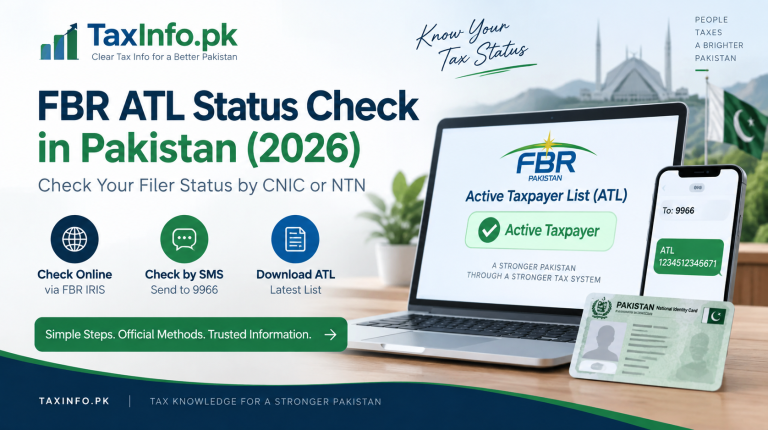
FBR currently provides three main ways to verify Income Tax ATL status:
Online verification
SMS verification
Downloading the ATL
For an individual, FBR specifies the following SMS format:
ATL [space] 13-digit CNIC
Send it to:
9966
For an AOP or company:
ATL [space] 7-digit NTN
Send it to:
9966.
Checking the actual ATL is better than relying on an old screenshot, tax certificate or assumption based on previous-year filing.
Does Filing an Income Tax Return Automatically Make You Active?
Not in every circumstance immediately and without conditions.
ATL inclusion depends on the applicable tax year, filing timing and current ATL rules.
FBR confirms that persons filing after the due date can be included subject to the applicable section 182A surcharge.
Therefore, simply submitting a return should not be treated as proof that the taxpayer has already obtained the desired status.
After filing, verify your actual ATL status.
For the filing process itself, see our How to File Income Tax Return Online in Pakistan.
Does Having NTN Make You a Filer?
No.
This is one of the most common misconceptions in Pakistan.
An NTN represents taxpayer registration.
ATL status represents the taxpayer’s current status under the applicable ATL rules.
Therefore:
NTN = Registration
Income Tax Return = Filing obligation/process
ATL = Active taxpayer status
They are connected, but they are not identical.
If you only need registration, see our NTN Registration Online in Pakistan.
Why Does ATL Status Matter?
ATL status can matter because higher withholding can create a real cash-flow cost.
Suppose two people enter the same transaction:
Person A → applicable ATL rate
Person B → applicable Non-ATL rate
If the law imposes a higher rate on Person B, more tax is deducted or collected at the transaction stage.
Depending on the relevant provision, some tax may later be adjustable or otherwise treated under the Income Tax Ordinance.
But paying a higher amount upfront can still affect cash flow.
This is why taxpayers should understand both:
the rate being deducted, and
the final tax treatment of that deduction.
Is Being on ATL the Same as Paying More Income Tax?
No.
ATL status and final income-tax liability are different concepts.
A taxpayer’s final income tax depends on taxable income, applicable rates, credits, deductions and other relevant provisions.
ATL status primarily affects several compliance and withholding-tax consequences.
For example, a person can be on ATL and still have little or no final income-tax liability depending on the person’s taxable circumstances.
Similarly, higher withholding from a Non-ATL person does not automatically mean that the higher deduction equals that person’s final income-tax liability.
Common Misunderstandings
“I have an NTN, so I am automatically active.”
Not necessarily. NTN and ATL status are different.
“I filed a return once, so I will always remain active.”
ATL status is tied to applicable filing requirements and current rules.
“Every Non-ATL tax rate is exactly double.”
Incorrect. The applicable differential depends on the specific provision.
“Late filer and Non-ATL always mean the same thing.”
Incorrect. Current law can distinguish late filers separately for certain transactions.
“Once I submit my return, I never need to check ATL.”
It is better to verify actual ATL status after completing the relevant requirements.
Frequently Asked Questions
What does ATL mean in Pakistan?
ATL means Active Taxpayer List. FBR maintains the list to identify taxpayers meeting the applicable requirements for active status.
What is the difference between filer and non-filer?
In everyday language, a filer usually means a person appearing on ATL, while non-filer commonly refers to a person receiving Non-ATL treatment. Current tax law can also separately recognize late filers for certain transactions.
Does an NTN make me an active taxpayer?
No. NTN registration alone does not establish current ATL status.
How can I check my ATL status?
Individuals can check through FBR’s online verification facility or send ATL [space] CNIC to 9966. Companies and AOPs can use their 7-digit NTN.
Is ATL updated every week?
Older information may say so, but FBR changed the system to daily ATL updates in 2024.
Can a late filer appear on ATL?
Yes. FBR states that a person filing after the due or extended date can be included subject to payment of the applicable surcharge under section 182A.
Do active taxpayers pay lower tax?
ATL taxpayers benefit from lower withholding rates in several specified transactions, but this does not mean every type of tax is automatically lower. The applicable tax provision must be checked.
Where can I find current ATL and Non-ATL rates?
FBR publishes an official Withholding Tax Rate Card. The current Tax Year 2027 card is updated through 30 June 2026 under Finance Act 2026.
Final Words
The most useful way to understand the system is not simply:
Filer vs Non-Filer
but:
Tax Registration → Return Filing → ATL Status → Applicable Tax Treatment
Having an NTN alone does not make someone active, and submitting a return does not mean every transaction will automatically receive the same tax treatment.
For 2026-27, taxpayers should also remember that late-filer treatment can matter separately from ordinary ATL and Non-ATL treatment.
Before a major property, vehicle, investment or other taxable transaction, checking current ATL status and the latest FBR rate card can prevent unexpected withholding tax.
Official FBR Sources
FBR Active Taxpayer List (Income Tax)
FBR – Check Active Taxpayer Status
FBR – Active Taxpayer Benefits
FBR – Current Withholding Tax Rate Cards
Disclaimer
This article is for general educational and informational purposes only and does not constitute tax, legal or professional advice. ATL, late-filer and Non-ATL treatment can differ according to the transaction, applicable section and current law. Tax rates and FBR procedures may change. Always verify the latest FBR rate card, Income Tax Ordinance and official guidance before making a tax or financial decision.