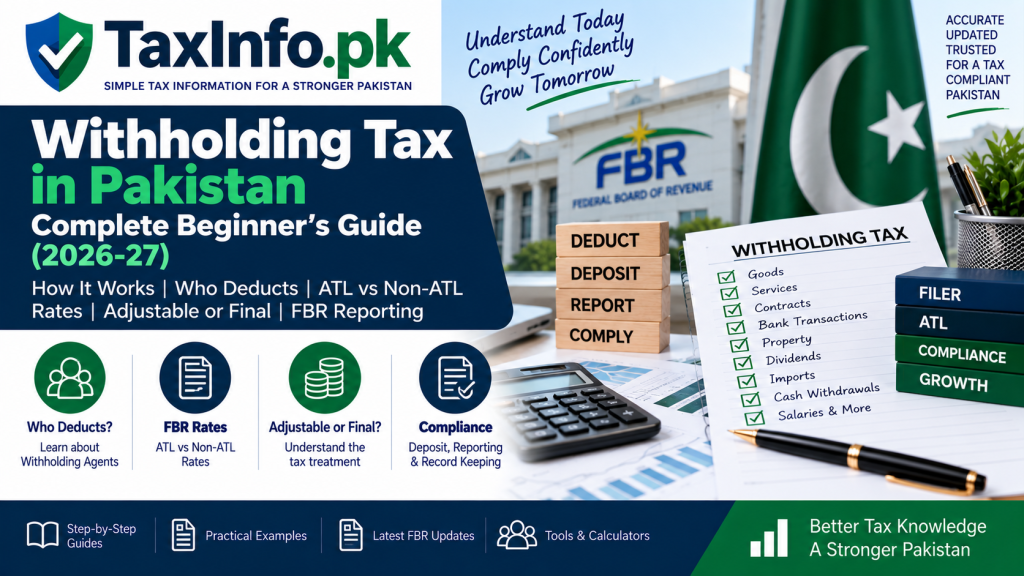
Withholding tax is one of the most important parts of Pakistan’s income tax system.
You may encounter it when receiving a payment for goods or services, withdrawing cash, earning profit from a bank account, buying or selling property, receiving dividends, entering into contracts, importing goods or carrying out various other transactions.
But withholding tax is frequently misunderstood.
A deduction at source does not necessarily mean that your complete income tax liability has been settled. Depending on the applicable provision, the tax deducted may have a different legal treatment.
This guide explains what withholding tax is, who deducts it, how FBR rates work, why ATL status matters, and how deducted tax can affect your income tax return.
What Is Withholding Tax?
FBR describes withholding tax as an advance payment of tax deducted at the time of specified economic activities under provisions of the Income Tax Ordinance, 2001 and Sales Tax Act, 1990.
The applicable rate varies according to the relevant section and transaction.
FBR also makes an important distinction: tax deducted under some provisions may constitute a final discharge, while tax deducted under others may be adjustable against the taxpayer’s final liability.
In simple terms:
Payment is made → applicable tax is withheld → balance is paid to the recipient → withheld amount is deposited with the government.
Simple Example
Suppose a business has to pay a supplier:
Invoice amount: Rs. 100,000
Assume, purely for illustration, that the applicable withholding rate for that particular transaction is 5%.
Tax withheld:
Rs. 100,000 × 5% = Rs. 5,000
Amount paid to supplier:
Rs. 95,000
Withholding tax:
Rs. 5,000
The Rs. 5,000 is not simply kept by the customer. The withholding agent has statutory responsibilities concerning deduction, deposit and reporting.
The actual rate must always be determined from the provision applicable to the transaction.
Who Is a Withholding Agent?
The person responsible under tax law for deducting or collecting tax is generally referred to as a withholding agent.
FBR states that responsibility for withholding at the specified rate rests with withholding agents prescribed for the relevant section.
Depending on the provision, withholding responsibilities may apply to entities such as:
- Companies
- Government organizations
- AOPs
- Certain businesses and prescribed persons
- Banks and financial institutions
- Property-related persons or authorities
- Import-related authorities
- Other persons specifically prescribed by tax law
Not every person making every payment automatically becomes a withholding agent.
The relevant section must first be checked.
Where Is Withholding Tax Commonly Applied?
Pakistan’s Income Tax Ordinance contains numerous withholding and advance-tax provisions.
Common areas include:
| Transaction / Income | Examples |
|---|---|
| Salary | Tax deducted by employer |
| Goods | Payments to suppliers |
| Services | Payments to service providers |
| Contracts | Contract payments |
| Profit on debt | Bank/deposit income |
| Dividends | Dividend payments |
| Property | Purchase and sale transactions |
| Imports | Tax collected at import stage |
| Cash withdrawals | Certain withdrawals where applicable |
| Prizes | Prize bonds and certain winnings |
| Exports | Specified export receipts/transactions |
| E-commerce | Certain digitally ordered transactions |
The applicable section, taxpayer category and tax treatment can differ substantially.
Therefore, there is no single withholding tax percentage for Pakistan.
What Is an FBR Withholding Tax Rate Card?
Because numerous withholding provisions exist, FBR publishes a Withholding Income Tax Rate Card.
As of the current 2026-27 period, FBR lists:
Withholding Tax Rate Card for Tax Year 2027
and states that it is updated up to 30 June 2026 as per Finance Act 2026.
The rate card helps identify information such as:
- Relevant section
- Nature of transaction
- Applicable taxpayer/category
- ATL rate
- Non-ATL rate where applicable
- Other applicable rate classifications
- Reference to the statutory rate
However, FBR’s rate cards are facilitative documents. The Income Tax Ordinance and applicable law remain controlling where there is any conflict.
ATL vs Non-ATL Withholding Tax
One of the most important concepts is Active Taxpayer List (ATL) status.
For a number of withholding provisions, a person who is not on the ATL can face a higher rate than an active taxpayer.
For example, the applicable rate card may contain separate columns for:
ATL Rate and Non-ATL Rate.
But the exact difference depends on the particular transaction.
Therefore, you should not assume that being a non-filer simply means “double tax” in every situation.
Always check the relevant section and current rate.
You can verify your current status through our FBR ATL Status Check by CNIC in Pakistan guide.
Does Withholding Tax Mean Extra Tax?
Not always.
This depends heavily on the legal treatment of the particular deduction.
Three concepts are especially important:
1. Adjustable Tax
An adjustable withholding tax can generally be taken into account when calculating the taxpayer’s final income tax liability.
For example, suppose:
Final income tax liability = Rs. 150,000
and eligible adjustable tax already deducted during the year is:
Rs. 100,000
A simplified illustration would leave:
Rs. 50,000
to be dealt with when determining the final position.
The actual return may contain multiple deductions, credits and other adjustments.
2. Final Tax
Under a final-tax treatment, tax deducted or collected under the relevant provision may constitute the final tax treatment for that income/transaction, subject to the law.
FBR expressly notes that deductions under some sections are treated as final discharge.
3. Minimum Tax
Some withholding provisions can operate as minimum tax.
This concept is different from simply treating every deduction as an advance credit.
The Income Tax Ordinance and current rate card should therefore be checked before deciding how a particular deduction will be treated.
This distinction is especially important for businesses and professionals.
What Is Section 153?
Section 153 of the Income Tax Ordinance, 2001 is one of the most commonly encountered withholding provisions in business transactions.
Broadly, it deals with certain payments relating to:
- Supplies of goods
- Rendering or providing services
- Execution of contracts
The precise rate depends on the nature of the payment and applicable taxpayer category.
Current FBR material shows different rates for supplies, specified services, other services, contracts and other categories rather than one universal Section 153 rate.
Section 153 is one of the most important withholding provisions for businesses, suppliers, service providers and contractors. For a detailed explanation of supplies, services, contracts and the applicable treatment, read our Section 153 Withholding Tax in Pakistan – Goods, Services & Contracts Explained.
Example: Why You Should Identify the Transaction First
Suppose a business receives an invoice for Rs. 500,000.
Before deducting tax, simply asking:
“What is the withholding tax rate?”
is not enough.
The business may need to establish:
What is being paid for?
Is it:
- Goods?
- Services?
- A contract?
- Advertising?
- IT services?
- Another specifically categorized service?
Then:
Who is receiving the payment?
The recipient’s status and legal category may affect the applicable rate.
Then:
What is the recipient’s ATL status?
Only after identifying these factors can the correct rate be selected.
Withholding Tax on Salary
Employers can also have responsibility for deducting tax from employees’ salaries under the applicable salary withholding provisions.
Salary taxation, however, has its own annual tax slabs and payroll calculation rules.
For the current employee rates, see our Income Tax Rates for Salaried Persons 2026-27 guide explains the progressive salary slabs separately.
Withholding Tax for Businesses and Professionals
Businesses can encounter withholding tax from both sides.
A business may be:
The withholding agent
It makes a payment and has a legal obligation to deduct tax.
Or:
The taxpayer receiving payment
Its customer deducts tax before paying the balance.
For example, a consultant may issue an invoice and receive an amount after withholding tax has been deducted.
That deduction should not simply be ignored when the consultant later prepares the income tax return.
The tax treatment and available credit should be checked in IRIS according to the applicable provision.
Does Withholding Tax Appear in FBR IRIS?
Tax deducted or collected and reported to FBR can form part of the taxpayer’s tax records.
When preparing an income tax return, taxpayers should reconcile relevant deductions with their available FBR/IRIS information and supporting certificates or records.
Do not assume every deduction shown somewhere in IRIS is automatically correct.
Check:
- CNIC/NTN
- Tax year
- Amount
- Section
- Withholding agent
- Nature of payment
Incorrect reporting should be investigated rather than simply incorporated into the return.
What Is a Withholding Tax Certificate?
A withholding certificate or supporting tax deduction record can help establish that tax was deducted from a payment.
For taxpayers receiving payments after deduction, retaining evidence is important.
Supporting information can be useful when reconciling:
Gross income → tax deducted → net amount received
This is especially important for businesses, consultants and professionals whose customers regularly deduct tax.
Responsibilities of a Withholding Agent
Withholding responsibility is not limited to subtracting money from a payment.
FBR states that withholding agents prescribed under the relevant provisions are responsible for withholding at the applicable rates, and sections 165 and 165C contain withholding-statement obligations at prescribed periods.
Depending on the applicable law and transaction, compliance can therefore include:
Deduct → Deposit → Report → Maintain records
Failing to perform required withholding obligations correctly can create compliance issues for the withholding agent.
How Do You Find the Correct Withholding Tax Rate?
A practical approach is:
- Identify the exact transaction.
- Identify the applicable section of the Income Tax Ordinance.
- Determine the recipient’s taxpayer category.
- Check ATL/non-ATL status where relevant.
- Open the current FBR Withholding Tax Rate Card.
- Check whether any special condition or exemption applies.
- Determine whether the deduction is adjustable, minimum or final.
- Keep evidence of deduction/payment.
For 2026-27 calculations, use the Tax Year 2027 rate card rather than an old rate card.
Why Using an Old Withholding Rate Is Risky
Withholding tax rates can change through Finance Acts and other legislative amendments.
For example, FBR’s explanatory circular for Finance Act 2025 documented changes to service withholding rates under sections 152 and 153.
That is why copying a rate from an old blog, YouTube video, spreadsheet or previous-year invoice can produce an incorrect deduction.
For current transactions, always verify the applicable tax year.
Withholding Tax and Income Tax Return
Withholding information becomes particularly important when filing the annual income tax return.
Depending on its legal treatment, tax already deducted can affect the final tax calculation.
Our complete filing guide is available here If you are a business owner or professional, also see our guide to Income Tax Rates for Non-Salaried Individuals & AOPs 2026-27.
Frequently Asked Questions
Is withholding tax the same as income tax?
Withholding is primarily a mechanism through which tax is deducted or collected at a specified transaction stage. Its treatment toward final income tax liability depends on the applicable provision.
Is every withholding tax adjustable?
No. FBR states that treatment varies between provisions. Some deductions may be adjustable while others can constitute final discharge; minimum-tax provisions also exist.
Is there one withholding tax rate in Pakistan?
No. Rates vary according to the relevant section, transaction, taxpayer category and other conditions.
Are withholding rates different for ATL and Non-ATL taxpayers?
For many provisions there can be different ATL and Non-ATL rates, but the exact difference must be checked against the applicable section and current FBR rate card.
Which FBR rate card applies in 2026-27?
FBR currently lists the Withholding Tax Rate Card for Tax Year 2027, updated up to 30 June 2026 according to Finance Act 2026.
What is Section 153 withholding tax?
Section 153 broadly deals with withholding on specified payments involving supplies, services and contracts. Rates vary by transaction/category, so it should not be treated as a single-rate provision.
Does having tax deducted automatically make me an active filer?
No. Tax deduction and ATL status are separate matters. ATL status should be verified independently.
Should I use the gross or net amount in my tax records?
That depends on the relevant income and accounting/tax treatment. Businesses and professionals should retain records showing the gross payment, withholding tax deducted and net amount actually received rather than treating only the net bank receipt as the complete transaction.
Final Words
Withholding tax in Pakistan is not a single tax with one percentage.
It is a broad tax collection mechanism covering many types of economic transactions. The applicable rate and treatment depend on the relevant provision of the Income Tax Ordinance, nature of transaction, taxpayer category, ATL status and other statutory conditions.
The most important practical rule is:
Identify the transaction first → identify the section → check the current FBR rate → determine the tax treatment.
For 2026-27, FBR’s Tax Year 2027 Withholding Tax Rate Card, updated according to Finance Act 2026, should be the starting reference for current rates.
Official FBR Sources
FBR – Withholding Taxes Overview
FBR – Current Withholding Tax Rate Cards
FBR – Income Tax Ordinance, 2001 (updated to 30 June 2026)
Disclaimer
This article is for general educational and informational purposes only and does not constitute tax, legal or professional advice. Withholding tax rates and treatment vary according to the applicable section, transaction, taxpayer category, ATL status and other circumstances. Tax laws may also change. Always verify the current FBR rate card and applicable provisions of the Income Tax Ordinance before deducting, depositing or claiming withholding tax.