
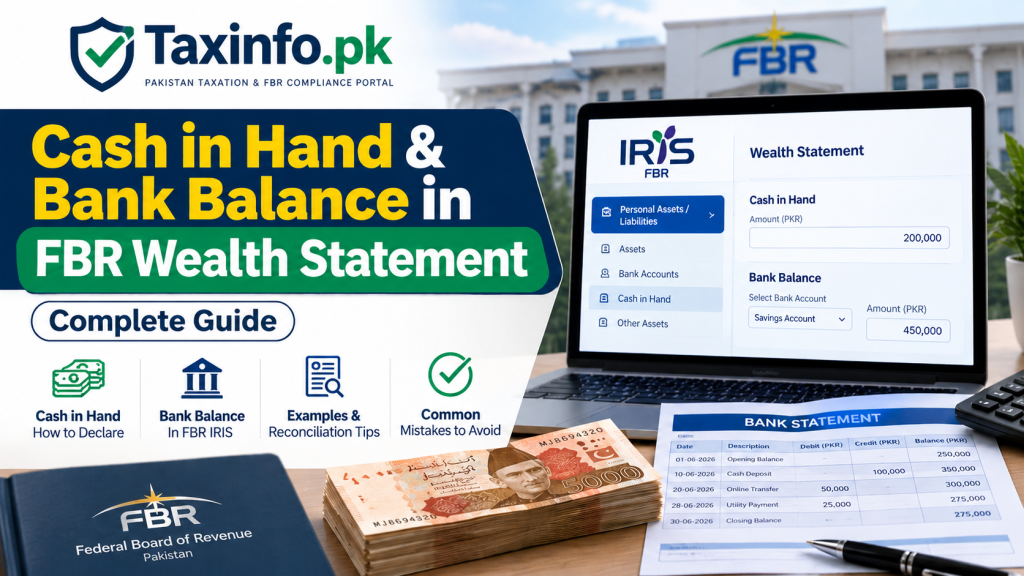
Cash in Hand in Wealth Statement is an important part of declaring your personal assets when filing an income tax return in Pakistan. Taxpayers must correctly report their cash savings and bank balances in the FBR IRIS system to avoid errors in wealth reconciliation.
Many taxpayers become confused about the difference between cash in hand, money deposited in a bank account, and the opening balance carried forward from the previous tax year.
This guide explains how to declare cash in hand and bank balances in FBR IRIS, with practical examples, common mistakes, and useful reconciliation tips.
Table of Contents
What Is Cash in Hand in Wealth Statement?
Cash in hand means the physical money you personally possess at the end of the relevant tax year.
It may include:
- Cash kept at home.
- Physical cash held for personal use.
- Cash savings accumulated from declared income.
- Other personally owned physical cash supported by an explainable source.
Cash in hand does not include money already deposited in a bank account.
For example, suppose a taxpayer has:
- Physical cash at home: Rs. 150,000
- Savings account balance: Rs. 450,000
- Current account balance: Rs. 100,000
The taxpayer’s total cash and bank assets are Rs. 700,000, but only Rs. 150,000 represents physical cash in hand.
The remaining Rs. 550,000 represents bank balances.
How to Declare Cash in Hand in Wealth Statement in FBR IRIS
Follow these steps to report cash in hand.
Step 1: Log In to FBR IRIS
Visit the official FBR IRIS Portal and sign in using your registered credentials.
Open the relevant income tax return and associated Wealth Statement for the required tax year.
Step 2: Open Personal Assets and Liabilities
Navigate to the section labelled Personal Assets / Liabilities / Receipts / Expenses.
Select Personal Assets / Liabilities.
The available options and screen layout may vary according to the return form and IRIS version.
Step 3: Find the Cash Category
Locate the relevant cash entry under personal assets.
Enter the actual amount of physical cash held at the end of the tax year.
For example:
Cash in hand on 30 June 2026: Rs. 200,000
This represents the closing cash balance for Tax Year 2026, not the total cash received throughout the year.
Step 4: Save the Information
Save the entered amount and review the total personal assets.
Ensure that the cash figure is not also included in another asset category.
How to Declare Bank Balance in FBR Wealth Statement
Bank balances are generally reported separately from physical cash.
Follow these steps:
- Obtain your bank statement for the relevant tax year.
- Identify the closing balance as of 30 June.
- Open the appropriate bank account or bank balance category in the IRIS Wealth Statement.
- Enter the account details requested by the form.
- Report the correct closing balance.
- Repeat the process for additional accounts, where applicable.
Example:
| Bank Account | Closing Balance |
|---|---|
| HBL Savings Account | Rs. 250,000 |
| UBL Current Account | Rs. 125,000 |
| Meezan Bank Account | Rs. 75,000 |
| Total Bank Balance | Rs. 450,000 |
The taxpayer should declare Rs. 450,000 as the combined balance of these accounts, using the appropriate fields in the applicable return.
Do not use the total annual deposits or withdrawals as the closing bank balance.
Difference Between Cash in Hand and Bank Balance
| Cash in Hand | Bank Balance |
|---|---|
| Physical money held personally | Money deposited in bank accounts |
| May be kept at home | Held by a financial institution |
| Based on actual cash available | Supported by bank statements |
| Reported under the cash category | Reported under the appropriate bank account category |
Both are assets, but they should not be counted twice.
Opening Balance vs Closing Balance in Wealth Statement
The opening balance represents the amount carried forward from the previous tax year’s closing position.
The closing balance represents the amount held at the end of the current tax year.
For example:
| Description | Amount |
|---|---|
| Opening Cash Balance | Rs. 100,000 |
| Cash Received During Year | Rs. 600,000 |
| Cash Payments During Year | Rs. 450,000 |
| Closing Cash Balance | Rs. 250,000 |
This is a simplified cash movement example. Actual wealth reconciliation also considers bank transfers, other assets, liabilities, income, expenses, and other relevant adjustments.
How Cash and Bank Balances Affect Wealth Reconciliation
Wealth reconciliation compares the change in net wealth with the taxpayer’s reported financial inflows and outflows.
For example:
| Particulars | Amount |
|---|---|
| Previous Year Net Wealth | Rs. 1,000,000 |
| Current Year Net Wealth | Rs. 1,350,000 |
| Increase in Net Wealth | Rs. 350,000 |
| Income and Other Explained Inflows | Rs. 900,000 |
| Personal Expenses and Other Outflows | Rs. 550,000 |
| Unreconciled Difference | Rs. 0 |
In this simplified example, the Rs. 350,000 increase in wealth is explained by the excess of inflows over outflows.
FBR requires wealth reconciliation to balance before successful submission.
If you need to correct an already submitted statement, read our How to Revise Wealth Statement in FBR IRIS guide.
You can also consult the official FBR income tax return filing instructions.
Common Mistakes When Declaring Cash and Bank Balances
1. Reporting the Same Amount Twice
Money deposited in a bank account should not simultaneously be declared as physical cash.
2. Entering Total Bank Deposits Instead of Closing Balance
The total deposits during the year are not necessarily the bank balance at year-end.
3. Reporting Unsupported Cash Savings
Cash savings should have a reasonable and documented explanation based on income, withdrawals, gifts, loans, or other genuine sources.
4. Ignoring Previous Year Balances
Incorrect opening wealth can create reconciliation differences.
5. Entering Figures Without Checking Records
Bank statements, previous wealth statements, and other supporting documents should be reviewed before filing.
Can You Declare Cash in Hand Without a Bank Statement?
Yes. Physical cash is not necessarily supported by a bank statement.
However, the amount should represent money actually held and its source should be explainable through appropriate records and financial history.
A taxpayer should not invent cash savings merely to make the wealth reconciliation balance.
Does Cash in Hand Create Additional Income Tax?
Declaring genuine existing cash as an asset does not automatically create a separate income tax liability.
However, unexplained amounts or discrepancies may raise questions under applicable income tax law.
The source of funds, previous declarations, and supporting evidence are important.
Frequently Asked Questions
What is cash in hand in FBR Wealth Statement?
Cash in hand is the physical money personally held by the taxpayer at the end of the relevant tax year.
Should I declare every bank account in my Wealth Statement?
Taxpayers should accurately disclose their relevant personal bank accounts and balances in accordance with the applicable Wealth Statement requirements.
Can cash in hand be zero?
Yes. If a taxpayer genuinely holds no physical cash at the relevant reporting date, the cash balance may be zero.
Can I show Rs. 500,000 as cash in hand?
Yes, if that amount was actually held and can be reasonably supported by genuine financial circumstances and records.
What happens if wealth reconciliation does not balance?
The taxpayer must identify and correct the underlying difference. FBR IRIS generally requires the unreconciled amount to be zero before submission.
Can I revise an incorrect cash balance after filing?
A Wealth Statement may be revised subject to applicable legal conditions and time limits. Check the current rules before making a revision.
Final Words
Correctly declaring Cash in Hand in Wealth Statement and bank balances is essential for accurate FBR tax filing.
Always use genuine year-end balances, avoid double-counting, maintain supporting records, and review wealth reconciliation before submission.
For additional help with personal assets, read our How to Declare Property in FBR Wealth Statement guide.
You can also visit the FBR IRIS Help Centre for official filing guidance.