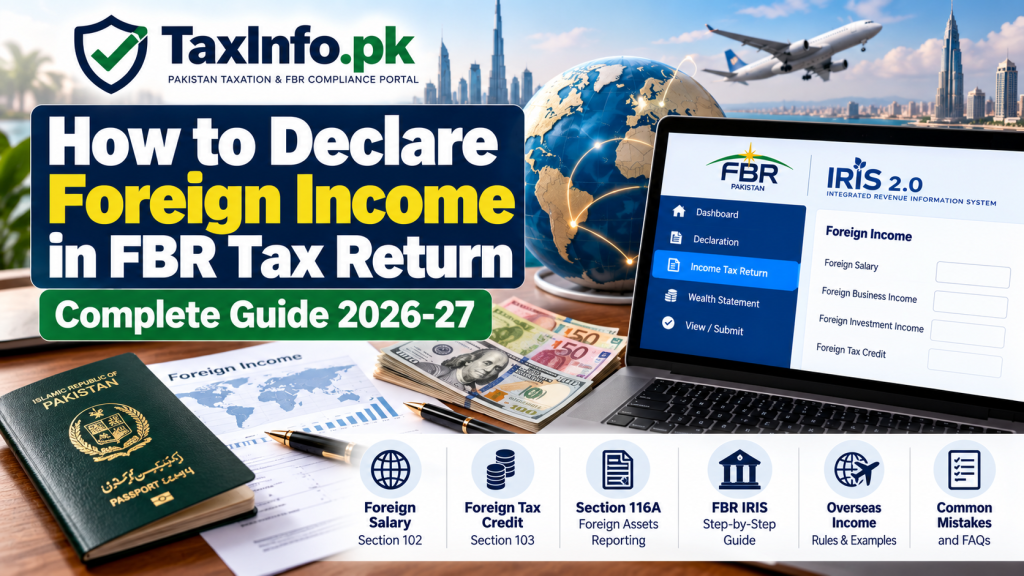
If you earn salary, business income, investment income, rent or other income outside Pakistan, it is important to understand how to Declare Foreign Income in FBR Tax Return correctly.
Foreign income does not have exactly the same tax treatment for every Pakistani taxpayer.
Your residential status, type of foreign income, foreign tax already paid, foreign assets and certain exemptions under the Income Tax Ordinance can all affect the final treatment.
For Tax Year 2027, this guide explains the practical FBR IRIS process, foreign tax credit, foreign salary rules, foreign assets reporting and common mistakes to avoid.
Table of Contents
Declare Foreign Income in FBR Tax Return — First Check Your Residential Status
Before entering foreign income in IRIS, determine whether you were a resident or non-resident for the relevant tax year.
This distinction is extremely important.
The Income Tax Ordinance contains separate rules for resident and non-resident persons and specific provisions dealing with foreign-source income of residents.
Do not assume that Pakistani citizenship automatically decides the tax treatment of every foreign receipt.
Similarly, simply having an overseas bank account does not by itself tell you whether the income is taxable in Pakistan.
Your residential status for the relevant tax year must be determined under the applicable provisions of the Income Tax Ordinance.
What Is Foreign-Source Income?
Foreign-source income can arise in several ways.
Examples include:
- salary earned from employment exercised outside Pakistan;
- overseas freelance or professional income;
- profit or income from a foreign business;
- rent from property located outside Pakistan;
- foreign dividends;
- profit or interest from overseas investments or bank accounts;
- gains from foreign assets, subject to applicable provisions; and
- other income whose geographical source is outside Pakistan.
The correct tax treatment depends on both the nature of the income and the taxpayer’s status.
Do not simply classify every overseas receipt as “foreign remittance.”
A remittance describes movement of money. It does not necessarily describe the original source or tax character of the income.
Step 1 — Collect Your Foreign Income Records
Before opening your return in IRIS, collect the documents relating to your foreign income.
Useful records may include:
- foreign salary certificate;
- employment contract;
- overseas payslips;
- foreign bank statements;
- freelance invoices;
- business accounts;
- dividend statements;
- overseas rental records;
- investment statements;
- evidence of foreign tax deducted or paid;
- foreign tax return, where applicable;
- proof of ownership of foreign assets;
- remittance records; and
- exchange-rate calculations used for Pakistani tax reporting.
Maintaining evidence is particularly important where you intend to claim foreign tax relief or need to explain the source of funds appearing in Pakistan.
Step 2 — Log In to FBR IRIS
Open the official FBR IRIS portal and log in with your CNIC/NTN and password.
Select the Income Tax Return for the correct tax year.
For this article, we are dealing with:
Tax Year 2027
FBR identifies IRIS as its online portal for filing Income Tax Returns.
If you need help with the complete return-filing process, read How to File Income Tax Return Online in Pakistan.
Always confirm the selected tax year before entering foreign income.
Step 3 — Identify the Correct Head of Income
Foreign income should not automatically be placed into one generic category merely because it originated outside Pakistan.
Its underlying nature still matters.
For example:
Foreign employment income → Salary
Foreign business/professional income → Business, where applicable
Foreign property rent → Relevant property-income treatment
Foreign investment income → Appropriate applicable head
This distinction becomes important when determining taxable income, exemptions, deductions and foreign tax relief.
The geographical source of the income and the head of income are related but separate questions.
Foreign Salary and Section 102
Foreign salary has an important specific rule.
Under Section 102, foreign-source salary received by a resident individual is exempt from tax where the individual has paid foreign income tax in respect of that salary.
For this purpose, a resident individual can be treated as having paid foreign income tax where tax was withheld from the salary by the employer and paid to the revenue authority of the foreign country in which the employment was exercised.
This makes evidence important.
Keep documents showing:
- gross foreign salary;
- foreign tax withheld;
- employer details;
- country of employment; and
- proof that the relevant foreign tax was paid or withheld.
Do not assume that every foreign salary is automatically tax-free merely because it was earned abroad.
The statutory conditions must be satisfied.
Step 4 — Determine Whether Foreign Tax Was Already Paid
Pakistan’s tax law also contains a foreign tax credit mechanism.
Section 103 generally provides a foreign tax credit where a resident taxpayer derives foreign-source income chargeable to tax in Pakistan and foreign income tax has been paid in respect of that income.
The credit is limited to the lower of:
Foreign income tax paid
or
Pakistan tax payable in respect of that foreign income
This prevents the foreign tax credit from automatically exceeding the Pakistani tax attributable to the same income.
Foreign Tax Credit Example
Suppose a resident taxpayer has foreign-source income that is taxable in Pakistan.
Foreign income:
Rs. 2,000,000
Assume foreign tax actually paid:
Rs. 250,000
Assume Pakistan tax attributable to that income:
Rs. 300,000
The Section 103 foreign tax credit would generally be limited to the lower amount:
Foreign tax paid: Rs. 250,000
Pakistan tax attributable: Rs. 300,000
Therefore, maximum credit:
Rs. 250,000
Now reverse the situation.
Suppose foreign tax paid was:
Rs. 400,000
but Pakistan tax attributable to the foreign income was:
Rs. 300,000
The foreign tax credit would generally be limited to:
Rs. 300,000
The excess foreign tax does not automatically become an unlimited credit against unrelated Pakistani tax.
Foreign Salary vs Foreign Tax Credit
It is useful to distinguish Section 102 from Section 103.
Section 102 specifically deals with foreign-source salary of resident individuals where the required foreign income tax has been paid.
Section 103 provides the foreign tax credit mechanism for foreign-source income chargeable to tax in Pakistan where qualifying foreign income tax has been paid.
Therefore, do not apply the same treatment mechanically to every foreign income source.
First identify the type of income and then apply the relevant provision.
Step 5 — Convert Foreign Currency Correctly
Foreign income earned in dollars, pounds, dirhams, riyals, euros or another currency must ultimately be dealt with appropriately when completing Pakistani tax information.
Do not randomly choose a convenient exchange rate merely to reduce the declared amount.
Maintain a consistent and supportable conversion method and keep your calculation records.
For example, if foreign income was:
USD 20,000
the Pakistani rupee amount used for tax reporting should be based on the appropriate conversion methodology applicable to the transaction and tax reporting period.
Keep the original foreign-currency figures as supporting records.
Step 6 — Report Foreign Assets Where Required
Foreign income and foreign assets are not the same thing.
You can have:
foreign income without owning a major foreign asset
or
foreign assets that continue to exist even when they generate little or no current-year income.
Examples of foreign assets can include:
- foreign bank accounts;
- property outside Pakistan;
- shares in foreign companies;
- overseas investment accounts;
- foreign business interests; and
- other assets located outside Pakistan.
Where applicable, foreign assets should also be correctly reflected in the taxpayer’s relevant wealth disclosures.
Section 116A Foreign Income and Assets Statement
Section 116A creates an additional reporting requirement for certain resident individuals.
A resident taxpayer being an individual is required to furnish a Foreign Income and Assets Statement where the person has:
foreign income of not less than USD 10,000
or
foreign assets with a value of not less than USD 100,000.
The statement requires particulars including:
- total foreign assets and liabilities at the end of the tax year;
- foreign assets transferred during the tax year and consideration for the transfer; and
- particulars of foreign income and relevant expenditure.
These thresholds should not be confused with a general tax exemption.
They relate to the specific Section 116A reporting requirement.
Example — Foreign Income Below USD 10,000
Suppose a resident individual earns:
USD 7,000 foreign income
and has no foreign assets reaching the USD 100,000 threshold.
The USD 10,000 Section 116A foreign-income threshold is not met on these facts.
However, this does not automatically mean the foreign income can simply be ignored for income-tax purposes.
The taxpayer must separately determine whether that foreign income is taxable, exempt or otherwise reportable under the relevant provisions.
Section 116A reporting thresholds and taxation of income are separate issues.
Example — Foreign Assets Above USD 100,000
Suppose a resident individual owns foreign property worth:
USD 150,000
but earns only:
USD 5,000 foreign income
The foreign income is below USD 10,000.
However, the foreign assets exceed USD 100,000.
The Section 116A reporting requirement can therefore still apply because the provision uses an “or” test.
You do not need to exceed both thresholds.
Step 7 — Reconcile Foreign Income With the Wealth Statement
Foreign income can also affect the taxpayer’s Wealth Statement.
Suppose a resident taxpayer receives qualifying foreign income and saves part of it.
If that money remains in:
- a Pakistani bank account;
- a foreign bank account;
- an investment;
- property;
- cash; or
- another asset,
the taxpayer’s closing wealth may increase.
The declared income, expenses, transfers and assets should therefore tell a consistent financial story.
FBR states that a Wealth Statement must reconcile before successful submission of the return.
For a practical explanation of reconciliation, see How to Declare Rental Income in FBR Tax Returns, where the Wealth Statement process is also illustrated.
Foreign Remittance Is Not Automatically Foreign Income
This is one of the most important distinctions in foreign-income reporting.
Imagine a person receives Rs. 5 million in Pakistan from an overseas bank account.
The transfer itself does not tell us whether the Rs. 5 million represents:
- current-year salary;
- old accumulated savings;
- sale proceeds of an asset;
- loan repayment;
- gift;
- business income;
- investment proceeds; or
- another source.
Therefore:
Bank transfer ≠ automatic determination of income type
The taxpayer should maintain evidence showing the actual source of the funds.
This becomes particularly important when explaining wealth increases or large banking transactions.
Foreign Income of Short-Term Resident Individuals
Section 50 contains a special rule for certain short-term resident individuals.
Subject to the statutory conditions, foreign-source income of an individual who is resident solely because of employment and whose presence in Pakistan does not exceed the specified period can qualify for exemption.
However, the exemption does not apply universally.
The provision contains exceptions, including circumstances involving business established in Pakistan and certain foreign-source income brought into or received in Pakistan.
Therefore, a foreign employee temporarily working in Pakistan should not assume the general resident rules apply without considering Section 50.
Returning Pakistani Expatriates
Section 51 provides another important exemption.
A Pakistani citizen who becomes resident after being non-resident in all four tax years immediately preceding the year of becoming resident can qualify for an exemption on foreign-source income in:
the tax year in which the person becomes resident
and
the following tax year.
Section 51 also contains a rule concerning salary earned outside Pakistan where a Pakistani citizen leaves Pakistan during a tax year and remains abroad during that tax year.
Returning expatriates should therefore check Section 51 before assuming their entire foreign income is immediately taxable after returning to Pakistan.
Foreign Losses
Foreign losses also have specific treatment.
Section 104 contains rules dealing with foreign losses.
Do not automatically offset an overseas loss against Pakistani income without checking the statutory restrictions.
Foreign-source income and losses can require source-by-source and category-specific analysis.
This becomes particularly important for taxpayers with overseas businesses, investments or rental properties.
What About Double Taxation Agreements?
Pakistan has agreements with various countries for the avoidance of double taxation.
A Double Taxation Agreement, commonly called a DTA or tax treaty, can affect:
- which country has taxing rights;
- whether income is exempt;
- withholding rates;
- availability of tax credit; and
- treatment of particular income categories.
Therefore, taxpayers with significant foreign income should check whether Pakistan has an applicable tax treaty with the country concerned.
Treaty analysis is especially relevant where both countries appear to tax the same income.
Practical Example — Pakistani Resident With Foreign Freelance Income
Suppose a Pakistani resident provides professional services to overseas clients.
Annual foreign freelance income:
Rs. 3,000,000 equivalent
Foreign tax paid:
Rs. 200,000
The taxpayer should first determine:
- the correct head of income;
- whether the income is foreign-source under the applicable rules;
- whether it is chargeable to tax in Pakistan;
- whether the foreign tax qualifies for Section 103 credit;
- the appropriate Pakistani tax attributable to that income; and
- whether Section 116A reporting is triggered.
The taxpayer should also reconcile any resulting savings or assets through the Wealth Statement.
If you earn income as an independent professional, our Income Tax for Freelancers in Pakistan guide provides additional context.
Practical Example — Pakistani Resident Working Abroad
Consider a resident individual who earns foreign-source salary from employment exercised abroad and foreign income tax is deducted by the overseas employer and paid to that country’s revenue authority.
Section 102 should be reviewed because it specifically deals with foreign-source salary of resident individuals.
The taxpayer should preserve:
- employment evidence;
- salary records;
- foreign tax deduction documents;
- foreign tax payment evidence where available;
- bank statements; and
- remittance records.
Do not classify the transaction solely by looking at the amount transferred to Pakistan.
What If Foreign Income Is Kept Outside Pakistan?
Keeping money in a foreign bank account does not by itself determine whether the underlying income is taxable or reportable.
You still need to consider:
- residential status;
- source of income;
- applicable exemption;
- foreign tax paid;
- Section 116A threshold;
- foreign asset reporting; and
- Wealth Statement implications.
The location of the bank account is only one part of the analysis.
Foreign Assets and Wealth Statement — Avoid Double Counting
Suppose foreign income is earned and retained in an overseas bank account.
Do not accidentally treat:
the income
and
the resulting bank balance
as two separate income amounts.
One is an income flow.
The other is an asset created or increased by that income.
Your return reports income, while the Wealth Statement and foreign asset disclosures deal with the resulting financial position where applicable.
The figures should reconcile without being duplicated.
Common Mistakes When Declaring Foreign Income
Treating every foreign remittance as exempt
The source and legal character of the money must be identified.
Ignoring residential status
Resident and non-resident treatment can differ significantly.
Confusing the Section 116A threshold with a tax-free limit
USD 10,000 foreign income and USD 100,000 foreign assets are thresholds for the specific foreign income and assets statement requirement. They are not general exemptions from income tax.
Failing to claim legitimate foreign tax relief
Where foreign tax has been paid and Section 103 applies, failing to consider the credit can result in unnecessary double taxation.
Claiming more foreign tax credit than allowed
The Section 103 credit is subject to statutory limits.
Ignoring foreign salary rules
Section 102 contains a specific rule for qualifying foreign-source salary.
Forgetting foreign assets
Foreign bank accounts, property and investments can create separate reporting considerations.
Ignoring Section 50 or Section 51
Short-term residents and qualifying returning expatriates can have specific exemptions.
Failing to reconcile the Wealth Statement
Foreign income, remittances, savings and foreign assets should fit logically into the taxpayer’s overall wealth position.
Keeping no evidence of foreign tax
A foreign tax credit or foreign salary exemption should be supported by appropriate records.
Records You Should Keep
FBR states that persons with taxable income are generally required to keep Income Tax Return records for six years.
For foreign income, useful records include:
- foreign tax returns;
- tax certificates;
- payslips;
- employer certificates;
- invoices;
- contracts;
- bank statements;
- foreign property documents;
- investment statements;
- remittance receipts;
- proof of foreign tax payments; and
- exchange-rate calculations.
Good documentation is particularly important where large amounts are transferred between countries.
Frequently Asked Questions
Do Pakistani residents have to declare foreign income?
Foreign-source income of a resident taxpayer must be considered under the applicable provisions of the Income Tax Ordinance. Its ultimate tax treatment depends on the type of income, foreign tax paid and any applicable exemption.
Is foreign salary taxable in Pakistan?
Section 102 provides a specific exemption for foreign-source salary received by a resident individual where the required foreign income tax has been paid. The statutory conditions and supporting evidence should be checked.
What is the foreign income threshold under Section 116A?
A resident individual with foreign income of not less than USD 10,000 or foreign assets worth not less than USD 100,000 is required to furnish the foreign income and assets statement under Section 116A.
Are both Section 116A thresholds required?
No. The law uses an “or” test. Either qualifying foreign income or qualifying foreign assets can trigger the requirement.
Is USD 10,000 of foreign income tax-free in Pakistan?
Not necessarily. USD 10,000 is relevant to the Section 116A statement requirement. It should not be treated as a universal tax-free foreign-income threshold.
Can foreign tax paid be adjusted in Pakistan?
Where Section 103 applies, a resident taxpayer can generally receive a foreign tax credit limited to the lower of qualifying foreign income tax paid or Pakistan tax payable in respect of that foreign income.
Is foreign remittance taxable in Pakistan?
The transfer itself does not determine the answer. You must identify what the remittance represents — such as salary, business income, old savings, gift, loan or sale proceeds — and apply the relevant law.
Do I need to declare a foreign bank account?
Foreign bank accounts can form part of foreign asset and wealth disclosures. Section 116A should also be checked where the applicable foreign asset threshold is reached.
Are returning overseas Pakistanis immediately taxed on all foreign income?
Not necessarily. Section 51 provides a specific exemption for qualifying returning expatriates, subject to its conditions.
Official FBR Resources
For filing, use the official FBR IRIS 2.0 Portal.
FBR’s Income Tax Return Filing Guide explains the Return of Income, Wealth Statement and reconciliation process.
For current legal provisions, consult the FBR Income Tax Ordinance and review Sections 50, 51, 81, 82, 101, 102, 103, 104 and 116A as applicable.
FBR also provides a dedicated Section 116A – Foreign Income and Assets Statement resource explaining the foreign income and foreign asset reporting thresholds.
Final Words
Learning how to Declare Foreign Income in FBR Tax Return requires more than simply entering the amount received from abroad.
Start by determining:
1. Your residential status
2. The actual source and nature of the foreign income
3. Whether a specific exemption applies
4. Whether foreign tax has already been paid
5. Whether Section 103 foreign tax credit is available
6. Whether Section 116A reporting is triggered
7. How the foreign income, remittances and foreign assets affect your Wealth Statement
The most important practical rule is to keep the income, remittance and asset concepts separate.
Money transferred to Pakistan is not automatically a new source of income, while money kept abroad does not automatically disappear from the taxpayer’s reporting obligations.
Maintain proper records and make sure your Income Tax Return, foreign income disclosures, foreign assets and Wealth Statement tell one consistent financial story.