
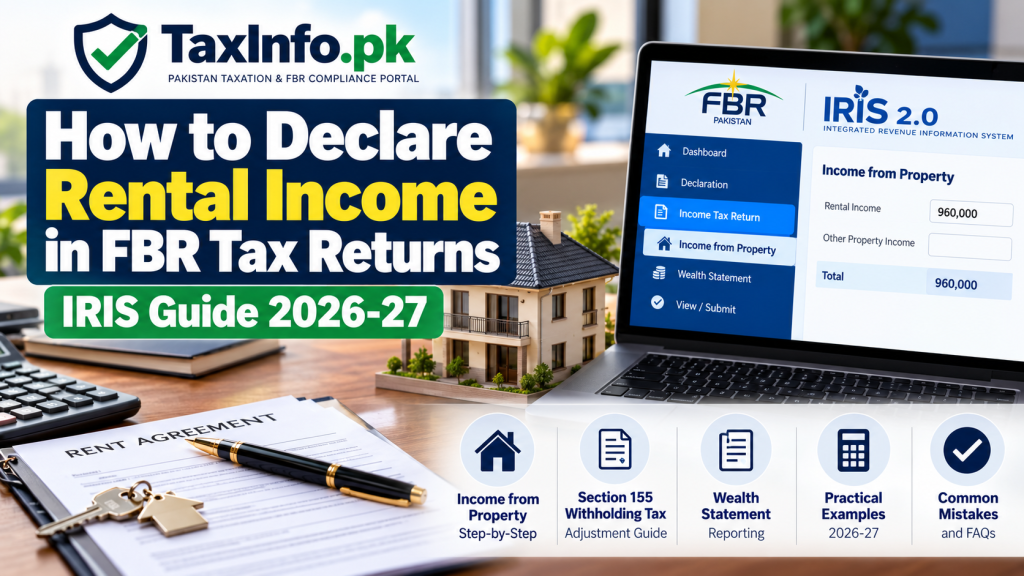
If you receive rent from a house, apartment, shop, office, commercial building or other immovable property, it is important to correctly Declare Rental Income in FBR Tax Returns.
Rental income is generally reported under the head Income from Property. However, entering the annual rent is only one part of the process.
A landlord may also need to deal with Section 155 withholding tax, other sources of income, the property shown in the Wealth Statement, personal expenses and wealth reconciliation before the FBR IRIS return can be successfully submitted.
This guide explains the practical.
Table of Contents
Before You Declare Rental Income in FBR Tax Returns
Before opening the return, collect the information you will need.
Keep the following available:
- total rent received or receivable during the tax year;
- monthly rent amount;
- rent or tenancy agreement;
- property ownership details;
- tenant information where relevant;
- details of advance rent, if any;
- withholding tax deducted from rent;
- evidence or certificate of tax deducted;
- details of any other amounts received with the rent; and
- property value and other information required for the Wealth Statement.
Do not calculate rental income simply by checking how much money reached your bank account.
If the tenant deducted withholding tax before paying you, the amount deposited into your account can be lower than the relevant gross rent.
Step 1 — Understand Whether the Receipt Is Income from Property
Section 15 of the Income Tax Ordinance generally charges rent received or receivable by the owner of land or a building under the head:
Income from Property
Therefore, if you own a house and rent it to another person, the rent will generally fall under this head.
The same principle can apply to qualifying rent from:
- houses;
- flats;
- shops;
- offices;
- warehouses;
- commercial buildings; and
- land.
However, special situations require care.
For example, an amount charged for certain amenities, utilities or other services connected with a rented building can have different treatment. Similarly, leasing a building together with plant and machinery can fall under a different head of income.
For the underlying tax rules, Section 155 rates and practical calculations, first read Rental Income Tax in Pakistan 2026-27 – Complete Guide.
Step 2 — Log In to FBR IRIS and Open the Correct Return
Open the official FBR IRIS portal and sign in using your registration credentials.
Select the Income Tax Return applicable to the correct tax year.
For this guide, we are discussing:
Tax Year 2027
Always confirm the tax year before entering figures.
Entering otherwise correct rental information in the wrong tax year’s return can create unnecessary problems.
FBR confirms that IRIS is its online portal for filing Income Tax Returns.
If you need the complete return-filing process rather than only the rental-income portion, see How to File Income Tax Return Online in Pakistan.
Step 3 — Open the Income from Property Section
Inside the applicable Income Tax Return, locate the area dealing with:
Income from Property
This is where qualifying rental income under Section 15 should generally be reported.
The exact labels, layout or fields displayed in IRIS can change as FBR updates the electronic return, so use the current form available for the selected tax year rather than relying blindly on screenshots from an older return.
The important principle is:
Rental property income → Income from Property
Do not enter ordinary rental income under Salary simply because you are otherwise a salaried taxpayer.
Similarly, do not automatically enter it as Business Income merely because you receive rent regularly.
Its classification should follow the applicable provisions of the Income Tax Ordinance.
Step 4 — Calculate the Annual Rental Income Correctly
Suppose you own a shop that remained rented for the entire tax year.
Monthly rent:
Rs. 80,000
Rental period:
12 months
Annual rent:
Rs. 80,000 × 12
= Rs. 960,000
The annual rental amount is therefore Rs. 960,000 before considering the separate effect of withholding tax deducted by a prescribed tenant.
Do Not Use Only the Net Bank Receipt
Assume the gross rent is:
Rs. 960,000
but the tenant deducts applicable tax before paying you.
If your actual bank receipts are lower because tax was withheld, this does not automatically mean the lower bank amount is your gross rental figure.
You need to distinguish between:
Gross rental income
and
tax already deducted from that payment.
This distinction is extremely important when preparing the return.
Step 5 — Check Section 155 Withholding Tax
A prescribed person paying rent of immovable property may be required to deduct tax under Section 155.
This means the landlord can receive:
Gross rent
minus
Section 155 withholding tax
=
Net amount actually paid
The withholding amount and the rental income should not be confused with each other.
Simple Example
Assume the annual gross rent is:
Rs. 1,200,000
For an ATL individual/AOP, the applicable Tax Year 2027 Section 155 calculation at this level is:
Rs. 15,000 + 10% of the amount exceeding Rs. 600,000
Excess:
Rs. 1,200,000 − Rs. 600,000
= Rs. 600,000
Tax:
Rs. 15,000 + Rs. 60,000
= Rs. 75,000
Therefore, the landlord could have:
Gross rent: Rs. 1,200,000
Section 155 withholding: Rs. 75,000
Balance after withholding: Rs. 1,125,000
The Rs. 1,125,000 net receipt should not simply replace the gross rental figure without considering the proper tax-return treatment.
For a broader explanation of tax deducted at source, see Withholding Tax in Pakistan 2026-27.
Step 6 — Claim/Adjust Rental Withholding Tax Correctly
Where tax has actually been deducted under Section 155, check the withholding information available against your taxpayer profile and supporting records.
The rental income and the withholding tax perform different functions in the return:
Rental income reports the income.
Withholding tax records tax already deducted/paid against the relevant transaction, subject to the applicable law.
Do not artificially reduce gross rental income merely to account for withholding.
Also avoid claiming a withholding amount merely because you calculate that the tenant should have deducted it.
Use the amount actually deducted and supported by the relevant FBR/tax records.
If there is a mismatch, investigate it before submission.
For more detail on how withholding works, read FBR Withholding Tax Rates 2026-27.
Step 7 — Report the Rental Property in the Wealth Statement
This step is frequently overlooked.
Reporting rental income in the Income Tax Return and reporting the underlying asset in the Wealth Statement are connected but separate matters.
If you own the property from which the rental income is being earned, review the relevant asset information in your Wealth Statement.
The figures should make logical sense together.
For example:
Income Tax Return: Rental income from property
Wealth Statement: Property/asset owned by taxpayer, where applicable
A return showing substantial rental income while the taxpayer’s wealth information gives no reasonable indication of the relevant property can create an inconsistency that should be reviewed before filing.
Wealth Statement Reconciliation Is Important
FBR requires the Wealth Statement to reconcile before successful submission.
In simple terms, the change between your previous and current wealth should be explainable through your declared inflows and outflows.
Rental income can form part of the income/inflow side of this overall picture.
Consider a simplified example.
Opening net assets:
Rs. 10,000,000
Rental and other income during the year:
Rs. 2,000,000
Personal and other explained outflows:
Rs. 1,200,000
All else being equal, the remaining Rs. 800,000 can contribute toward the increase in closing wealth.
Real Wealth Statements can contain many more items, but the underlying idea is that your declared income, expenses and change in wealth should reconcile.
Do not force reconciliation by entering an invented amount under “Other” merely to make the difference zero.
The entries should be supported by the taxpayer’s actual financial position.
Example — Salary Plus Rental Income
Consider an individual who earns both salary and rent.
Annual salary:
Rs. 1,800,000
Annual gross rental income:
Rs. 720,000
The taxpayer should not ignore the rental income simply because salary is the main source of earnings.
The return may contain income under different heads:
Salary → Salary
Qualifying rent → Income from Property
The applicable tax computation then considers the taxpayer’s taxable position under the current law.
This is one reason taxpayers with multiple sources of income should not assume that a return designed around salary alone covers every source automatically.
What If the Property Was Rented for Only Part of the Year?
Report the amount relevant to the period for which rent was received or receivable during the applicable tax year, subject to the law.
For example:
Monthly rent:
Rs. 50,000
Property rented for:
8 months
Basic rental calculation:
Rs. 50,000 × 8
= Rs. 400,000
Do not automatically multiply the monthly amount by 12 if the property was genuinely not rented for the whole year.
Maintain records showing when the tenancy started or ended.
What If Rent Was Increased During the Year?
Calculate each period separately.
For example:
First 6 months:
Rs. 50,000 × 6 = Rs. 300,000
Next 6 months:
Rs. 60,000 × 6 = Rs. 360,000
Total annual rent:
Rs. 660,000
This is more accurate than applying either the old or new monthly rent to the entire year.
What About Advance Rent?
Advance rent requires careful treatment.
Section 15 contains specific rules concerning amounts received by an owner that are not adjustable against rent, including rules that can spread qualifying amounts over multiple tax years.
Therefore, do not automatically treat every security deposit or advance received from a tenant in exactly the same way.
First determine whether the amount is:
- refundable security;
- adjustable advance rent;
- non-adjustable amount;
- forfeited amount; or
- another payment connected with the tenancy.
The legal character of the payment matters.
What If Rent Is Lower Than Fair Market Rent?
Section 15 also contains a fair-market-rent rule.
Where rent received or receivable is below the fair market rent of the property, the law can treat the taxpayer as having derived fair market rent for the relevant period, subject to the statutory exception.
Therefore, deliberately putting an artificially low rent in an agreement should not be treated as a safe method of reducing taxable rental income.
This rule is explained in detail in our Rental Income Tax Pakistan guide.
Can an Individual Deduct Property Expenses?
Be careful with older online guides.
The current Section 15A deduction framework applies to a company deriving income chargeable under the head Income from Property.
Therefore, an individual landlord should not automatically claim items such as a 20% repair allowance merely because an old article, video or calculator says such a deduction is universally available.
Use the provisions applicable to your taxpayer category and current tax year.
Section 155 Withholding Is Not the Same as Rental Income
This distinction is worth repeating because it causes many filing errors.
Suppose:
Gross rental income = Rs. 1,200,000
Section 155 withholding = Rs. 75,000
The correct conceptual treatment is not:
Rental income = Rs. 1,125,000
Instead, think of the transaction as:
Rental income: Rs. 1,200,000
Tax withheld: Rs. 75,000
Cash received after withholding: Rs. 1,125,000
The exact return fields should then be completed according to the current IRIS form and applicable tax treatment.
Check Your ATL Status
ATL status can affect withholding tax rates on rental payments.
A landlord who is not appearing on the Active Taxpayers List can face higher withholding treatment where the applicable provisions prescribe it.
Do not rely merely on having an NTN or having filed a return sometime in the past.
Check the taxpayer’s actual current status.
Our Active Taxpayer vs Non-Active Taxpayer in Pakistan guide explains the distinction.
Review Before Submitting the Return
Before pressing Submit, perform a final rental-income review.
Check that:
- the correct Tax Year is selected;
- annual rental income has been calculated correctly;
- qualifying rent is under Income from Property;
- gross and net rent have not been confused;
- Section 155 withholding is supported by records;
- other income has also been declared;
- the property information is consistent with the Wealth Statement;
- personal expenses are reasonable and complete;
- current and previous wealth reconcile; and
- no figure was inserted merely to force the Wealth Statement difference to zero.
FBR states that both the Return of Income and Wealth Statement must be completed and that successful submission is reflected when the forms move from Draft to Completed Task.
Keep Supporting Records After Filing
Do not delete your records once the return is submitted.
Keep relevant documents such as:
- tenancy agreement;
- rent receipts;
- bank statements;
- property documents;
- withholding certificates;
- CPR/payment evidence where applicable;
- correspondence with the tenant; and
- calculations used to determine annual rental income.
These records can help if a figure later needs to be verified or the return needs to be revised.
What If You Forgot to Declare Rental Income?
Do not ignore the error merely because the return has already been submitted.
FBR states that an Income Tax Return may be revised within five years of the original filing to correct an omission or wrong statement, subject to the applicable revision procedure in IRIS.
The Wealth Statement also has its own revision mechanism.
Therefore, if rental income was accidentally omitted, review the correct revision process rather than carrying the mistake forward into future years.
Common Mistakes When Declaring Rental Income
Reporting only net rent
Do not automatically report only the cash received after Section 155 withholding.
Ignoring rental income because tax was already deducted
Withholding tax and declaration of income are separate concepts.
Using an old Section 15A deduction
Individuals should not blindly use outdated deductions that do not apply to their current legal treatment.
Forgetting the property in the Wealth Statement
Review whether the underlying property is correctly reflected in the taxpayer’s assets.
Declaring rent under the wrong head
Ordinary qualifying property rent generally belongs under Income from Property.
Ignoring other charges received from the tenant
Utilities, amenities or services can require separate tax treatment.
Claiming withholding that was never actually deducted
Verify tax records rather than estimating a credit yourself.
Forcing Wealth Statement reconciliation
Never invent gifts, cash, loans or “other” inflows merely to make the unreconciled amount zero.
Frequently Asked Questions
Where is rental income declared in an FBR return?
Qualifying rent from land or buildings is generally declared under Income from Property in accordance with Section 15.
Do I have to declare rent if the tenant already deducted tax?
Yes. Tax deducted under Section 155 and declaration of the underlying rental income are separate issues. Withholding does not mean the income itself should simply disappear from the return.
Should I enter gross rent or rent received after withholding?
You should distinguish the gross rental income from tax withheld at source. Do not automatically reduce rental income merely because Section 155 tax was deducted before the balance was paid to you.
Do I need to show the rented property in my Wealth Statement?
If you own the property, review and correctly report the relevant asset information in your Wealth Statement. Your return and wealth information should be internally consistent.
Can I declare rental income together with salary?
Yes. A taxpayer can have more than one head of income. Salary can be reported under Salary while qualifying rental income is reported under Income from Property.
Can I claim Section 155 tax in my return?
Tax actually deducted under the applicable provision should be dealt with according to its legal treatment and supported by the relevant withholding records. Do not claim an amount merely because it should theoretically have been deducted.
What if my property remained vacant for several months?
Calculate the rental position according to the actual period and applicable Section 15 rules. Do not automatically assume twelve months of actual rent where the property was genuinely vacant for part of the year.
Can I revise my return if I forgot rental income?
FBR states that an Income Tax Return can generally be revised within five years of the original filing to correct an omission or wrong statement, subject to the applicable IRIS revision process.
Official FBR Resources for Rental Income and Tax Return Filing
For the latest rules and filing requirements, taxpayers should always verify information from official FBR resources.
You can access the FBR IRIS 2.0 Portal to prepare and submit your Income Tax Return and Wealth Statement online.
FBR also provides an official Income Tax Return Filing Guide explaining the return filing process, Wealth Statement requirements, reconciliation and successful submission through IRIS.
For the legal provisions governing Income from Property, including Section 15 and related provisions, refer to the latest Income Tax Ordinance, 2001 published by the Federal Board of Revenue.
Taxpayers dealing with rent withholding can also check the latest FBR Withholding Taxes Rate Card for current withholding tax rates and applicable provisions.
Final Words
Learning how to Declare Rental Income in FBR Tax Returns is not just about entering one annual figure.
A correct filing should connect:
Rental property → Income from Property
Gross rent → annual rental income
Section 155 deduction → withholding tax record
Owned property → Wealth Statement
Rental and other income → wealth reconciliation
Before submitting the return, compare your rent agreement, bank receipts, withholding records, Income from Property figures and Wealth Statement.
If all of these tell the same financial story, the return is much easier to review and support later.
For the legal basis, refer to the official FBR Income Tax Ordinance, 2001, currently listed by FBR as amended up to 30 June 2026, and use the current electronic return available in IRIS for the relevant tax year.