
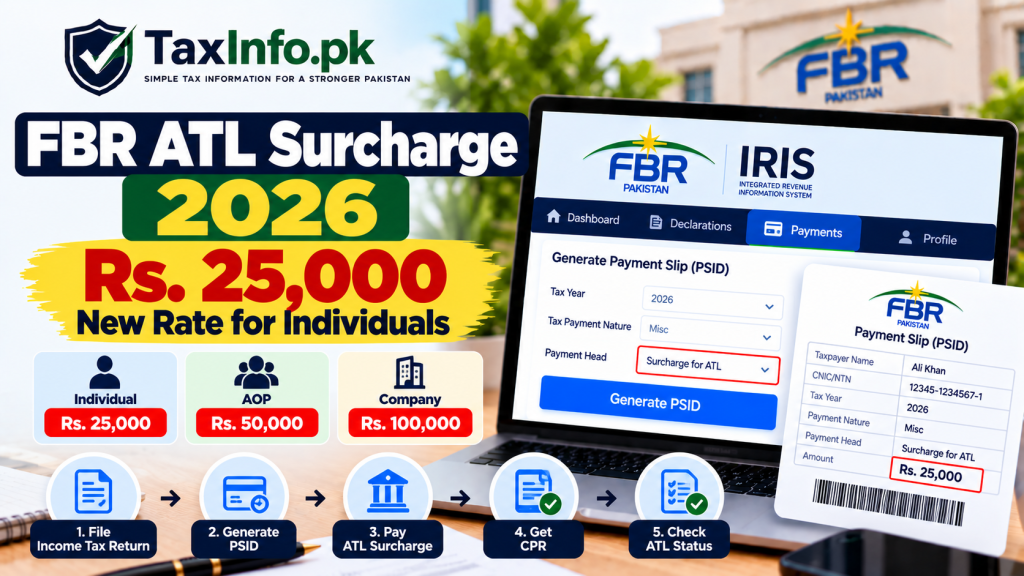
Pakistan’s rules for late filers have become significantly more expensive. The FBR ATL Surcharge 2026 for an individual has increased from the previous Rs. 1,000 to Rs. 25,000, while higher amounts apply to an Association of Persons (AOP) and a company.
The ATL surcharge is relevant when a taxpayer files an Income Tax Return after the applicable due date or extended due date and wants to be included in the Active Taxpayer List (ATL).
Under the 2026 amendment to section 182A of the Income Tax Ordinance, the surcharge amounts have been increased to Rs. 25,000 for an individual, Rs. 50,000 for an AOP and Rs. 100,000 for a company.
This guide explains the new FBR ATL surcharge rates, who may have to pay the surcharge, how to generate the payment through FBR’s system, and how to check your ATL status after payment.
Table of Contents
What Is FBR ATL Surcharge?
The Active Taxpayer List, commonly called the ATL, is maintained by the Federal Board of Revenue to identify taxpayers who satisfy the applicable requirements for active taxpayer status.
Being on the ATL is important because many withholding-tax provisions apply different rates depending on whether a person is an active taxpayer.
A person who files the relevant Income Tax Return within the prescribed due date or valid extended due date can generally qualify for ATL inclusion without paying an ATL surcharge.
However, a person who files after the applicable deadline may have to pay the surcharge prescribed under section 182A of the Income Tax Ordinance, 2001 to obtain ATL inclusion.
FBR has confirmed that taxpayers who file after the due or extended date may still be included in the ATL after payment of the surcharge specified in section 182A.
FBR ATL Surcharge 2026 – New Rates
A major change has been made to the ATL surcharge amounts.
The FBR ATL Surcharge 2026 rates are:
| Taxpayer Type | New ATL Surcharge |
|---|---|
| Individual | Rs. 25,000 |
| Association of Persons (AOP) | Rs. 50,000 |
| Company | Rs. 100,000 |
The 2026 legislative amendment changes the amounts contained in section 182A.
For individuals, the amount previously expressed as one thousand rupees has been changed to twenty-five thousand rupees.
For an AOP, the amount increases to Rs. 50,000.
For a company, it increases to Rs. 100,000.
These are substantial increases, particularly for individual taxpayers who previously faced a much smaller ATL surcharge.
Old vs New ATL Surcharge Rates
The difference becomes clearer when the previous and new amounts are compared.
| Taxpayer | Previous Rate | 2026 Rate | Increase |
|---|---|---|---|
| Individual | Rs. 1,000 | Rs. 25,000 | Rs. 24,000 |
| AOP | Rs. 10,000 | Rs. 50,000 | Rs. 40,000 |
| Company | Rs. 20,000 | Rs. 100,000 | Rs. 80,000 |
For an individual, the surcharge is therefore 25 times the previous Rs. 1,000 amount.
This makes timely return filing much more important than before.
Important Note About Older FBR Webpages
Taxpayers searching online may still encounter an older FBR webpage displaying:
- Individual – Rs. 1,000
- AOP – Rs. 10,000
- Company – Rs. 20,000
Those figures relate to the previous section 182A framework and older FBR guidance.
For the 2026 change, taxpayers should rely on the latest applicable legislation and current FBR system rather than assuming an older webpage reflects the amended rate.
Who Has to Pay ATL Surcharge?
The surcharge is relevant to a taxpayer who files the applicable Income Tax Return after the due date or valid extended due date and seeks inclusion in the ATL under section 182A.
The key distinction is between:
Return Filed on Time
If the relevant return is filed within the prescribed deadline or a valid extension applicable to the taxpayer, ATL surcharge should not arise merely for ATL inclusion on account of late filing.
Return Filed Late
If the relevant return is filed after the applicable due or extended date, section 182A becomes relevant for ATL inclusion.
FBR’s ATL guidance confirms that a late filer can become part of the ATL after paying the required surcharge.
Therefore, filing the late return and becoming active on the ATL should not automatically be treated as the same thing.
Can an Individual Avoid ATL Surcharge Under Section 182A(3)?
Finance Act 2026 introduced a specific exception under Section 182A(3) of the Income Tax Ordinance, 2001.
The provision states that the surcharge payment conditions under Section 182A(1) do not apply to an individual who furnishes an undertaking before the Commissioner, declaring that the individual will not purchase, acquire or otherwise obtain ownership or beneficial interest in any property for six months from the date of furnishing the undertaking.
The undertaking must be furnished in the prescribed form.
This exception should not be confused with a general waiver for all late filers. Taxpayers should verify the prescribed procedure and their eligibility before relying on it.
Official source: FBR Finance Act 2026.
Why Did the Individual Surcharge Increase to Rs. 25,000?
The increase forms part of the 2026 amendments to the Income Tax Ordinance.
The amendment to section 182A replaces the previous surcharge amounts with significantly higher figures.
For individuals, the change from Rs. 1,000 to Rs. 25,000 is particularly significant.
Practically, the higher surcharge creates a much stronger financial consequence for missing the return-filing deadline and subsequently seeking ATL inclusion.
For taxpayers, the practical lesson is simple:
File your Income Tax Return within the applicable due date whenever possible.
Paying attention to the deadline can now potentially save an individual Rs. 25,000 in ATL surcharge alone.
How to Pay FBR ATL Surcharge
FBR’s published payment guidance identifies “Surcharge for ATL” as a payment option.
According to FBR, late filers can pay the ATL surcharge by selecting:
Tax Payment Nature → Misc → Surcharge for ATL
when creating the PSID.
Official FBR payment guidance:
The exact interface may change as FBR updates its payment systems, but the payment should be generated against the correct taxpayer, Tax Year and ATL surcharge liability.
Step 1: File Your Income Tax Return
Before dealing with ATL surcharge, make sure the Income Tax Return for the relevant Tax Year has actually been filed.
Do not confuse:
Return prepared or saved in Draft
with:
Return successfully submitted
A return left in Draft is not the same as a filed return.
If you want to verify whether your return was successfully submitted, read:
How to Check Filed Income Tax Return in FBR IRIS
Check the relevant Tax Year carefully before generating any surcharge payment.
Step 2: Open the FBR Payment System
Use the official FBR payment facility associated with your taxpayer account.
FBR’s payment guidance explains that taxpayers can access the e-payment facility and create a payment slip for payment of tax liabilities.
Official guidance:
Make sure you are generating the payment for the correct CNIC/NTN and relevant Tax Year.
A payment created against incorrect taxpayer information can create unnecessary complications.
Step 3: Select “Surcharge for ATL”
This is one of the most important steps.
FBR specifically instructs late filers to select:
Tax Payment Nature: Misc
and then select the relevant:
Surcharge for ATL
option.
Do not randomly select another payment head simply because the amount is the same.
The payment must be correctly identified in FBR’s system as the applicable ATL surcharge.
Step 4: Generate the PSID
After selecting the appropriate payment type, generate the Payment Slip ID (PSID).
Before confirming the PSID, carefully check:
- taxpayer name;
- CNIC or NTN;
- relevant Tax Year;
- payment nature;
- ATL surcharge description; and
- amount payable.
For the new FBR ATL Surcharge 2026, the applicable statutory amount depends on taxpayer type:
Individual: Rs. 25,000
AOP: Rs. 50,000
Company: Rs. 100,000
Do not blindly rely on an old screenshot, old article or previous year’s PSID.
Check what the current FBR system generates and verify it against the applicable law.
Step 5: Pay the ATL Surcharge
Once the PSID has been generated, pay it through an FBR-supported payment channel.
Depending on the payment facility available, tax payments may be made through supported banking and alternate delivery channels.
Follow the payment instructions displayed against your PSID.
Most importantly, verify that the payment has been successfully completed.
Generating a PSID alone does not mean the surcharge has been paid.
Step 6: Keep Your CPR
After successful payment, retain the Computerized Payment Receipt (CPR).
The CPR is important evidence that the payment was deposited.
FBR’s payment guidance states that a CPR is generated after payment and that the payment is reflected in IRIS.
Keep a digital copy of:
- PSID;
- CPR;
- payment confirmation; and
- relevant filed Income Tax Return.
These records may be useful if your ATL status does not update as expected.
Step 7: Check Your ATL Status
After payment, check whether your status has become active.
FBR provides multiple ways to check Active Taxpayer status.
Check ATL Online
You can use FBR’s online ATL status verification facility.
Check ATL by SMS
For an individual, FBR provides the following SMS method:
ATL [space] 13-digit CNIC
Send it to:
9966
Use the CNIC without unnecessary formatting where required by the service.
For an AOP or company, FBR states that ATL status can be checked using the relevant NTN through the prescribed SMS format.
You can also read:
How to Check FBR ATL Status in Pakistan
How Long Does ATL Activation Take?
The ATL system has changed significantly from the older weekly-update model.
FBR announced that, following amendments to the Income Tax Rules in October 2024, the Active Taxpayer List is now updated on a daily basis.
FBR also stated that late filers may be included after payment of the surcharge specified under section 182A.
This means taxpayers should no longer assume they must wait for the old weekly ATL update cycle.
However, payment and system records may still require processing.
Therefore, after paying the surcharge:
- keep your CPR;
- allow the payment to reflect in FBR’s system;
- check ATL status again; and
- contact FBR if the status does not update despite fulfilling the applicable requirements.
Can You Become Active Without Paying the Surcharge?
For a taxpayer who has filed the relevant return late, section 182A surcharge is generally linked to ATL inclusion.
FBR’s published guidance specifically states that late filers can obtain inclusion after payment of the prescribed ATL surcharge.
Therefore, simply filing a late return should not be assumed to automatically remove the surcharge requirement for ATL inclusion.
However, taxpayers should always consider the latest statutory provisions and any applicable exceptions or special rules before making payment.
If your case involves a special exemption, extension, system error or another unusual circumstance, verify your position before generating the payment.
ATL Surcharge vs Late-Filing Penalty
An important distinction is often overlooked.
ATL surcharge and a penalty for failure to file a return on time are not necessarily the same thing.
The ATL surcharge under section 182A relates to obtaining inclusion in the Active Taxpayer List after late filing.
Other provisions of the Income Tax Ordinance may separately prescribe penalties or consequences for non-compliance.
Therefore, paying the ATL surcharge should not automatically be interpreted as cancelling every other legal consequence that may arise from late filing.
Similarly, a taxpayer should not assume that every amount described as a late-filing penalty is the section 182A ATL surcharge.
Always identify the legal provision and payment nature involved.
Example 1 – Individual Files Return Late
Suppose an individual was required to file an Income Tax Return by the applicable deadline but failed to do so.
The person later files the return and wants ATL inclusion.
Under the amended FBR ATL Surcharge 2026 framework, the applicable ATL surcharge for an individual is:
Rs. 25,000
After filing the relevant return, the taxpayer would need to deal with the applicable ATL surcharge requirement and verify active status after payment.
Example 2 – AOP Files After the Deadline
Suppose an Association of Persons files its applicable Income Tax Return after the due date and wants ATL inclusion.
The revised section 182A amount for an AOP is:
Rs. 50,000
This is substantially higher than the previous Rs. 10,000 surcharge.
Example 3 – Company Files Late
For a company subject to the ATL surcharge requirement, the amended amount is:
Rs. 100,000
The previous figure was Rs. 20,000.
This makes timely filing particularly important for companies as well.
Why Timely Filing Is Now More Important
The new surcharge amounts materially increase the cost of late compliance.
Previously, an individual facing a Rs. 1,000 ATL surcharge might have viewed the amount as relatively minor.
At Rs. 25,000, that approach can now be expensive.
Taxpayers should therefore:
- know their filing deadline;
- start preparing records early;
- reconcile income and withholding taxes before the deadline;
- avoid waiting until the final day;
- file within a valid extension where applicable; and
- confirm successful submission in IRIS.
A return should not be left in Draft under the assumption that it has already been filed.
Common Mistakes to Avoid
When dealing with ATL surcharge, avoid these common mistakes:
- Relying on the old Rs. 1,000 individual rate
- Assuming filing a late return automatically gives ATL status
- Generating a PSID under the wrong payment head
- Selecting the wrong Tax Year
- Using the wrong CNIC or NTN
- Generating a PSID but forgetting to actually pay it
- Failing to keep the CPR
- Confusing ATL surcharge with other late-filing penalties
- Relying on old FBR screenshots or outdated guides
- Assuming ATL is still updated only weekly
- Paying an amount without first confirming why it is payable
- Failing to check ATL status after payment
Quick ATL Surcharge Checklist
Before payment:
- Confirm that your Income Tax Return has been filed
- Confirm that it was filed after the applicable due/extended date
- Check the relevant Tax Year
- Confirm your taxpayer type
- Verify the applicable surcharge amount
When creating payment:
- Use the correct taxpayer details
- Select the relevant payment facility
- Choose Misc
- Select Surcharge for ATL
- Verify the PSID
- Pay the amount
After payment:
- Save the CPR
- Allow the payment to reflect
- Check ATL status online or through SMS
- Keep your return, PSID and CPR together
Frequently Asked Questions
What is the FBR ATL Surcharge 2026 for an individual?
Under the 2026 amendment to section 182A, the ATL surcharge amount for an individual is Rs. 25,000, compared with the previous Rs. 1,000 amount.
What is the new ATL surcharge for an AOP?
The revised amount for an Association of Persons is Rs. 50,000.
What is the ATL surcharge for a company?
The revised surcharge amount for a company is Rs. 100,000.
Was the individual ATL surcharge previously Rs. 1,000?
Yes. Older FBR guidance shows the previous individual surcharge of Rs. 1,000. The 2026 amendment increases the amount to Rs. 25,000.
How do I pay ATL surcharge?
FBR’s payment guidance says late filers can pay Surcharge for ATL by selecting the Misc head while creating the PSID.
Do I need to file my return before paying ATL surcharge?
The ATL surcharge mechanism relates to late filers seeking ATL inclusion. Make sure the relevant Income Tax Return has actually been filed and that you are dealing with the correct Tax Year before making payment.
Does generating a PSID mean the surcharge is paid?
No. A PSID is the payment slip/reference. The payment itself must be successfully completed. Keep the CPR generated after payment.
How can I check whether I am active after payment?
FBR provides online ATL verification and SMS verification. Individuals can send ATL [space] CNIC to 9966.
Is ATL still updated once a week?
No. FBR announced in October 2024 that ATL would be updated on a daily basis, replacing the previous weekly update mechanism.
Why does an FBR webpage still show Rs. 1,000?
Some older FBR ATL guidance remains accessible online and displays the previous rates. The 2026 legislative amendment changes the section 182A surcharge figures. Always check the latest applicable legislation and current FBR system when making a payment.
Is ATL surcharge the same as a late-return penalty?
Not necessarily. The section 182A surcharge concerns ATL inclusion after late filing. Other provisions may separately impose penalties or other consequences for non-compliance.
Can I simply pay Rs. 25,000 without checking the PSID?
No. First verify that the surcharge applies to your case, select the correct Tax Year and payment nature, and check the details generated by FBR’s system before making payment.
Conclusion
The FBR ATL Surcharge 2026 represents a major change for taxpayers who file their Income Tax Returns after the applicable deadline.
The revised surcharge amounts are:
Individual – Rs. 25,000
AOP – Rs. 50,000
Company – Rs. 100,000
For individuals in particular, the increase from Rs. 1,000 to Rs. 25,000 makes timely return filing much more important.
If you file late and need ATL inclusion, first confirm that your Income Tax Return has been successfully submitted for the correct Tax Year. Then use the appropriate FBR payment facility, select Surcharge for ATL under the relevant payment head, generate and pay the PSID, keep your CPR and check your ATL status afterward.
Because older FBR webpages may still display the previous surcharge figures, always verify the latest applicable law and current FBR system before making payment.
Disclaimer: This article is for general information and educational purposes only and does not constitute legal, tax or professional advice. Tax laws, FBR procedures, surcharge amounts and IRIS/payment-system interfaces may change. Always verify the latest applicable provisions and instructions from the Federal Board of Revenue (FBR) before filing a return or making a payment.