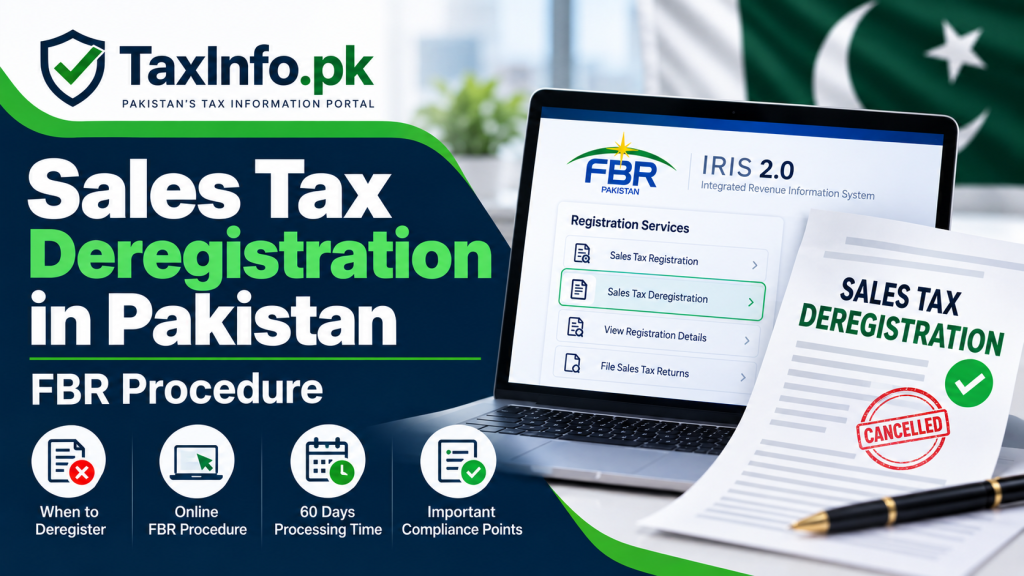
Sales Tax deregistration in Pakistan may be required when a registered person stops carrying on the business, no longer makes taxable supplies, or otherwise ceases to meet the conditions requiring Sales Tax registration.
However, deregistration is not simply a matter of deleting an STRN. The Federal Board of Revenue (FBR) may need to examine the taxpayer’s registration status, outstanding liabilities, previous returns and other compliance matters before the process is completed.
Importantly, the procedure has changed. Under amendments introduced in 2025, an application for Sales Tax deregistration is made through the computerized system, and FBR subsequently clarified that manual deregistration applications should not be entertained.
This guide explains who may apply, how the current FBR procedure works, what happens after an application is submitted, and what happens to previous Sales Tax liabilities.
Table of Contents
What Is Sales Tax Deregistration?
Sales Tax deregistration is the process through which a person who is registered for Sales Tax ceases to remain registered after satisfying the applicable legal and procedural requirements.
Registration may originally have been required because the person was carrying on a taxable business or making supplies falling within the Sales Tax registration regime.
Circumstances can later change.
For example, a business may:
- permanently close;
- stop making taxable supplies;
- move entirely into exempt supplies; or
- cease to meet an applicable registration requirement.
Deregistration formally deals with the person’s Sales Tax registration status.
If you are looking for the opposite process—obtaining Sales Tax registration—see our Sales Tax Registration in Pakistan – FBR IRIS Step-by-Step Guide.
Who Can Apply for Sales Tax Deregistration in Pakistan?
FBR’s guidance identifies situations in which deregistration may become relevant, including where a registered person:
- ceases to carry on the business;
- no longer makes taxable supplies;
- makes only exempt supplies; or
- falls below an applicable registration threshold.
Eligibility should be considered according to the taxpayer’s actual circumstances and the current Sales Tax law.
Falling below a threshold should not automatically be treated as permission to stop Sales Tax compliance immediately. The taxpayer should complete the applicable deregistration process and wait for the registration status to be dealt with through FBR.
Latest FBR Online Sales Tax Deregistration Procedure
A major procedural change was introduced through SRO 608(I)/2025 issued by FBR.
The amendment to Rule 11 of the Sales Tax Rules replaced the previous application wording with a requirement for the deregistration application to be received through the computerized system.
FBR subsequently issued Sales Tax General Order No. 04 of 2025 clarifying that taxpayers seeking deregistration should apply online through the computerized system and that manual applications should not be entertained.
Therefore, taxpayers should follow the current online FBR procedure rather than relying on older guides that describe only a manual application.
Step 1 – Access the FBR Online System
Start with the official FBR IRIS portal and access the taxpayer’s account using the applicable credentials.
Use only official FBR systems for tax-registration matters.
Because FBR can change menu names and interface layouts, follow the current options displayed in IRIS rather than relying entirely on an old screenshot.
Step 2 – Submit the Online Deregistration Application
Use the relevant online deregistration facility available through the computerized system.
Complete the information requested by FBR carefully.
Depending on the taxpayer’s circumstances, relevant information may relate to:
- cessation of business;
- nature of current supplies;
- registration details;
- previous Sales Tax compliance;
- outstanding liabilities; and
- other information required by FBR.
Do not provide a reason for deregistration that is inconsistent with the actual business position.
Step 3 – Provide Required Information and Records
Submitting the request does not necessarily mean that deregistration will be completed immediately.
The Commissioner may require records or information relevant to determining the taxpayer’s position.
Taxpayers should therefore keep their Sales Tax records available, particularly records relating to:
- Sales Tax returns;
- purchases and sales;
- output tax;
- input tax;
- stock and business assets;
- outstanding tax liabilities; and
- previous tax periods.
The exact information required can depend on the circumstances of the business.
Step 4 – Address Outstanding Sales Tax Matters
Deregistration should not be treated as a way of eliminating an existing Sales Tax liability.
The current Sales Tax Rules contemplate examination of the taxpayer’s outstanding liability before the deregistration process is finalized.
If tax remains payable, FBR may require the liability to be addressed according to the applicable law.
This is particularly important for a business that has:
- unpaid Sales Tax;
- unfiled returns;
- unresolved compliance issues;
- stock or assets with Sales Tax implications; or
- an ongoing audit or inquiry.
The appropriate treatment depends on the facts of the case.
Step 5 – FBR Processes the Deregistration
Following the application and applicable examination, FBR deals with the taxpayer’s deregistration under Rule 11.
An important amendment made through SRO 608(I)/2025 was the replacement of the previous 90-day period in the relevant rule with 60 days.
However, taxpayers should not interpret this as an unconditional guarantee that every practical issue will always be completed exactly within 60 calendar days regardless of outstanding information, liability, audit or other compliance matters.
Where FBR requires action from the taxpayer, delays may depend on the circumstances of the case.
Is a Manual Sales Tax Deregistration Application Still Accepted?
The current procedure is online.
FBR’s Sales Tax General Order No. 04 of 2025 specifically instructed that persons seeking Sales Tax deregistration should apply online through the computerized system.
The order further states that manual applications for deregistration shall not be entertained.
Therefore, taxpayers should be cautious when following older online guides that still describe deregistration primarily as a manual application to the Commissioner.
The later FBR amendments and instructions should be considered when following the current procedure.
How Long Can Sales Tax Deregistration Take?
Rule 11 was amended in 2025 so that the relevant period was reduced from 90 days to 60 days.
This is an important change because older FBR pages or third-party guides may still refer to 90 days.
However, the actual handling of a particular case can depend on whether FBR requires:
- additional records;
- payment or determination of liability;
- completion of an audit or inquiry;
- correction of compliance defaults; or
- other action by the taxpayer.
For that reason, the statutory/procedural period should not be presented as a guaranteed completion date for every case.
What Happens to Sales Tax Returns After Applying?
The amended Sales Tax Rules contain an important provision regarding return filing after an online deregistration application is received.
Subject to the applicable Rule 11 provisions, the obligation to file monthly Sales Tax returns is suspended from the date the deregistration application is received through the computerized system until the person is deregistered or the application is rejected.
This point is important because taxpayers may otherwise assume either:
- that they must continue filing in exactly the same manner indefinitely; or
- that simply deciding to deregister automatically ends every compliance obligation.
Neither assumption should be made without considering the current Rule 11 procedure.
If the application is rejected, the taxpayer should follow the resulting FBR status and applicable compliance requirements.
Does Deregistration Remove Previous Sales Tax Liabilities?
No.
Deregistration does not erase tax obligations relating to periods during which the person carried on the registered business.
The Sales Tax Rules make clear that cancellation of registration does not relieve the person of liabilities and obligations relating to the period when the person conducted business as a registered person.
This means previous matters can remain relevant after deregistration, including:
- unpaid Sales Tax;
- previous returns;
- assessments;
- audits;
- inquiries;
- record-keeping obligations; and
- other liabilities arising from earlier tax periods.
A taxpayer should therefore not use deregistration as a substitute for resolving previous compliance issues.
Deregistration vs Suspension of Sales Tax Registration
Deregistration and suspension should not be treated as the same thing.
Deregistration generally concerns ending the Sales Tax registration where the applicable requirements are satisfied.
Suspension is a different status and may arise in connection with compliance or enforcement issues.
A suspended taxpayer should not simply assume that suspension means the business has successfully been deregistered.
Similarly, a deregistration application should not be confused with an FBR action suspending or blocking registration.
After the process is completed, taxpayers can use the procedures explained in our Check STRN Online in Pakistan – FBR Sales Tax Verification Guide to review the relevant Sales Tax status.
Can FBR Deregister a Taxpayer Itself?
Sales Tax law also provides mechanisms through which registration can be dealt with by FBR in appropriate circumstances.
A taxpayer should therefore not assume that deregistration can occur only when the taxpayer voluntarily requests it.
However, the legal basis and consequences can vary according to the reason for FBR’s action.
Where registration is being cancelled, suspended or otherwise affected by an FBR enforcement or compliance action, the taxpayer should review the relevant notice/order and obtain professional advice where necessary.
What Happens to Sales Tax Invoices After Deregistration?
A person who has completed deregistration should not continue presenting the business as though it remains an active Sales Tax-registered supplier where this is no longer legally correct.
Sales Tax invoices have specific legal requirements.
For details, see our Sales Tax Invoice Requirements in Pakistan guide.
Businesses should also ensure that accounting, invoicing and tax systems are updated after deregistration so that Sales Tax is not incorrectly charged or reported.
Common Sales Tax Deregistration Mistakes
1. Simply Stopping Sales Tax Returns
Stopping business activity does not necessarily mean the Sales Tax registration has automatically disappeared.
Use the proper FBR deregistration procedure.
2. Following an Old Manual Procedure
Older material may describe a manual deregistration application.
Current FBR instructions require taxpayers seeking deregistration to apply through the computerized system.
3. Assuming Deregistration Erases Old Tax
Previous Sales Tax liabilities and obligations can survive deregistration.
Resolve outstanding compliance issues appropriately.
4. Ignoring FBR Requests for Information
If FBR requests records or information, failure to respond can delay or affect the application.
5. Treating the 60-Day Period as an Absolute Guarantee
The rule now contains a 60-day period instead of the older 90-day period, but an individual case can involve unresolved tax, audit, inquiry or information requirements.
6. Continuing to Charge Sales Tax Incorrectly
Once deregistration has been completed, business invoicing and accounting processes should reflect the correct registration status.
How to Check Whether Deregistration Has Been Completed
Do not rely solely on the fact that an application was submitted.
Check the resulting status through the relevant FBR facilities and review any order or communication issued through the taxpayer’s account.
You can follow our Check STRN Online in Pakistan guide to understand the difference between Sales Tax registration information and Sales Tax ATL status.
Keep a copy of relevant FBR orders and records for future reference.
Frequently Asked Questions
Can I deregister from Sales Tax online in Pakistan?
Yes. Under the current procedure, a person seeking Sales Tax deregistration applies through the computerized system. FBR has instructed that manual deregistration applications should not be entertained.
How long does FBR Sales Tax deregistration take?
Rule 11 was amended in 2025 to replace the previous 90-day period with 60 days. However, the circumstances of an individual case, including outstanding liability, records, audit or inquiry matters, can affect practical processing.
Do I need to file Sales Tax returns after applying for deregistration?
The amended rules provide for suspension of the monthly Sales Tax return filing obligation from the date the online application is received until deregistration or rejection of the application, subject to the applicable Rule 11 provisions.
Does closing my business automatically cancel my STRN?
No. Business closure can be a reason for deregistration, but the applicable FBR deregistration procedure should still be completed.
Does Sales Tax deregistration remove old tax liabilities?
No. Deregistration does not remove liabilities and obligations relating to periods during which the registered business was conducted.
Can FBR ask for records before deregistration?
Yes. Records, liability determination and other compliance matters can be relevant to the deregistration process.
Can I submit a manual deregistration application to FBR?
Current FBR instructions require persons seeking deregistration to apply online through the computerized system and state that manual applications shall not be entertained.
How can I confirm that my STRN has been deregistered?
Review the relevant FBR order/account status and use the appropriate FBR verification facilities. Remember that Sales Tax registration status and Sales Tax ATL status are related but not identical.
Final Words
Sales Tax deregistration in Pakistan is a formal FBR compliance process, not simply a decision to stop filing returns or stop using an STRN.
The current procedure requires taxpayers seeking deregistration to apply through the computerized system. The 2025 amendments also reduced the relevant period in Rule 11 from 90 days to 60 days and introduced important treatment for monthly Sales Tax return filing after an online deregistration application is received.
Before applying, review outstanding returns, liabilities, records and any pending FBR matters.
After the process is completed, verify the resulting Sales Tax status and keep the relevant FBR documentation for your records.