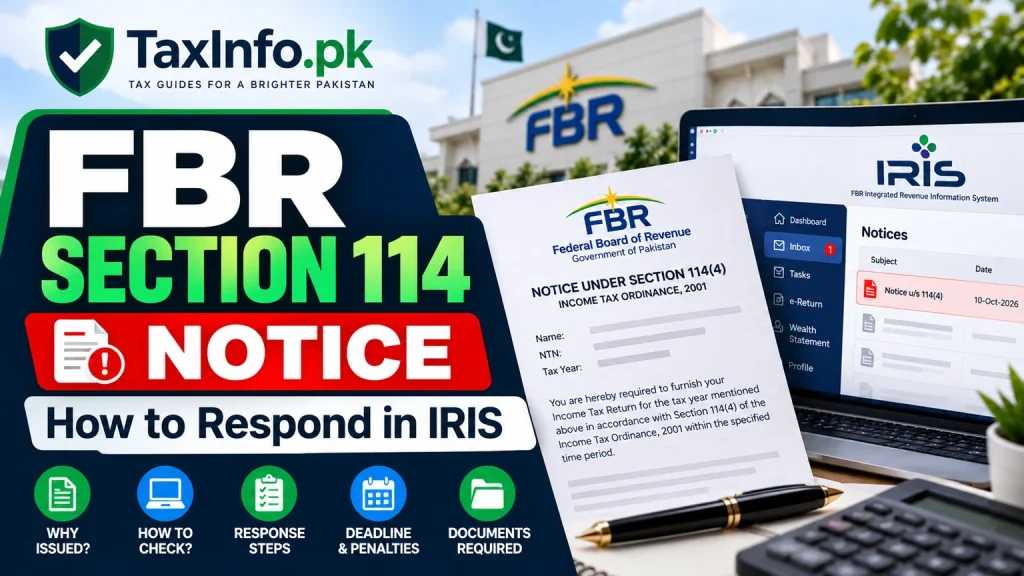
FBR Section 114 Notice is an important income tax compliance notice issued under Pakistan’s Income Tax Ordinance, 2001. If you receive a notice under Section 114(4), it generally means that the Federal Board of Revenue (FBR) considers you legally required to file an income tax return for a particular tax year but has not received the required return.
Receiving this notice does not automatically mean that you have committed tax fraud or that FBR has determined a specific amount of additional tax against you.
However, ignoring the notice can lead to further proceedings, potential penalties and other legal consequences.
This guide explains why FBR issues Section 114 notices, how to check them in IRIS, how to respond, what happens if the deadline is missed, and which documents may be required.
Table of Contents
1. What Is an FBR Section 114 Notice?
Section 114 of the Income Tax Ordinance, 2001 deals with the obligation to furnish an income tax return.
Under Section 114(4), the Commissioner may issue a written notice requiring a person to file a return where the Commissioner considers that the person was required to file but failed to do so.
The notice generally identifies:
- The taxpayer’s name and registration details.
- The relevant tax year.
- The legal provision under which the notice is issued.
- The requirement to furnish a return of income.
- The deadline for compliance.
- The issuing tax authority.
For the official law, refer to the FBR Income Tax Ordinance, 2001.
Is Section 114 a Tax Demand Notice?
Not necessarily.
A Section 114(4) notice primarily concerns the requirement to file a return of income.
It should not be confused with a tax assessment order, recovery notice or notice seeking an explanation of unexplained assets.
Any additional tax liability depends on the taxpayer’s actual income, applicable tax rules, credits, deductions and subsequent proceedings.
2. Why Does FBR Issue a Section 114 Notice?
FBR may issue a Section 114(4) notice where its records or available information indicate that a person was legally required to submit an income tax return but did not do so.
Common situations include the following.
A. A Previous Tax Return Was Not Filed
A taxpayer may have submitted returns in earlier years but failed to file for a later year despite continuing to meet the filing requirements.
B. The Taxpayer Has a Business or Professional Income
A person carrying on business or earning professional income may be required to file depending on the applicable statutory conditions.
C. The Taxpayer Owns Certain Assets
Section 114 includes filing obligations linked to specified categories of property, vehicles and other circumstances.
However, owning an asset does not mean that every taxpayer automatically has the same filing obligation. The relevant legal conditions must be examined.
D. The Taxpayer Has an NTN but Has Not Filed
Holding a National Tax Number can be relevant to the return-filing requirements under Section 114, subject to the applicable provisions and exceptions.
E. FBR Identifies a Potential Filing Obligation
Information available to the tax authorities may indicate that a person falls within a category required to file.
The existence of a bank account or financial transaction alone does not establish that every person must file a return. The legal basis must be considered.
For a detailed explanation of filing obligations, read Who Is Required to File Income Tax Return in Pakistan?.
3. FBR Section 114(4) Notice Deadline – How Much Time Do You Have?
Under Section 114(4), the statutory framework generally refers to filing within 30 days from service of the notice, or within another period specified or allowed under the applicable provision.
Always follow the actual deadline written on your notice rather than assuming that every taxpayer has exactly 30 days.
For example:
| Notice Information | Example |
|---|---|
| Tax year | 2024 |
| Notice section | 114(4) |
| Date of service | 1 October 2026 |
| Compliance deadline | As specified in the notice |
| Required action | Furnish the relevant income tax return |
This is an illustrative example, not an actual FBR notice.
Can FBR Issue a Notice for Previous Tax Years?
Yes. Section 114(5) provides rules governing the tax years for which notices under Section 114(4) may be issued.
The provision generally addresses the last five completed tax years, with specific circumstances involving a longer period or foreign income and assets.
The applicable limitation depends on the precise statutory conditions and facts.
Therefore, receiving a notice for an older tax year does not automatically establish that the notice is valid or invalid.
4. How to Check an FBR Section 114 Notice in IRIS
Taxpayers should verify the notice through official FBR channels before responding.
Step 1: Open the Official IRIS Portal
Visit FBR IRIS.
Step 2: Log In
Enter your registered credentials.
If you cannot access your account, follow How to Reset FBR IRIS Password.
Step 3: Review Your Notices and Tasks
After logging in, check the relevant notices, inbox, tasks or communications area.
The precise menu labels may vary depending on the IRIS interface.
Step 4: Open the Section 114 Notice
Confirm the tax year, issuing authority, section number, service details and deadline.
Step 5: Save a Copy
Download or print the notice for your records.
Step 6: Verify the Required Action
Determine whether the notice requires a return to be filed or contains another specific instruction.
For general guidance, see FBR Notice in IRIS – How to Check and Respond.
5. How to Respond to FBR Section 114 Notice – 7 Essential Steps
The correct response depends on whether you were required to file the return and whether that return has already been submitted.
Step 1: Identify the Relevant Tax Year
A notice for Tax Year 2023 should not be treated as a notice for Tax Year 2026.
Check the year carefully before preparing the return or response.
Step 2: Confirm Your Filing Obligation
Review your income, business activities, assets, registration status and other relevant facts for the specified tax year.
If you believe you were not legally required to file, prepare an explanation supported by the relevant facts and statutory provisions.
Step 3: Check Whether the Return Was Already Filed
Log in to IRIS and review your completed returns.
If the return was already filed, retain its acknowledgement and submission records.
A return appearing in Draft is not the same as a successfully submitted return.
Step 4: Gather Your Financial Records
Depending on your circumstances, relevant documents may include:
- Salary certificates and employer tax deductions.
- Bank statements.
- Business income and expense records.
- Withholding tax certificates.
- Property and vehicle information.
- Investment and rental income records.
- Previous income tax returns.
- Wealth Statement details.
Step 5: Prepare the Correct Income Tax Return
If filing is legally required and the return remains outstanding, prepare the return for the relevant tax year using the appropriate IRIS form.
For filing instructions, read How to File Income Tax Return Online in Pakistan.
Step 6: Complete the Wealth Statement Where Required
An individual may also need to complete the relevant Wealth Statement and reconcile assets, liabilities, income and expenses.
Read Wealth Statement in Pakistan – FBR IRIS Guide.
Step 7: Submit and Verify Compliance
Complete the prescribed filing or response process within the applicable deadline.
Check that the return and required statements have moved to the completed status in IRIS.
Where the notice requires a separate reply or compliance action, follow that instruction as well. Filing a return should not be assumed to close every notice automatically.
Retain the acknowledgement and other evidence of compliance.
The official FBR Income Tax Return Filing Guide explains the filing process.
6. What If You Receive a Section 114 Notice but Have No Taxable Income?
This is a common situation.
A person may have little or no taxable income but still fall within a category required to furnish a return.
For example, a taxpayer’s filing obligation may arise from conditions other than exceeding the basic income tax threshold.
Therefore, zero tax payable and no return-filing obligation are not necessarily the same thing.
If a return is required, the taxpayer should report actual income and other relevant information correctly.
If the taxpayer believes no filing obligation exists, the appropriate response is to explain the position with supporting evidence rather than ignoring the notice.
Example: Individual With No Employment Income
Suppose a person has no salary or business income for the relevant tax year but receives a Section 114 notice.
The person should examine whether another filing condition applies, such as an applicable asset-ownership or registration requirement.
The person should not automatically file an inaccurate nil return merely to remove the notice.
7. What Happens If You Ignore an FBR Section 114 Notice?
Ignoring a valid notice may expose the taxpayer to additional compliance problems.
Depending on the circumstances and applicable law, consequences may include:
- Further notices or compliance proceedings.
- Penalties for failure to furnish a required return under Section 182.
- Assessment-related proceedings under the applicable provisions.
- Default surcharge or other financial consequences where legally applicable.
- Continued non-compliant return-filing status.
These consequences are not automatic or identical in every case.
Is There a Fixed Section 114 Notice Penalty?
No single fixed penalty should be assumed merely because a Section 114 notice has been issued.
The relevant penalty provisions, including Section 182, must be applied to the taxpayer’s actual circumstances, the applicable tax year and any statutory conditions.
Section 114 creates filing obligations; penalty provisions are dealt with separately.
For deadline-related guidance, see Income Tax Return Due Date 2026 in Pakistan.
8. What If You Have Already Filed the Return?
If the relevant return was submitted before the notice was received, verify the following:
- The correct tax year was selected.
- The return was successfully submitted.
- The return is visible in the completed records.
- Any required Wealth Statement was completed.
- You have a valid acknowledgement or submission record.
If the notice remains outstanding, provide the relevant filing evidence through the procedure specified in the notice.
For additional guidance, read How to Check Filed Income Tax Return in FBR IRIS.
9. Can You Respond Without Filing a Return?
In appropriate circumstances, a taxpayer may have grounds to explain that the return was already filed or that the legal filing requirement does not apply.
However, submitting a written explanation does not automatically eliminate a valid obligation to file.
The response should address the precise statutory basis of the notice and include supporting evidence.
If the notice appears to involve an incorrect tax year, mistaken identity, duplicate registration or other factual error, the issue should be raised promptly with the relevant tax authority.
10. Section 114 Notice vs Other FBR Notices
Different provisions serve different purposes.
| Section | General Purpose |
|---|---|
| Section 114(4) | Requiring a person to furnish an outstanding income tax return |
| Section 111 | Addressing unexplained income, investments, assets and certain expenditures |
| Section 122 | Amendment of assessments under applicable conditions |
| Section 176 | Requiring information or evidence |
| Section 177 | Audit-related powers and procedures |
A taxpayer should always respond according to the section and instructions mentioned in the actual notice.
For a detailed explanation of unexplained funds, read FBR Section 111 – Unexplained Income, Bank Deposits & Assets.
11. Practical Example: Section 114 Notice for Tax Year 2024
Consider a person who operated a small business during Tax Year 2024 but did not file an income tax return.
In October 2026, the person receives a Section 114(4) notice concerning Tax Year 2024.
A practical response would involve:
- Checking whether the person was legally required to file for Tax Year 2024.
- Reviewing the exact deadline and instructions.
- Collecting relevant business records.
- Calculating actual taxable income and applicable tax.
- Preparing the return and any required Wealth Statement.
- Filing through IRIS, if required.
- Completing any separate notice-response action and retaining proof.
If the person believes no filing obligation existed, the response should instead explain that position with appropriate legal and factual support.
The important point is that the response must be based on the taxpayer’s actual circumstances rather than a generic template.
Frequently Asked Questions
What does an FBR Section 114 Notice mean?
It generally means that FBR considers a person required to furnish an income tax return for a particular tax year and has issued a notice requiring compliance.
Is a Section 114 Notice the same as a tax demand?
No. A Section 114(4) notice primarily requires the filing of a return. Any tax demand or assessment must be considered according to the relevant legal provisions.
How many days do I have to respond to a Section 114 Notice?
Section 114(4) generally refers to 30 days from service, subject to another period specified or allowed under the law. Always check the deadline on the actual notice.
Can FBR issue a Section 114 Notice for an old tax year?
Yes, subject to Section 114(5) and its applicable conditions, including rules concerning older years and certain foreign income or asset situations.
Can I file a nil income tax return after receiving a Section 114 Notice?
A nil return may be appropriate only where it accurately reflects the taxpayer’s circumstances and the applicable filing requirements. It should not be used to conceal income or avoid explaining relevant transactions.
What if my Section 114 Notice is incorrect?
Review the legal basis and facts. If the notice concerns an incorrect tax year, an already filed return or a person who was not required to file, submit an appropriate explanation with supporting records through the prescribed channel.
Does filing a return automatically close the Section 114 Notice?
Not necessarily. Verify the return’s completed status and comply with any separate notice-response requirements.
Can I receive a Section 114 Notice even if tax was deducted from my salary?
Yes. Tax deducted by an employer does not necessarily remove a separate statutory obligation to furnish an income tax return.
Conclusion
An FBR Section 114 Notice should be handled promptly and carefully. Its main purpose is generally to require a taxpayer to furnish an income tax return that FBR considers outstanding.
The correct approach is to verify the notice, examine the legal filing obligation, prepare accurate records and complete the required filing or response within the applicable deadline.
Taxpayers should avoid ignoring notices, submitting inaccurate nil returns or assuming that tax already deducted means no filing obligation exists.
For official guidance and legislation, consult the Federal Board of Revenue, the Income Tax Ordinance, 2001 and the FBR IRIS Help Portal.