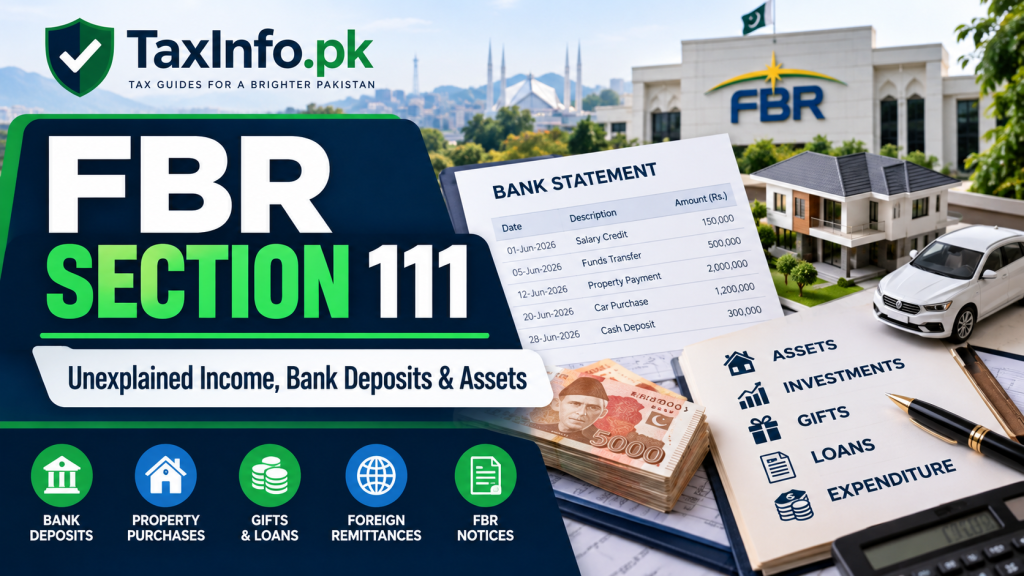
FBR Section 111 of the Income Tax Ordinance, 2001 deals with unexplained income, investments, money, assets and certain expenditures in Pakistan. If a taxpayer cannot satisfactorily explain the nature and source of funds, the Federal Board of Revenue (FBR) may treat the relevant unexplained amount as taxable income under the applicable legal provisions.
However, an important distinction must be understood: a bank deposit, property purchase or increase in wealth is not automatically taxable merely because it is a large transaction. The taxpayer’s explanation, supporting evidence and applicable law matter.
This guide explains seven important rules under Section 111, practical examples involving bank deposits and property purchases, documents that may help establish the source of funds, and what to do when FBR asks for an explanation.
Table of Contents
1. What Is FBR Section 111 in Pakistan?
Section 111 is titled Unexplained income or assets. It provides a mechanism for dealing with amounts or transactions whose nature and source have not been satisfactorily explained.
Broadly, the provision addresses situations involving:
- Amounts credited in a person’s books of account.
- Investments or ownership of money or valuable articles.
- Expenditure for which the source of funds is unexplained.
- Concealed income or inaccurate particulars of income, including suppressed business receipts or sales.
Where the relevant statutory conditions are met, the inadequately explained amount may be included in taxable income.
The classification depends on the circumstances. Certain unexplained amounts may fall under Income from Other Sources, while suppressed business income or receipts may be included under Income from Business.
For the governing legislation, consult the FBR Income Tax Ordinance, 2001.
2. How Does FBR Section 111 Apply to Bank Deposits?
A bank deposit can raise questions when its source is inconsistent with the taxpayer’s declared income, records or financial position.
Consider the following example.
Example: Rs. 2 Million Bank Deposit
A salaried individual declares annual salary income of Rs. 1,200,000. During the year, Rs. 2,000,000 is deposited into the individual’s bank account.
The deposit does not automatically establish Rs. 2,000,000 of additional taxable income.
Possible explanations might include:
- Savings accumulated in previous years.
- Proceeds from selling an asset.
- A genuine loan.
- A properly documented family gift.
- A transfer from another account owned by the taxpayer.
- Previously declared business income.
Each explanation must be consistent with the actual transaction and supported by appropriate records.
For instance, if Rs. 800,000 was transferred from the person’s own second bank account, the two bank statements may establish that it was an internal transfer rather than fresh income.
Important: The taxpayer should not describe an unexplained deposit as a loan, gift or previous savings unless that explanation is genuine and supportable.
3. FBR Section 111 and Unexplained Property or Vehicle Purchases
Section 111 may become relevant where a person purchases an expensive asset but cannot adequately establish the funds used to acquire it.
Example: Property Purchase of Rs. 10 Million
Suppose a taxpayer purchases property for Rs. 10 million.
The purchase is funded through:
| Source | Amount |
|---|---|
| Documented previous savings | Rs. 4,000,000 |
| Bank financing | Rs. 4,000,000 |
| Documented proceeds from an earlier asset sale | Rs. 2,000,000 |
| Total | Rs. 10,000,000 |
If these sources are genuine, properly documented and legally acceptable, they may help explain how the purchase was financed.
Useful records may include the property agreement, bank loan documentation, repayment schedule, asset-sale documents and relevant bank statements.
Property owners should also understand the difference between explaining a purchase under Section 111 and declaring the property in an annual Wealth Statement.
For practical filing instructions, read How to Declare Property in FBR Wealth Statement.
Similarly, vehicle owners can follow How to Declare Vehicle in FBR Wealth Statement.
4. Can Gifts and Loans Explain Unexplained Income?
Genuine gifts and loans may provide an explanation for the source of funds, but they must be examined according to their real nature and the applicable tax provisions.
Genuine Family Gift
Suppose a father transfers Rs. 1,000,000 to his adult child.
Relevant evidence might include:
- Banking records showing the transfer.
- Identification of the donor and recipient.
- A gift declaration or other appropriate documentation.
- Evidence supporting the donor’s financial capacity.
- Applicable tax treatment under the Income Tax Ordinance.
Simply entering Rs. 1,000,000 as a gift in a Wealth Statement does not, by itself, establish that the transaction is genuine or exempt from tax.
Genuine Personal Loan
Suppose a taxpayer borrows Rs. 700,000 from a relative.
Evidence might include a loan agreement, banking trail, confirmation from the lender, repayment terms and records demonstrating the lender’s source of funds.
A genuine loan also creates a repayment obligation, which may need to be reflected as a liability.
The tax treatment of gifts, loans and other receipts should be assessed under the applicable provisions, including Section 39 where relevant.
For more examples, read Gifts and Loans in FBR Wealth Statement.
5. How Are Foreign Remittances Treated Under Section 111?
Foreign remittances require particular care because the legal treatment depends on the transaction, applicable statutory conditions and supporting evidence.
Section 111 contains a specific provision relating to qualifying foreign exchange remittances received through prescribed banking channels, subject to the conditions and monetary limits stated in the law.
This protection should not be interpreted as a blanket exemption for every overseas transfer.
Taxpayers should distinguish between:
- A genuine personal remittance from abroad.
- Foreign salary or business income.
- Export or freelance service receipts.
- A loan or gift received from overseas.
- Transfers involving previously held funds.
The underlying nature of the receipt remains important, and separate tax provisions may apply.
Relevant documents can include bank credit advice, remittance certificates, transaction references, sender details and evidence of the underlying transaction.
If the receipt is actually foreign business or employment income, review How to Declare Foreign Income in FBR Tax Return.
Always check the latest statutory wording before relying on the remittance-related exception.
6. What Happens If FBR Questions the Source of Funds?
An inquiry concerning unexplained funds should be handled by reviewing the actual notice and its legal basis.
FBR may seek information or supporting evidence under applicable provisions of the Income Tax Ordinance. An inquiry, an assessment amendment and a final tax demand are not necessarily the same stage of proceedings.
Practical Response Process
Step 1: Read the notice carefully.
Identify the issuing authority, tax year, relevant section, questions raised and response deadline.
Step 2: Identify the disputed transactions.
Prepare a transaction-wise reconciliation of the bank deposits, investments, assets or expenditures questioned.
Step 3: Gather genuine supporting documents.
Collect bank statements, contracts, loan documents, asset-sale records, remittance evidence and other relevant records.
Step 4: Prepare a clear explanation.
Explain where the funds came from, when they were received and how they were used. Reconcile the explanation with previously filed returns and Wealth Statements.
Step 5: Submit the response through the prescribed channel.
Follow the instructions in the actual notice and retain proof of submission.
Step 6: Address further proceedings promptly.
If the matter progresses to an assessment, demand or appeal, evaluate the relevant statutory procedure and deadlines.
For general IRIS notice guidance, see FBR Notice in IRIS – How to Check and Respond.
7. How to Avoid Section 111 Problems in Future Tax Returns
Accurate recordkeeping and consistent declarations can reduce avoidable questions about unexplained funds.
Maintain a Reliable Financial Trail
Retain records of substantial receipts, transfers, purchases, loans and gifts. The appropriate evidence will depend on the nature of each transaction.
Declare Assets and Liabilities Correctly
Ensure that the annual Wealth Statement reflects genuine assets, liabilities and relevant financial movements.
Read Wealth Statement in Pakistan – FBR IRIS Guide for an explanation of the filing process.
Reconcile Wealth Using Actual Figures
An unexplained reconciliation difference should be investigated rather than eliminated by inserting fictitious cash, gifts or loans.
Our guide Wealth Statement Not Reconciling? 7 Easy Fixes explains common reconciliation errors.
Avoid Unsupported Opening Balances
Previous-year savings or opening cash balances should be consistent with credible historical records. Creating an unsupported opening balance solely to justify a later asset purchase can introduce additional compliance risks.
Review Returns Before Submission
Compare the income tax return, Wealth Statement, bank records and significant asset transactions before filing.
If a genuine error is discovered after filing, determine whether revision is available under the applicable law and procedural conditions.
See How to Revise Wealth Statement in FBR IRIS.
Does Section 111 Automatically Mean a Fixed Tax Rate?
No. Section 111 is not simply a separate fixed-rate tax on every unexplained deposit.
Where an amount is lawfully included in taxable income, the applicable tax calculation depends on the relevant tax year, taxpayer category, income classification and other governing provisions.
Interest, default surcharge, penalties or other consequences may arise under separate provisions where their legal conditions are met.
The amount of a bank transaction should therefore not be multiplied by an arbitrary percentage and described as the Section 111 tax.
Frequently Asked Questions
What is FBR Section 111?
FBR Section 111 is a provision of Pakistan’s Income Tax Ordinance, 2001 dealing with unexplained income, investments, money, assets and certain expenditures. It can apply when the taxpayer’s explanation of the nature and source of funds is inadequate under the law.
Is every bank deposit taxable under Section 111?
No. A bank deposit is not automatically taxable merely because money enters an account. The nature of the receipt, source of funds, evidence and applicable law must be considered.
Can FBR question a property purchase made from previous savings?
Yes, questions may arise if the source of funds requires explanation. Genuine previous savings supported by relevant records may help establish how the property was purchased.
Can a family gift be used to explain a bank deposit?
A genuine family gift may be relevant, but its tax treatment and supporting evidence must be examined. Merely labeling a deposit as a gift is not sufficient.
Does a loan count as taxable income under Section 111?
A genuine loan is not automatically income merely because funds were received. However, the taxpayer may need to establish that the loan was genuine and explain the transaction with appropriate evidence.
Are all foreign remittances exempt from Section 111?
No. The Ordinance provides specific treatment for qualifying remittances subject to statutory conditions. Different kinds of overseas receipts may also be governed by other income tax provisions.
What should I do if I receive a Section 111-related FBR notice?
Read the notice, identify the transactions questioned, gather authentic evidence and respond within the applicable deadline through the prescribed procedure. Where significant amounts or disputed facts are involved, professional representation may be appropriate.
Conclusion
FBR Section 111 is an important provision dealing with unexplained income and assets in Pakistan. Its application depends on the legal requirements, actual transactions and the taxpayer’s ability to provide a satisfactory explanation.
The most effective compliance approach is to maintain reliable financial records, declare genuine assets and liabilities correctly, and ensure that bank transactions and investments can be reconciled with documented sources of funds.
For the authoritative statutory text, consult the Federal Board of Revenue – Income Tax Ordinance, 2001 and the FBR Finance Acts.