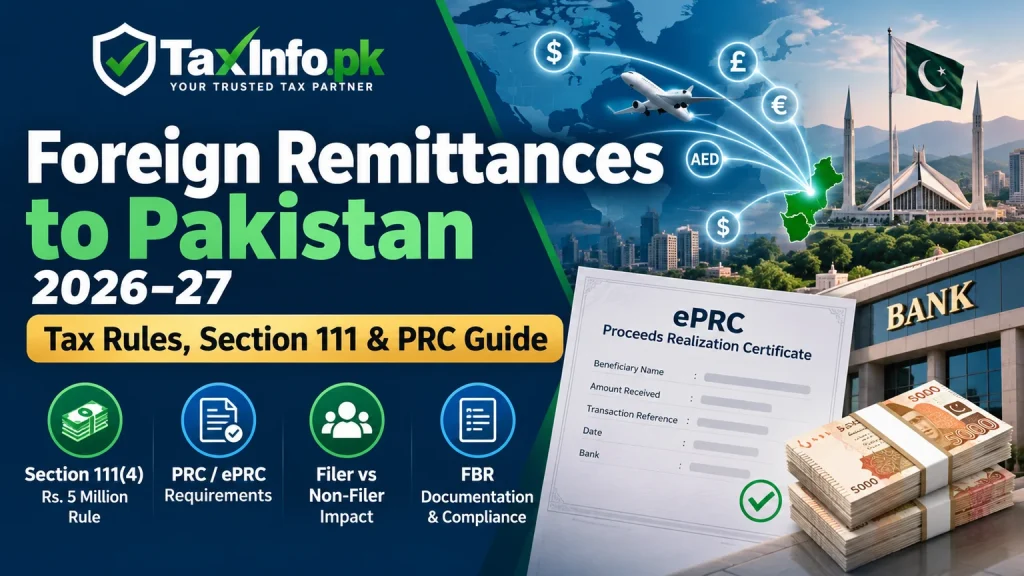
Foreign Remittances to Pakistan are an important source of financial support for millions of families receiving money from overseas Pakistanis. However, taxpayers often misunderstand the difference between receiving money from abroad, earning foreign income and claiming protection under Section 111 of the Income Tax Ordinance, 2001.
For Tax Year 2027, genuine foreign remittances may qualify for specific protection under Section 111(4), provided the statutory requirements are satisfied.
The most important point is that receiving money from abroad does not automatically make every transaction tax-free. The source of funds, purpose of payment, banking channel and supporting documentation all matter.
This guide explains the Rs. 5 million rule, the role of Proceeds Realization Certificates (PRCs), the difference between family remittances and business income, and how to maintain appropriate records for FBR compliance.
Key Takeaways
- Foreign Remittances to Pakistan are not automatically taxable merely because funds arrive from overseas.
- Section 111(4) provides specific protection for qualifying remittances not exceeding Rs. 5 million in a tax year, subject to statutory conditions.
- A PRC or ePRC supports the banking record but does not automatically prove that the underlying receipt is exempt from income tax.
- Family support, foreign salary, freelance earnings and business receipts may have different tax treatments.
- Taxpayers should maintain banking evidence and correctly reconcile relevant receipts, assets and expenses in their FBR records.
Table of Contents
Are Foreign Remittances to Pakistan Tax-Free in 2026–27?
A genuine personal remittance from overseas is not automatically taxable income merely because it is received in a Pakistani bank account. However, its tax treatment depends on the underlying transaction and the applicable provisions of the Income Tax Ordinance.
Section 111(4) provides protection from the unexplained-income provisions for qualifying foreign exchange remittances, subject to its prescribed conditions and annual limit.
This is not a general exemption for all foreign earnings.
For example, money received from an overseas relative as family support is different from payment received from a foreign customer for professional services.
The first may represent a personal remittance, while the second may constitute business or professional income.
Understanding the tax treatment of Foreign Remittances to Pakistan is essential for individuals receiving money from overseas relatives. The correct treatment depends on the source of funds, the nature of the transaction and the applicable provisions of Pakistan’s income tax law.
What Is Section 111(4) of the Income Tax Ordinance?
Section 111 deals with unexplained income, investments, assets and expenditure.
Under Section 111(1), FBR may examine amounts or assets for which a taxpayer cannot provide a satisfactory explanation of their nature and source.
Section 111(4) provides a specific exception for qualifying foreign exchange remittances not exceeding Rs. 5 million in a tax year, subject to the statutory conditions.
The provision requires that the foreign exchange:
- Be remitted from outside Pakistan through normal banking channels.
- Not exceed the specified Rs. 5 million limit during the relevant tax year.
- Be encashed into Pakistani rupees by a scheduled bank.
- Be supported by a certificate issued by the bank.
The law also recognizes qualifying remittances routed through money service bureaus, exchange companies and money transfer operators under its explanation.
The complete provision should be read in the current FBR Income Tax Ordinance, 2001.
For a detailed explanation of unexplained assets and deposits, read our FBR Section 111 Guide.
What Is the Rs. 5 Million Foreign Remittance Rule?
The Rs. 5 million rule is frequently described as a tax exemption, but that description can be misleading.
The Rs. 5 million threshold relates to the specific protection available under Section 111(4), not a universal tax-free allowance for every type of foreign receipt.
The statutory threshold is measured for a tax year, rather than being a separate allowance for each individual transfer.
For Foreign Remittances to Pakistan, the Rs. 5 million threshold under Section 111(4) should be understood as a specific statutory protection rather than a general exemption from income tax. Taxpayers should maintain supporting banking records and verify whether their transactions satisfy the relevant legal conditions.
Example: Foreign Remittance of Rs. 3 Million
Suppose a Pakistani resident receives Rs. 3,000,000 from a family member working overseas.
The amount is transferred through a qualifying channel, converted into Pakistani rupees by a scheduled bank, and supported by the required bank certificate.
If all relevant legal conditions are met, the amount may qualify for Section 111(4) protection.
The recipient should preserve the bank records and evidence explaining the transaction.
Example: Foreign Remittance of Rs. 7 Million
Suppose another taxpayer receives Rs. 7,000,000 from overseas during the same tax year.
Because the total exceeds Rs. 5 million, the taxpayer should not assume that the entire amount enjoys the specific Section 111(4) protection.
Receiving more than Rs. 5 million does not, by itself, mean that the entire remittance becomes taxable.
Instead, the taxpayer must be able to establish the nature and legitimate source of the funds and determine whether any other tax provisions apply.
Appropriate documentation becomes particularly important.
Foreign Remittance vs Foreign Income: What Is the Difference?
A foreign remittance describes the movement of money into Pakistan.
Foreign income describes money earned from a source that is classified as foreign-source income under the applicable tax rules.
These are not interchangeable concepts.
| Type of receipt | Typical example | Main tax consideration |
|---|---|---|
| Family remittance | Brother sends money from Saudi Arabia for household expenses | Establish genuine source and applicable Section 111(4) conditions |
| Foreign salary | Individual earns salary from employment abroad | Residency and foreign salary provisions may apply |
| Freelance earnings | Pakistani freelancer receives payment from a US client | Business income and applicable export-of-services rules |
| Foreign business receipts | Overseas customer pays for goods or services | Business income and relevant tax provisions |
| Overseas gift | Relative transfers money as a genuine gift | Gift provisions, relationship and evidence |
| Transfer of own savings | Individual moves existing funds from an overseas account | Source of savings and potential reporting obligations |
The payment channel alone does not determine whether an amount is taxable.
For example, a payment received through an international transfer service does not become a family remittance if it actually represents income from freelance work.
To understand how overseas earnings are reported, see How to Declare Foreign Income in FBR Tax Return.
Are Remittances From Overseas Pakistanis Taxable?
When an overseas Pakistani sends genuine family support to a relative in Pakistan, the receipt should be evaluated according to its actual nature.
The recipient should maintain evidence showing:
- Who sent the money.
- The sender’s relationship to the recipient.
- The amount and date of the transfer.
- The banking or remittance channel used.
- The reason for the transfer.
- The required bank certificate, where applicable.
For larger transfers, supporting evidence of the sender’s legitimate source of funds may also be useful.
The recipient should not label a business payment as a personal family remittance merely because the sender lives abroad.
Does Tax Residency Affect Foreign Remittances?
Yes. Tax residency can significantly affect the treatment of foreign-source income.
A Pakistani citizen living abroad may be a non-resident for a particular tax year, depending on the applicable statutory tests.
Similarly, a person living in Pakistan may be required to consider foreign-source income under the rules applicable to residents.
Specific provisions, including Sections 50, 51, 102 and 103, may be relevant in appropriate circumstances.
For example, Section 102 contains an exemption relating to qualifying foreign-source salary where foreign income tax has been paid.
Section 51 also provides specific treatment for certain returning expatriates.
These provisions should not be confused with Section 111(4).
Tax residency, foreign income taxation and remittance documentation are separate questions that must be examined together.
What Is a Proceeds Realization Certificate (PRC)?
A Proceeds Realization Certificate (PRC) is a banking document that records the realization of qualifying funds received from abroad.
It can provide important evidence of a foreign remittance, including the amount received and its realization in Pakistan.
The State Bank of Pakistan has introduced electronic issuance and verification arrangements for PRCs.
What Is an ePRC?
An electronic Proceeds Realization Certificate, or ePRC, is the digital version of a PRC.
Depending on the bank’s system, the recipient may receive or access the certificate electronically.
An ePRC helps establish that funds were received from abroad through the relevant banking arrangements.
However, a PRC or ePRC is evidence of a remittance, not automatic proof that the underlying receipt is exempt from income tax.
A freelancer, for example, may have a valid PRC for export proceeds while still having tax obligations on the related business income.
The official framework is explained in the State Bank of Pakistan’s ePRC Circular.
How to Obtain a PRC or ePRC in Pakistan
The exact process may differ between banks, but the following steps provide a practical starting point.
Step 1: Receive Funds Through a Recognized Channel
Ensure that the foreign remittance is received through an appropriate banking or authorized remittance arrangement.
Keep the transaction reference and payment confirmation.
Step 2: Check Your Bank Records
Review the incoming transaction in your bank statement.
Confirm the amount credited, transaction date and available remittance details.
Step 3: Request the PRC or ePRC
Check whether your bank provides the ePRC automatically through email, online banking or another digital channel.
If it is not available, contact the bank’s remittance or customer support department.
Step 4: Verify the Certificate Details
Check the recipient information, amount, transaction reference and other relevant particulars.
Report any discrepancies to the bank.
Step 5: Preserve the Certificate
Save a digital copy with the corresponding bank statement and remittance advice.
If FBR requests an explanation of the transaction, these records may help support your response.
Proper documentation of Foreign Remittances to Pakistan is important for explaining overseas receipts during an FBR inquiry. A bank-issued PRC or ePRC can support the transaction record, although it does not independently establish that the underlying funds are exempt from income tax.
Can FBR Ask About Foreign Remittances?
Yes. FBR may examine transactions and request relevant information under applicable legal provisions.
Section 111(4) provides protection where its conditions are satisfied, but it does not mean that taxpayers should maintain no records or that every transaction is beyond examination.
For a qualifying remittance, the taxpayer should be able to produce the required bank certificate and supporting transaction records.
Where the transaction does not qualify for Section 111(4), the taxpayer may still explain its legitimate source using other reliable evidence.
For example, documents may establish that the money represents:
- Accumulated savings.
- A genuine gift.
- Repayment of a loan.
- Sale proceeds of an asset.
- Previously declared income.
- Another legitimate source.
The evidence required depends on the facts of the case.
How to Show Foreign Remittances in an FBR Wealth Statement
Foreign remittances may affect the recipient’s assets, bank balances and annual wealth reconciliation.
However, the amount should be classified according to its actual nature.
When reporting Foreign Remittances to Pakistan in an FBR Wealth Statement, taxpayers should ensure that bank balances, assets and expenditures are consistent with the actual movement of funds. The receipt must be classified according to its genuine nature to avoid inaccurate income reporting or double counting.
Example: Family Support Used for Household Expenses
A taxpayer receives Rs. 2,000,000 from an overseas family member.
During the year:
- Rs. 1,200,000 is used for household expenses.
- Rs. 800,000 remains in the bank account.
The Wealth Statement and reconciliation should reflect the relevant receipt, expenses and closing assets without counting the same amount twice.
Example: Foreign Income Transferred to Pakistan
A resident taxpayer earns foreign income and transfers the resulting savings into a Pakistani bank account.
The taxpayer should not automatically treat the transfer as a second source of income.
The original income, any applicable tax treatment, the transfer and the resulting assets should be reported consistently.
For a practical filing explanation, read Wealth Statement in Pakistan – FBR IRIS Guide.
Are Freelance Payments Received From Abroad Tax-Free?
No. A freelancer should not assume that overseas client payments are tax-free merely because the funds arrive through a foreign remittance channel.
Payments for services generally need to be considered under the applicable business-income and export-of-services provisions.
Where Section 154A applies, the correct rate and tax treatment depend on the type of service, relevant registration status and statutory conditions.
The existence of an ePRC does not convert freelance revenue into a personal gift or family remittance.
For detailed guidance, see Income Tax for Freelancers in Pakistan 2026–27.
What Documents Should You Keep for Foreign Remittances?
Maintaining a clear documentary record is one of the most effective ways to avoid future difficulties.
Depending on the transaction, relevant documents may include:
- Bank statements showing incoming funds.
- PRC or ePRC issued by the bank.
- Remittance receipts and transaction references.
- Sender’s identification and relationship evidence.
- Documents explaining the source and purpose of funds.
- Gift documentation, where relevant.
- Loan agreements or repayment evidence, where applicable.
- Invoices or contracts for business-related receipts.
- Supporting tax and Wealth Statement records.
Keep documents in a form that allows individual transactions to be traced and explained.
Common Foreign Remittance Tax Mistakes
Assuming Every Foreign Transfer Is Tax-Free
Foreign salary, freelance payments, business income and genuine family remittances can have different tax consequences.
Treating Rs. 5 Million as a Universal Exemption
The Section 111(4) limit relates to a specific statutory protection. It is not a general exemption for all overseas receipts.
Ignoring the Bank Certificate Requirement
Where Section 111(4) protection is claimed, the statutory banking and certification conditions matter.
Treating an ePRC as Proof of Tax Exemption
An ePRC documents the remittance. It does not independently establish the income-tax treatment of the underlying payment.
Failing to Reconcile Bank Balances
Large incoming transfers may affect assets, expenditures and Wealth Statement reconciliation.
Misclassifying Business Income as Family Support
The actual source and purpose of the funds should determine their classification.
One common mistake involving Foreign Remittances to Pakistan is assuming that every overseas transfer qualifies for the same tax treatment. Personal family support, foreign employment income and payments for business services must be evaluated separately under the applicable tax rules.
Frequently Asked Questions
1. Is foreign remittance taxable in Pakistan in 2026–27?
A genuine foreign remittance is not automatically taxable simply because money is received from abroad. Its treatment depends on the underlying source and applicable law. Section 111(4) may protect qualifying remittances from unexplained-income treatment, subject to its specific requirements.
2. What is the Rs. 5 million foreign remittance limit?
Section 111(4) provides a specific exception for qualifying foreign exchange remittances not exceeding Rs. 5 million in a tax year. The limit should not be interpreted as a general exemption for all foreign income or business receipts.
3. Is foreign remittance above Rs. 5 million automatically taxable?
No. Exceeding Rs. 5 million does not automatically make the entire amount taxable. However, the taxpayer cannot assume that the full amount qualifies for the specific Section 111(4) protection. The legitimate source and applicable tax treatment must be established.
4. Is a PRC necessary for claiming Section 111(4) protection?
The provision requires a certificate from the relevant scheduled bank confirming the prescribed realization of the remitted foreign exchange. A PRC or appropriate bank-issued documentation may be relevant to satisfying that requirement, depending on the transaction.
5. Are payments from foreign clients considered family remittances?
No. Payments received for professional, freelance or business services should be examined under the relevant income-tax provisions. Their arrival through an overseas payment channel does not change their underlying commercial nature.
Official Sources and Further Reading
The following official resources provide the legal and banking framework discussed in this guide:
- FBR — Income Tax Ordinance, 2001 (Amended up to 30 June 2026)
- FBR — Income Tax Basics
- FBR — Section 51: Foreign-Source Income of Returning Expatriates
- FBR — Section 102: Foreign-Source Salary
- State Bank of Pakistan — Electronic PRC Circular
Final Words
Understanding Foreign Remittances to Pakistan requires a clear distinction between receiving money from abroad and earning taxable income.
For Tax Year 2027, Section 111(4) provides important protection for qualifying remittances within its statutory limit and conditions.
However, the rule does not eliminate all reporting obligations, exempt every foreign receipt or replace the need to maintain proper banking records.
Before claiming a particular tax treatment, identify the actual source of funds, confirm the applicable law, obtain the relevant bank documentation and ensure that the transaction is reflected consistently in your tax records.
Accurate classification and reliable evidence are essential for FBR compliance.