Issuing a proper tax invoice is an important responsibility for a sales-tax-registered business. The Sales Tax Invoice Requirements in Pakistan determine what information should appear on an invoice so that taxable sales are properly documented and reported.
A sales tax invoice is more than an ordinary cash memo. It provides evidence of the transaction, identifies the supplier and buyer where required, records the taxable value and sales tax charged, and supports sales tax reporting.
A valid invoice can also be important for a registered buyer claiming admissible input tax.
This guide explains the key FBR sales tax invoice requirements, STRN rules, invoice particulars, digital invoicing, common mistakes and practical compliance points.
Table of Contents
What Is a Sales Tax Invoice?
A sales tax invoice is a document issued in connection with a taxable supply by a person registered under the sales tax regime.
It records important information about the transaction, including the supplier, buyer where applicable, goods or services supplied, value of the supply and sales tax charged.
Section 23 of the Sales Tax Act, 1990 deals with tax invoices.
The invoice serves several important purposes:
- records the taxable supply;
- shows the sales tax charged;
- identifies the registered supplier;
- supports sales tax return reporting;
- provides transaction evidence; and
- may support the buyer’s input tax claim where the applicable legal requirements are satisfied.
If you are still unclear about the difference between tax charged on sales and tax paid on purchases, first read our Input Tax vs Output Tax in Pakistan guide.
Who Can Issue a Sales Tax Invoice?
A key rule is that a business should not charge sales tax merely because it has an NTN.
FBR has specifically clarified that sales tax can only be recovered from customers by a supplier registered for sales tax purposes, subject to the applicable law.
A registered supplier should display its Sales Tax Registration Number (STRN) on the invoice or receipt.
Therefore:
NTN alone does not authorize a business to charge sales tax.
A person who is required to obtain sales tax registration should first complete the appropriate registration process.
For practical guidance, see our Sales Tax Registration in Pakistan guide.
7 Key Sales Tax Invoice Requirements in Pakistan
The precise particulars required should always be checked against the current Sales Tax Act, Rules and applicable electronic-invoicing requirements.
For a practical understanding, the following are seven key areas you should check on a sales tax invoice.
1. Supplier Details
The invoice should properly identify the supplier.
Relevant particulars generally include the supplier’s:
- name;
- address; and
- Sales Tax Registration Number (STRN).
The STRN is especially important because it identifies the supplier as registered for sales tax purposes.
2. Buyer Details Where Required
The invoice should contain the buyer/recipient information required under the applicable provisions.
Depending on the transaction, this may include:
- buyer’s name;
- address;
- STRN where the buyer is registered; and
- CNIC/NTN where specifically required by law.
Do not assume that the same buyer-identification requirement applies to every type of transaction.
3. Invoice Date
The invoice should clearly state the date of issue.
The date is important because sales tax is reported according to the applicable tax period and time-of-supply rules.
A business should therefore avoid issuing invoices with incorrect or arbitrary dates.
4. Invoice Number
A sales tax invoice should carry a proper serial or invoice number as required under the applicable framework.
A systematic invoice-numbering process helps businesses:
- maintain an audit trail;
- prevent duplicate invoices;
- reconcile sales records;
- identify cancelled or corrected invoices; and
- prepare Sales Tax Returns accurately.
5. Description and Quantity of Goods or Services
The invoice should properly describe what has been supplied.
Depending on the nature of the supply, this can include:
- description of goods or services;
- quantity;
- unit of measurement; and
- other information required under the applicable invoicing framework.
Avoid vague descriptions that make it difficult to determine what was actually sold.
6. Value of Supply and Applicable Tax
The invoice should clearly distinguish the relevant value of the supply and the applicable sales tax.
For example:
Value excluding Sales Tax: Rs. 100,000
Sales Tax @ applicable rate: Rs. 18,000
Total Invoice Value: Rs. 118,000
This allows both the supplier and buyer to identify the sales tax component separately.
The 18% rate in this example is only an illustration of an ordinary standard-rated supply. Different goods or services may have different tax treatment.
7. Total Amount Payable
The invoice should make the final transaction amount clear.
A customer should be able to understand:
Taxable Value + Applicable Sales Tax = Total Invoice Amount
Where other legally applicable amounts, duties or taxes are involved, they should be dealt with according to the applicable requirements.
Sample Sales Tax Invoice
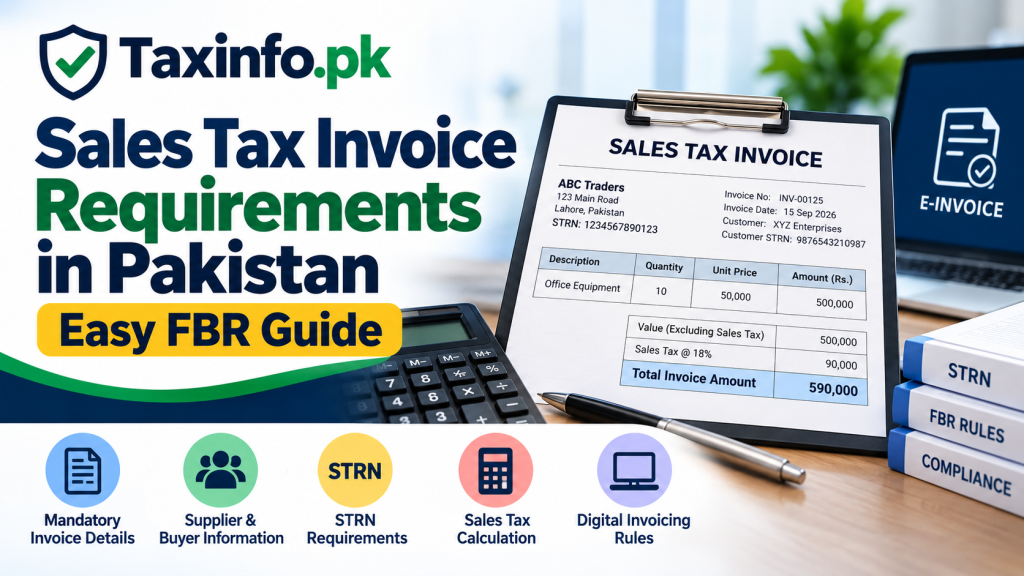
Consider a simple example involving ABC Traders, a registered supplier.
| Particular | Example |
|---|---|
| Supplier | ABC Traders |
| Supplier STRN | 1234567890123 |
| Buyer | XYZ Enterprises |
| Invoice No. | INV-00125 |
| Invoice Date | 15 September 2026 |
| Goods | Office Equipment |
| Quantity | 10 Units |
| Value excluding tax | Rs. 500,000 |
| Sales Tax | Rs. 90,000 |
| Total Invoice | Rs. 590,000 |
This is a simplified educational example only.
An actual invoice should comply with the complete legal and electronic-invoicing requirements applicable to the particular taxpayer and transaction.
Is STRN Mandatory on a Sales Tax Invoice?
The supplier’s sales tax registration status is extremely important.
FBR has warned customers that where sales tax is being charged, they should look for the supplier’s STRN on the invoice or receipt.
FBR states that only a sales-tax-registered supplier is entitled to recover sales tax from customers under the applicable framework.
Therefore, if a business is charging you sales tax but only displaying an NTN, do not automatically assume that it is registered for sales tax.
Is NTN the Same as STRN?
No.
This is a common misunderstanding.
NTN relates to taxpayer registration, particularly within the income tax framework.
STRN identifies registration for sales tax purposes.
FBR has expressly clarified that:
NTN is not a substitute for STRN when a supplier is charging sales tax.
A business can therefore have an NTN without that fact alone establishing that it is authorized to charge sales tax.
If you regularly deal with suppliers, checking their sales tax registration status can be an important compliance step.
Buyer CNIC or NTN Requirements
Buyer-identification requirements can depend on the nature of the transaction.
For example, FBR’s current digital-invoicing FAQ refers to section 23(1)(b) and explains that where a manufacturer or importer supplies to an unregistered distributor, the invoice should contain the NIC or NTN of that unregistered distributor.
This should not be converted into a blanket statement that every ordinary consumer must always provide a CNIC for every purchase.
Always check the requirement applicable to the actual transaction and supplier category.
Why a Valid Invoice Matters for Input Tax
A valid sales tax invoice can be important for the buyer because input tax adjustment is subject to legal and documentary requirements.
Suppose a registered business purchases goods for:
Value: Rs. 1,000,000
Sales Tax: Rs. 180,000
The Rs. 180,000 may represent potential input tax.
However, the business should not automatically claim it merely because an amount labelled “sales tax” appears on a receipt.
The supplier’s registration, invoice particulars, nature of the transaction and other input-tax requirements can affect admissibility.
For a detailed explanation, read Input Tax vs Output Tax in Pakistan.
💡 Quick Tool: Calculate Sales Tax
Need to calculate the sales tax component of an ordinary taxable amount?
Use the TaxInfo.pk Sales Tax Calculator for a quick standard federal sales tax calculation.
For example, if the taxable value is Rs. 100,000 and the applicable standard rate is 18%:
Sales Tax = Rs. 18,000
Total = Rs. 118,000
The calculator is a general calculation tool. Special-rate, reduced-rate, zero-rated or exempt supplies can have different treatment, so always check the law applicable to the actual transaction.
What Is Digital Invoicing in Pakistan?
Pakistan’s sales tax system has moved toward electronic or digital invoicing integrated with FBR’s computerized system.
Under FBR’s electronic-invoicing framework, notified/covered registered persons integrate their invoicing systems with FBR through the prescribed mechanism and issue electronic invoices.
Digital invoicing allows transaction information to be transmitted and recorded electronically rather than relying only on traditional manually prepared invoices.
This framework is particularly important because businesses should no longer treat digital invoicing as merely an optional invoice-design feature.
It forms part of the sales tax compliance system for persons covered by the applicable FBR requirements.
Who Is Required to Issue Electronic Invoices?
FBR issued S.R.O. 1413(I)/2025 setting out integration, testing and electronic-invoice issuance requirements for categories of sales-tax-registered persons.
The notification superseded an earlier 2025 notification and provided schedules for registration, testing and issuance of electronic invoices.
Businesses registered for sales tax should therefore determine whether and how the current integration requirements apply to them rather than relying on old manual-invoicing practices.
Because FBR can amend implementation requirements, always check the latest FBR notification and guidance before configuring an invoicing system.
When Should a Digital Invoice Be Issued?
FBR’s current Digital Invoicing FAQs explain that digital invoices are issued according to the time of supply rules.
FBR states that this is linked to the earlier of:
- receipt of payment; or
- delivery of goods,
as provided under the applicable Sales Tax Act framework.
Businesses should therefore avoid assuming that an electronic invoice can always be delayed until the end of the month.
The time-of-supply rules should be considered when determining when the invoice is required.
Can an Electronic Sales Tax Invoice Be Corrected or Cancelled?
Yes, but the current FBR procedure imposes an important time limit.
Under Sales Tax General Order No. 01 of 2026, FBR provides a mechanism for an integrated person to correct, cancel or delete a valid electronic sales tax invoice generated due to a bona fide mistake.
Where the correction is made within the prescribed 72-hour period, the integrated person can use the applicable FBR system mechanism.
After that period, prior approval of the concerned Commissioner Inland Revenue is required under the procedure specified by FBR.
Therefore, businesses should review electronic invoices quickly after issuance rather than waiting until the Sales Tax Return is due.
Sales Tax Invoice and Sales Tax Return
Invoices form an important part of sales tax return preparation.
Sales invoices help determine:
- taxable supplies;
- output tax;
- customer information where required;
- sales value; and
- tax-period reporting.
Purchase invoices can also be relevant to:
- input tax;
- supplier details;
- purchase value; and
- input tax admissibility.
The invoices and the amounts declared in the Sales Tax Return should therefore reconcile.
For the complete filing procedure, read our How to File Sales Tax Return in Pakistan guide.
Sales Tax Invoice vs Ordinary Receipt
An ordinary receipt and a compliant sales tax invoice should not automatically be treated as the same document.
A basic receipt might show:
Total Paid: Rs. 5,000
but provide no information about:
- supplier STRN;
- taxable value;
- sales tax amount;
- invoice particulars; or
- buyer details where required.
If sales tax is being recovered, the documentation should comply with the applicable sales tax requirements.
Customers and registered businesses should therefore pay attention to the invoice rather than merely checking the final amount paid.
What If a Business Charges Sales Tax Without STRN?
FBR has specifically warned against this practice.
A supplier should not represent itself as entitled to recover sales tax merely by displaying an NTN.
If a business charges sales tax without being properly registered for sales tax, this can raise a compliance issue.
FBR advises customers to look for the supplier’s STRN on invoices or receipts where sales tax is charged.
This also protects registered buyers from relying on questionable invoices when maintaining their own tax records.
Records Businesses Should Keep
A registered business should maintain organized invoice records.
Depending on the business and applicable requirements, these can include:
- issued sales invoices;
- purchase invoices;
- electronic invoice records;
- cancelled invoices;
- corrected invoices;
- debit notes;
- credit notes;
- customer details where required;
- supplier details;
- payment evidence; and
- Sales Tax Return records.
Invoice numbering and electronic records should be maintained consistently so that transactions can be traced and reconciled.
Common Sales Tax Invoice Mistakes
1. Showing NTN Instead of STRN
An NTN does not replace the supplier’s sales tax registration number.
2. Charging Sales Tax While Unregistered
A business should not charge sales tax merely because it is registered for income tax.
3. Missing Invoice Number
Poor invoice numbering makes reconciliation and audit trails difficult.
4. Incorrect Invoice Date
Using an incorrect date can affect tax-period reporting and time-of-supply treatment.
5. Not Separating Sales Tax
The taxable value, sales tax and total invoice amount should be clearly understandable.
6. Incorrect Buyer Information
Where buyer particulars are legally required, incorrect or incomplete information can create compliance problems.
7. Using the Wrong Tax Rate
Not every supply necessarily attracts the standard rate.
Check the actual tax treatment of the goods or services.
8. Claiming Input Tax on Weak Documentation
A buyer should not assume that every receipt containing the words “sales tax” supports an admissible input tax claim.
9. Ignoring Digital Invoicing Requirements
Registered persons covered by FBR’s integration requirements should not continue relying solely on manual invoicing where electronic invoicing is required.
10. Waiting Too Long to Correct an E-Invoice
Under FBR’s 2026 procedure, the 72-hour correction window is important. A delayed correction can require prior Commissioner approval.
Sales Tax Invoice Checklist
Before issuing an invoice, check:
Supplier
- Correct business name
- Correct address
- Correct STRN
Buyer
- Correct buyer details where required
- STRN/CNIC/NTN where applicable
Invoice
- Correct invoice number
- Correct date
- Proper description
- Correct quantity
- Correct taxable value
- Correct tax rate
- Correct sales tax amount
- Correct total
Digital Compliance
- Electronic invoice issued where applicable
- Invoice transmitted through the required system
- Errors checked promptly
- Correction/cancellation procedure followed where necessary
Official FBR Guidance on Sales Tax Invoices
Businesses should always verify invoice requirements from the latest official FBR guidance. FBR specifically states that a supplier charging sales tax should be registered for sales tax purposes and should reflect its STRN on the invoice or receipt.
Read the official guidance here: FBR – Sales Tax Can Be Recovered Only by a Registered Supplier.
Official FBR Digital Invoicing Guidance
Businesses subject to electronic invoicing should also review FBR’s latest digital invoicing requirements. FBR’s official FAQs explain electronic invoices, integration requirements, licensed integrators, time of supply and other practical compliance issues.
See the official resource: FBR – Digital Invoicing FAQs.
Frequently Asked Questions
What are the Sales Tax Invoice Requirements in Pakistan?
A sales tax invoice should contain the particulars required under the Sales Tax Act and applicable rules, including appropriate supplier information, transaction details, taxable value, sales tax and other prescribed information.
Can an unregistered business charge sales tax?
FBR states that sales tax can only be recovered by a supplier registered for sales tax purposes under the applicable framework.
Is STRN required on a sales tax invoice?
The supplier’s STRN is an important sales tax invoice requirement. FBR specifically advises customers to check the STRN where sales tax is being charged.
Is NTN enough for charging sales tax?
No. FBR has expressly clarified that NTN is not a substitute for STRN.
Does every customer have to provide CNIC?
Not necessarily. Buyer-identification requirements depend on the transaction and applicable provisions. For example, FBR specifically discusses NIC/NTN requirements for supplies by a manufacturer or importer to an unregistered distributor.
Why is a sales tax invoice important for input tax?
A proper invoice forms part of the documentary support for an input tax claim, but invoice possession alone does not guarantee that the input tax is admissible.
What is an electronic sales tax invoice?
It is a sales tax invoice issued and reported electronically through the applicable FBR-integrated invoicing framework.
Is digital invoicing mandatory in Pakistan?
FBR has issued notifications requiring categories of sales-tax-registered persons to integrate with its computerized system and issue electronic invoices according to the applicable implementation schedule and requirements.
When should a digital invoice be issued?
FBR’s Digital Invoicing FAQs link invoice issuance to the time-of-supply framework, including the earlier of receipt of payment or delivery of goods under the applicable provision.
Can I correct an electronic invoice after issuing it?
FBR’s Sales Tax General Order No. 01 of 2026 provides a procedure for correcting, cancelling or deleting an electronic invoice issued due to a bona fide mistake. The 72-hour period is particularly important; after that, prior approval of the concerned Commissioner is required under the specified procedure.
How do sales tax invoices affect my return?
Sales invoices support reported taxable sales and output tax, while eligible purchase invoices can be relevant to input tax. These records should reconcile with the Sales Tax Return.
Can I calculate the sales tax amount online?
Yes. For quick calculations involving the ordinary standard federal rate, use the TaxInfo.pk Sales Tax Calculator. Always verify whether the standard rate actually applies to the transaction.
Final Words
Understanding the Sales Tax Invoice Requirements in Pakistan is important for both suppliers and buyers.
A registered supplier should issue invoices containing the required particulars, use the correct STRN, calculate sales tax accurately and comply with electronic-invoicing requirements where applicable.
For buyers, a proper invoice is also important because it provides transaction evidence and may form part of the documentation required for an admissible input tax claim.
Remember that NTN and STRN are not interchangeable. FBR specifically states that NTN is not a substitute for STRN when sales tax is being charged.
Businesses should also pay close attention to digital invoicing. Current FBR requirements have expanded electronic integration, while the 2026 correction procedure makes it important to identify invoice mistakes promptly.
For further guidance, read our Input Tax vs Output Tax in Pakistan and Sales Tax Return Filing Guide, or use the TaxInfo.pk Sales Tax Calculator for quick standard sales tax calculations.
Disclaimer: This article is for general information and educational purposes only and does not constitute legal, tax or professional advice. Sales tax invoice requirements, electronic invoicing procedures, tax rates and FBR systems may change. Always verify the latest Sales Tax Act, Sales Tax Rules, FBR notifications and official guidance or consult a qualified tax professional for your specific circumstances.