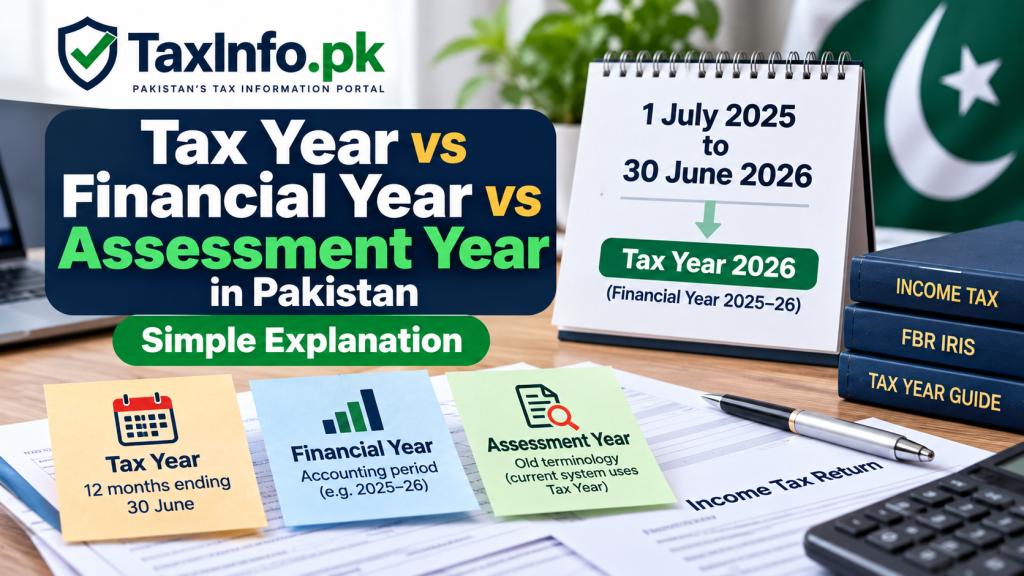
Understanding Tax Year vs Financial Year can be confusing, especially when FBR IRIS shows a Tax Year that appears one year ahead of the financial period you have in mind.
For example, income earned from 1 July 2025 to 30 June 2026 falls within Financial Year 2025–26, but for normal Income Tax purposes FBR refers to this period as Tax Year 2026.
This does not mean that an extra year has been added. The difference is mainly in the way the period is named.
There is another term—Assessment Year—that taxpayers sometimes encounter in old tax documents or online discussions. Under Pakistan’s current Income Tax system, however, Tax Year is the main terminology you will normally encounter.
This guide explains Tax Year, Financial Year, Assessment Year, Normal Tax Year and Special Tax Year in simple terms.
Quick Answer: What Is the Tax Year in Pakistan?
Pakistan’s normal financial year starts on 1 July and ends on 30 June. Under Section 74 of the Income Tax Ordinance, 2001, FBR names the normal Tax Year after the calendar year in which the period ends.
- Financial Year 2025–26 = Tax Year 2026
- Financial Year 2026–27 = Tax Year 2027
For normal tax-year taxpayers, both terms refer to the same 12-month period. A legally applicable Special Tax Year may follow a different period.
Table of Contents
What Is a Tax Year in Pakistan?
A Tax Year is the period to which your Income Tax Return and taxable income relate.
Under FBR’s normal Tax Year concept, it is a period of 12 months ending on 30 June.
The important part is how the period is named.
FBR denotes the Tax Year by the calendar year in which 30 June falls.
For example:
1 July 2025 to 30 June 2026 = Tax Year 2026
Similarly:
1 July 2026 to 30 June 2027 = Tax Year 2027
This naming convention is particularly important when selecting the correct return in FBR IRIS.
FBR explains this concept in its official Income Tax Basics guidance.
What Is a Financial Year in Pakistan?
A Financial Year generally describes a 12-month financial or accounting period.
For Pakistan’s normal Income Tax year, the relevant period runs from:
1 July to 30 June
Therefore:
Financial Year 2025–26 = 1 July 2025 to 30 June 2026
For a taxpayer using the Normal Tax Year, FBR itself describes the Tax Year as the financial year ending on 30 June.
The confusion usually comes from the naming convention.
A Financial Year is commonly written using both calendar years:
2025–26
while the corresponding normal FBR Tax Year is identified by the year in which the period ends:
Tax Year 2026
Tax Year vs Financial Year – What’s the Difference?
For a person following Pakistan’s Normal Tax Year, Tax Year and Financial Year can refer to the same 12-month period, but they are commonly expressed differently.
For example:
| Period | Financial Year | FBR Tax Year |
|---|---|---|
| 1 July 2023 – 30 June 2024 | FY 2023–24 | Tax Year 2024 |
| 1 July 2024 – 30 June 2025 | FY 2024–25 | Tax Year 2025 |
| 1 July 2025 – 30 June 2026 | FY 2025–26 | Tax Year 2026 |
| 1 July 2026 – 30 June 2027 | FY 2026–27 | Tax Year 2027 |
So, in a normal case:
Financial Year 2025–26 and Tax Year 2026 cover the same period.
The main difference is how that period is described.
However, this simple equivalence should not be applied blindly to taxpayers using a Special Tax Year, which is explained later in this guide.
Why Is Financial Year 2025–26 Called Tax Year 2026?
This is one of the most common sources of confusion.
The reason is straightforward:
FBR names the Normal Tax Year according to the calendar year in which 30 June falls.
Financial Year 2025–26 ends on:
30 June 2026
Therefore, its FBR designation is:
Tax Year 2026
You can remember it with this simple rule:
Look at the year containing the ending 30 June. That is normally the FBR Tax Year.
So:
FY 2024–25 → TY 2025
FY 2025–26 → TY 2026
FY 2026–27 → TY 2027
This is why a taxpayer filing income earned during July 2025 to June 2026 should normally be looking for Tax Year 2026 in IRIS.
If you are preparing your return, our How to File Income Tax Return Online in Pakistan – FBR IRIS Guide explains the complete filing process.
What Is an Assessment Year in Pakistan?
The term Assessment Year can cause additional confusion because it is common in some other tax systems and can also appear in older Pakistani tax material.
Pakistan’s current Income Tax framework under the Income Tax Ordinance, 2001 primarily uses the concept of a Tax Year.
References to an “assessment year” can still appear in historical material, particularly in connection with the tax regime that existed under the repealed Income Tax Ordinance.
Therefore, you should not automatically assume that:
Assessment Year = current FBR Tax Year
without checking the context of the document.
For normal current return filing in IRIS, taxpayers should generally pay attention to the Tax Year shown in the system.
Is Assessment Year Still Used by FBR?
You may still encounter the expression “assessment year” in older legislation, historical assessments, legacy records or provisions referring back to the repealed Income Tax Ordinance.
That does not mean FBR’s current annual return system has replaced the Tax Year field with an Assessment Year field.
For current Income Tax compliance, Tax Year is the key term taxpayers normally need to understand.
If you are reading an older tax document containing “Assessment Year,” identify:
- which law the document relates to;
- which period is involved;
- whether the reference is historical; and
- whether the document relates to the repealed tax regime.
Do not convert an old Assessment Year into a current Tax Year merely by guessing from the number.
What Is a Normal Tax Year?
The standard Tax Year used by most taxpayers is called the Normal Tax Year.
FBR defines it as the 12-month period ending on 30 June.
For example:
Example of a Normal Tax Year
Income period:
1 July 2025 to 30 June 2026
Financial Year:
2025–26
FBR Tax Year:
Tax Year 2026
This is the normal July-to-June cycle most individual taxpayers encounter when filing an Income Tax Return.
For example, TaxInfo.pk’s Income Tax Rates for Salaried Persons 2026–27 explains how the financial period 2026–27 corresponds with the applicable Tax Year concept.
What Is a Special Tax Year?
Not every taxpayer necessarily uses the normal July-to-June Tax Year.
FBR recognizes a Special Tax Year, which is a 12-month period different from the Normal Tax Year.
FBR’s official Income Tax Basics guidance gives examples including:
1 January to 31 December
and
1 October to 30 September
as periods that can operate as Special Tax Years in the applicable circumstances.
The naming convention is also important.
FBR explains that a Special Tax Year is denoted by the calendar year relevant to the Normal Tax Year in which the closing date of that Special Tax Year falls.
Example of a Special Tax Year
FBR gives the example of a Special Tax Year running:
1 January 2017 to 31 December 2017
which is denoted as:
Tax Year 2018
This can initially look unusual because the accounting period ends in December 2017.
That is why taxpayers using a Special Tax Year should not simply apply the standard July–June examples to their own situation.
FBR’s official Income Tax Basics guide explains both Normal and Special Tax Years.
Can a Taxpayer Choose Any Special Tax Year?
A Special Tax Year should not be treated as an arbitrary accounting period that any taxpayer can simply select in IRIS whenever convenient.
The Income Tax Ordinance contains specific provisions dealing with Normal Tax Years, Special Tax Years and changes between them.
Therefore, if your business accounts follow a period other than July–June, confirm that the applicable Special Tax Year treatment is legally recognized for your case.
Do not simply select a different Tax Year because your internal accounts use another closing date.
Which Tax Year Should You Select in FBR IRIS?
For a taxpayer following the Normal Tax Year, identify the period in which the income was earned and then look at the year in which 30 June falls.
For example, suppose you are preparing a return for salary earned between:
1 July 2025 and 30 June 2026
The correct normal Tax Year is:
Tax Year 2026
Not Tax Year 2025.
Similarly, income from:
1 July 2026 to 30 June 2027
normally relates to:
Tax Year 2027
Selecting the wrong Tax Year can result in preparing or submitting a return for the wrong period.
Before submitting, check:
- beginning date of the income period;
- ending date;
- Tax Year displayed in IRIS;
- income records;
- employer/tax certificates where applicable; and
- previous return history.
If you discover that an already-filed return contains an omission or incorrect statement, see our How to Revise Income Tax Return in FBR IRIS guide before taking corrective action.
Does the Tax Year Affect Income Tax Slabs?
Yes, identifying the correct Tax Year is important when determining which tax rules and rates apply to income.
Tax rates can change through annual Finance Acts.
Therefore, you should not take a tax slab from one period and automatically apply it to income earned during another period.
For example, if you are calculating salary tax for the financial period 1 July 2026 to 30 June 2027, use the rates applicable to that period rather than an older table.
You can check our Income Tax Rates for Salaried Persons 2026–27 for the current salary-rate guide applicable to that financial period.
This is also why identifying the correct Tax Year should come before calculating annual Income Tax liability.
Tax Year vs Income Tax Return Filing Date
The end of the Tax Year and the deadline for filing the Income Tax Return are not the same thing.
For example, a Normal Tax Year may end on:
30 June
but the return is filed after that period has ended.
FBR’s current general due-date guidance lists:
| Taxpayer | General FBR Due Date |
|---|---|
| Individual | On or before 30 September |
| Association of Persons (AOP) | On or before 30 September |
| Company | On or before 31 December |
| Company having a Special Tax Year | On or before 30 September |
These are FBR’s general published due dates. Specific statutory changes, notifications or deadline extensions can affect a particular Tax Year.
Always check the current filing deadline rather than assuming that an older year’s extension applies again.
FBR publishes its general dates on the official Income Tax Due Dates page.
Does Filing After the Due Date Change the Tax Year?
No.
Filing a return late does not normally turn the underlying income into income of the next Tax Year.
For example, if the income relates to:
1 July 2025 – 30 June 2026
it remains associated with:
Tax Year 2026
even if the taxpayer files the return after the normal filing deadline.
The filing date and the income period are separate concepts.
Late filing can, however, have separate compliance consequences.
Tax Year and Active Taxpayer Status
The Tax Year can also matter when considering return filing and Active Taxpayer List status.
FBR’s ATL guidance links inclusion in the relevant ATL with filing the Income Tax Return for the corresponding Tax Year.
This is another reason taxpayers should make sure they are filing for the correct Tax Year rather than merely selecting the newest year visible in IRIS.
For a broader comparison of taxpayer status, see our Active Taxpayer vs Non-Active Taxpayer in Pakistan guide.
Common Tax Year Mistakes
1. Selecting Tax Year 2025 for Financial Year 2025–26
For a Normal Tax Year taxpayer, Financial Year 2025–26 corresponds to Tax Year 2026, not Tax Year 2025.
2. Thinking the Tax Year Starts in January
Pakistan’s Normal Tax Year starts on 1 July and ends on 30 June.
A January–December period may be relevant in a Special Tax Year context, but it is not the standard Normal Tax Year.
3. Confusing Tax Year With Return Filing Year
The year in which you physically submit the return does not necessarily determine the Tax Year.
Look at the income period.
4. Treating Assessment Year as a Current Synonym
Assessment Year may appear in historical material, but current FBR Income Tax filing primarily uses Tax Year terminology.
5. Applying Normal Tax Year Rules to a Special Tax Year
A taxpayer legitimately using a Special Tax Year can have a different accounting period.
6. Using the Wrong Year’s Tax Slabs
Always match the applicable rates with the correct income period and Tax Year.
7. Assuming 30 June Is the Return Filing Deadline
30 June is the end of the Normal Tax Year. It is not the standard annual Income Tax Return filing deadline.
Frequently Asked Questions
What is the Tax Year in Pakistan?
The Normal Tax Year is a 12-month period ending on 30 June and is named according to the calendar year in which 30 June falls.
Is Financial Year 2025–26 Tax Year 2025 or 2026?
For a Normal Tax Year taxpayer, Financial Year 2025–26 is Tax Year 2026.
Why is FY 2025–26 called Tax Year 2026?
Because the financial period ends on 30 June 2026, and FBR names the Normal Tax Year according to the calendar year in which 30 June falls.
What period does Tax Year 2026 cover?
For a taxpayer following the Normal Tax Year:
1 July 2025 to 30 June 2026
is Tax Year 2026.
What period does Tax Year 2027 cover?
For the Normal Tax Year:
1 July 2026 to 30 June 2027
is Tax Year 2027.
Is Tax Year the same as Financial Year?
For a taxpayer following the Normal Tax Year, both can refer to the same July-to-June period, although they are commonly named differently. Special Tax Years require separate consideration.
What is an Assessment Year?
Assessment Year is terminology that may appear in historical Pakistani tax material and under the repealed tax regime. Current FBR Income Tax filing primarily uses Tax Year terminology.
What is a Special Tax Year?
A Special Tax Year is an applicable 12-month period different from the Normal July-to-June Tax Year and is treated and named according to the applicable Income Tax rules.
Which Tax Year should I select for income earned from July 2025 to June 2026?
For the Normal Tax Year, select Tax Year 2026.
Does the Tax Year end on the Income Tax Return filing deadline?
No. The Normal Tax Year ends on 30 June. The return filing deadline occurs later according to the applicable filing rules.
What is the difference between a normal tax year and a special tax year in Pakistan?
A normal tax year ends on June 30, whereas a special tax year (approved by the FBR) may end on a different date based on business requirements.
Which fiscal year applies to the current tax filing?
The tax year runs from July 1 of the previous year to June 30 of the current year.
Official FBR Resources for Tax Year and Return Filing
Before selecting a Tax Year or filing an Income Tax Return, taxpayers should verify the applicable rules from official FBR sources.
FBR’s Income Tax Basics page explains the Normal Tax Year and Special Tax Year, including how these periods are determined and named.
The FBR Tax Period for Income Tax Return guidance explains the tax period applicable to an Income Tax Return and the normal July-to-June cycle.
Before submitting a return, taxpayers should also check FBR’s Income Tax Due Dates for the applicable filing deadline.
You can also review FBR’s Active Taxpayer List guidance to understand how filing the relevant Income Tax Return relates to ATL status.
These official sources are particularly important where a taxpayer uses a Special Tax Year or has circumstances that differ from the standard examples discussed in this guide.
Final Words
Understanding Tax Year vs Financial Year becomes much easier once you remember one basic rule:
For Pakistan’s Normal Tax Year, look at the year in which 30 June falls.
Therefore:
Financial Year 2025–26 = Tax Year 2026
and:
Financial Year 2026–27 = Tax Year 2027
For most individual taxpayers, both terms describe the same July-to-June income period but use different naming conventions.
The position can be different where a taxpayer legitimately uses a Special Tax Year, while the term Assessment Year should not automatically be treated as a synonym for the current Tax Year.
When filing through FBR IRIS, always match the return with the actual income period rather than choosing a Tax Year based only on when you happen to be filing the return.