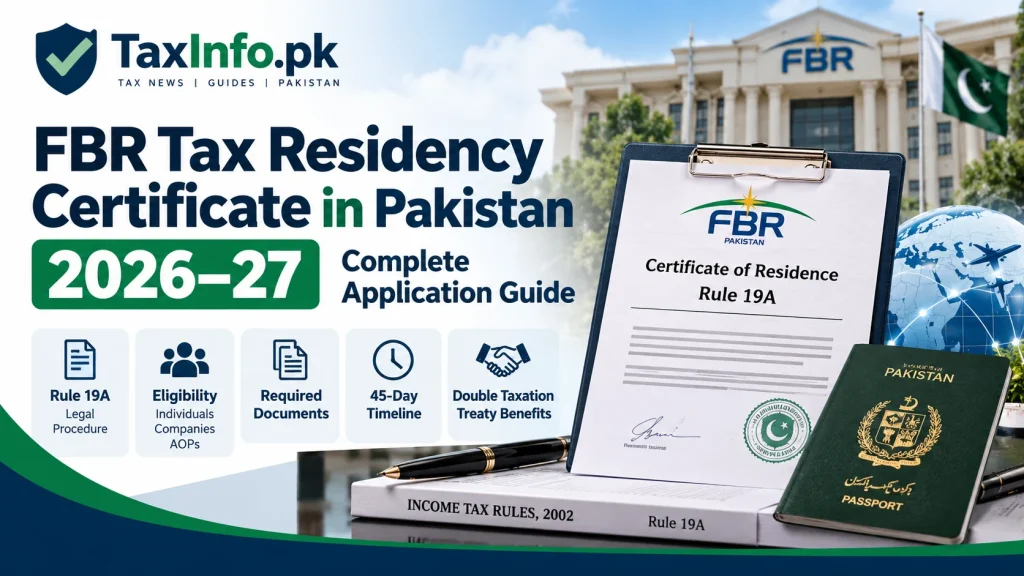
An FBR Tax Residency Certificate is an official document issued by Pakistan’s Federal Board of Revenue to establish a taxpayer’s residence status in Pakistan for a specified tax year. It is particularly important for individuals, companies and associations of persons earning income from countries that have a Double Taxation Agreement (DTA) with Pakistan.
Under Rule 19A of the Income Tax Rules, 2002, an eligible Pakistani tax resident may apply for a Certificate of Residence to support a claim for treaty-based tax relief in another country.
The certificate does not automatically eliminate foreign taxes. Instead, it provides evidence of Pakistani tax residence that foreign tax authorities may require when considering reduced withholding tax, tax credits or other benefits under an applicable treaty.
This guide explains the eligibility requirements, documents, application procedure, FBR processing timeline and practical considerations for Tax Year 2027.
Table of Contents
What Is an FBR Tax Residency Certificate?
An FBR Tax Residency Certificate (also called a Certificate of Residence or TRC) is a document issued by the competent tax authority of Pakistan confirming that an applicant is resident in Pakistan for the relevant tax year.
It is primarily used when a taxpayer needs to establish Pakistani residence before the tax authorities of another country under a Double Taxation Agreement.
For example, a Pakistani business receiving certain income from a foreign treaty partner may be asked to provide a Tax Residency Certificate before the foreign payer applies a treaty withholding-tax rate.
The certificate establishes residence status for treaty purposes; it does not independently determine the tax treatment of every transaction.
Key Takeaways
- The FBR Tax Residency Certificate is governed by Rule 19A of the Income Tax Rules, 2002.
- Eligible applicants may include resident individuals, companies and associations of persons.
- The certificate is generally used to claim benefits under an applicable Double Taxation Agreement.
- Section 82 provides important residency tests for individuals.
- Rule 19A provides a 45-day period for the competent authority to decide an application.
- A separate application and certificate are required for each tax year.
- Having an NTN or appearing on the Active Taxpayer List does not automatically establish treaty residence.
Who Can Apply for an FBR Tax Residency Certificate?
Under Rule 19A, a person resident in Pakistan may apply for a Certificate of Residence when it is required for presentation before the tax authorities of another country with which Pakistan has entered into a relevant tax treaty.
Potential applicants include:
- Resident individuals: Employees, professionals, investors and other persons who meet Pakistan’s tax-residency requirements.
- Resident companies: Companies qualifying as residents under the applicable provisions of the Income Tax Ordinance.
- Resident associations of persons (AOPs): Entities meeting the relevant residence conditions.
Eligibility depends on the applicant’s actual legal residence status, the tax year concerned and the purpose for which the certificate is requested.
A Pakistani passport, CNIC or NTN alone does not conclusively establish tax residence.
How Is Tax Residency Determined in Pakistan?
Tax residence is determined under the Income Tax Ordinance, 2001, rather than solely by nationality or immigration status.
Section 82: Residency Rules for Individuals
Under Section 82, an individual is treated as a resident for a tax year if any applicable statutory condition is satisfied.
| Residency condition | Legal requirement |
|---|---|
| 183-day test | Present in Pakistan for 183 days or more during the tax year |
| 120-day plus four-year test | Present for at least 120 days during the tax year and at least 365 days in aggregate during the preceding four years |
| Government employee rule | Employee or official of the Federal or Provincial Government posted abroad during the tax year |
The number of days must be calculated according to the applicable statutory rules.
For an individual, satisfying one of the relevant conditions can establish residence under Pakistan’s domestic income-tax law.
However, if the individual is also considered resident in another country, the applicable tax treaty may contain additional tie-breaker provisions.
Official reference: FBR — Section 82: Resident Individual
Example: Individual Living in Pakistan
Suppose an individual spends 210 days in Pakistan during Tax Year 2027.
Because the individual exceeds the 183-day threshold, the person generally satisfies the domestic residency condition under Section 82.
If that individual also earns income from a treaty partner country, an FBR Tax Residency Certificate may help establish eligibility for relevant treaty benefits.
Example: Overseas Pakistani Visiting Pakistan
Suppose an overseas Pakistani spends 90 days in Pakistan during the tax year and does not satisfy another statutory residency condition.
Pakistani citizenship alone does not make the person a resident under Section 82.
The person should not assume eligibility for a Pakistani Tax Residency Certificate without establishing the relevant residence requirements.
What Is Rule 19A of the Income Tax Rules, 2002?
Rule 19A establishes the procedure for obtaining a Certificate of Residence from the Competent Authority of Pakistan.
It applies where a Pakistani resident seeks to present the certificate to the tax authorities of another country with which Pakistan has a relevant agreement for avoiding double taxation and fiscal evasion.
The prescribed application requests information about the applicant, Pakistani residence, foreign income, treaty partner country and the intended tax relief.
Rule 19A also addresses verification, the competent authority’s decision and the issuance of certificates for individual tax years.
Official reference: FBR — Rule 19A: Certificate of Residence
Why Is a Tax Residency Certificate Required?
A Tax Residency Certificate may be requested when a Pakistani resident earns income from a foreign jurisdiction and wishes to claim relief available under a tax treaty.
Possible situations include:
- Dividend income from shares held in another country.
- Interest income from qualifying overseas investments.
- Royalties or licensing income.
- Certain professional or business payments.
- Other income covered by an applicable treaty.
The specific benefit depends on the treaty, the nature of income, the taxpayer’s eligibility and any procedural requirements imposed by the foreign jurisdiction.
Example: Foreign Withholding Tax on Royalty Income
A Pakistani resident company receives royalty income from a foreign treaty partner.
Assume the foreign country’s ordinary withholding-tax rate is 20%, while the applicable treaty permits a 10% rate for a qualifying recipient.
On royalty income of Rs. 1,000,000 equivalent:
| Tax calculation | Illustrative amount |
|---|---|
| Royalty income | Rs. 1,000,000 |
| Ordinary withholding tax at 20% | Rs. 200,000 |
| Treaty withholding tax at 10% | Rs. 100,000 |
| Potential difference | Rs. 100,000 |
These percentages are illustrative only, not verified rates for any particular country or treaty.
The taxpayer must confirm the actual treaty provisions, beneficial-ownership requirements and foreign-country procedures before claiming relief.
A Tax Residency Certificate is supporting evidence, not a guarantee that the reduced rate will be granted.
Documents Required for an FBR Tax Residency Certificate
Rule 19A prescribes supporting documents for the application.
The required documents listed in the rule include:
- Proof of earning income in the foreign country.
- Copy of the applicant’s NIC.
- Copy of the NTN Certificate.
- Copy of the Certificate of Incorporation, where applicable.
- Copy of the income tax return for the latest tax year, where applicable.
The application form also requests identifying and tax-related particulars.
Information Required in the Application
| Information | Details |
|---|---|
| Applicant name | Individual, company or AOP name |
| Applicant type | Individual, AOP or company |
| Identification | CNIC, registration or incorporation number |
| Pakistan address | Residential or registered address |
| Contact information | Telephone and email |
| NTN | National Tax Number |
| Income declared | Income for the relevant tax year |
| Foreign tax authority | Authority before which the certificate will be presented |
| Foreign income | Nature and particulars of income earned abroad |
The taxpayer should ensure that the application is consistent with available FBR registration and income-tax records.
For guidance on updating taxpayer particulars, read How to Update FBR Registration Details in IRIS.
How to Apply for an FBR Tax Residency Certificate in Pakistan
The following procedure follows the requirements established by Rule 19A.
Step 1: Confirm Your Pakistani Tax Residency
Determine whether you qualify as a resident individual, resident company or resident AOP for the relevant tax year.
Individuals should review the applicable Section 82 conditions.
Where dual residence is possible, examine the relevant treaty provisions before claiming treaty benefits.
Step 2: Identify the Applicable Double Taxation Agreement
Confirm that Pakistan has a relevant tax treaty with the country where the certificate will be presented.
Review the treaty article covering the particular income.
Pakistan’s tax treaties do not necessarily provide identical relief for every category of income.
You can review treaty partners through the FBR Bilateral Full Scope Treaties directory.
Step 3: Prepare the Rule 19A Application
Use the prescribed Form of Application for Obtaining Certificate of Residence under Rule 19A.
The application is addressed to:
The Competent Authority of Pakistan
Federal Board of Revenue
Constitution Avenue
Islamabad, Pakistan
Complete the prescribed particulars accurately, including the relevant tax year, foreign income and intended treaty relief.
Step 4: Gather Supporting Documents
Attach the supporting documents applicable to your circumstances.
These may include the NIC, NTN Certificate, proof of foreign income, incorporation documents and latest income tax return.
Review the official Rule 19A form to ensure that the required documents have been included.
Step 5: Submit the Application Through the Available FBR Channel
Submit the application using the submission channel currently accepted by FBR for Certificate of Residence requests.
FBR’s official Help Portal includes guidance titled How to submit application for certificate of residence.
Taxpayers should consult the current FBR Help Portal or confirm the accepted filing procedure with the relevant FBR office before submission.
The precise online menu, form availability and submission method may change.
Step 6: Respond to Verification Requests
Under Rule 19A, the Competent Authority may request a report from the concerned Commissioner.
The Commissioner is required to verify the relevant facts and submit the report within 30 days of receiving the application from FBR.
Applicants should provide any additional information legitimately requested during verification.
Step 7: Receive the Decision
Rule 19A requires the Competent Authority to decide the application within 45 days of its submission.
If approved, the authority issues the prescribed Certificate of Residence.
If rejected, the authority must communicate the decision together with reasons within the same 45-day period.
Keep a copy of the submitted application and any acknowledgement or correspondence.
How Long Does FBR Take to Issue a Tax Residency Certificate?
Rule 19A provides a 45-day decision period from submission of the application.
The rule also specifies a 30-day reporting period for the concerned Commissioner where the Competent Authority seeks verification.
These periods are statutory requirements rather than a guarantee that every administrative case will be completed without delays.
| Stage | Rule 19A requirement |
|---|---|
| Application | Submitted to the Competent Authority |
| Commissioner’s report, if requested | Within 30 days of receipt from FBR |
| Approval or rejection decision | Within 45 days of application submission |
| Rejection communication | Reasons communicated within the 45-day period |
If the decision is delayed, the applicant may follow up through the relevant official FBR channel using the application reference and supporting records.
Is a Separate Certificate Required Every Tax Year?
Yes.
Rule 19A(5) requires a separate application and a separate Certificate of Residence for each tax year.
A certificate issued for an earlier tax year should not automatically be treated as proof of residence for Tax Year 2027.
For example, a company that obtained a certificate for Tax Year 2026 may need another certificate for Tax Year 2027 if a foreign tax authority requires confirmation for the later period.
The applicant must establish residence and provide the required particulars for the relevant year.
To understand the distinction between tax years and financial years, read Tax Year vs Financial Year in Pakistan.
Tax Residency Certificate vs NTN Certificate vs ATL Status
These documents and statuses serve different purposes.
| Document or status | Main purpose | Does it establish treaty residence? |
|---|---|---|
| FBR Tax Residency Certificate | Confirms residence for the specified tax year and relevant treaty context | Yes, as official supporting evidence |
| NTN Certificate | Identifies a taxpayer registered with FBR | No |
| Active Taxpayer List status | Indicates whether the taxpayer appears on the relevant ATL | No |
| Income tax return | Reports income and tax information | Not by itself |
| CNIC or passport | Establishes identity or nationality | No |
A person may have an NTN without qualifying as a Pakistani resident for a particular tax year.
Similarly, filing a tax return does not automatically establish entitlement to benefits under every international tax treaty.
Can Freelancers and Exporters Apply for a Tax Residency Certificate?
A Pakistani resident freelancer or business may need an FBR Tax Residency Certificate when a foreign payer or tax authority requires proof of Pakistani residence for a treaty claim.
However, eligibility for treaty relief depends on the relevant income category and treaty conditions.
For example, a foreign client may ask a Pakistani service provider to supply residency documentation before determining withholding-tax obligations.
The service provider should confirm whether a treaty benefit is actually available for that payment.
An FBR Tax Residency Certificate should not be confused with a bank-issued PRC or ePRC.
A PRC records foreign exchange realization, while a Tax Residency Certificate establishes tax residence.
For related information, read Foreign Remittances to Pakistan 2026–27 and Income Tax for Freelancers in Pakistan.
What Happens if FBR Rejects the Application?
Rule 19A requires the Competent Authority to communicate the reasons for rejection within the prescribed decision period.
Possible issues that may require clarification include:
- Insufficient evidence of Pakistani tax residence.
- Missing prescribed documents.
- Inconsistent applicant particulars.
- Unclear information about the relevant foreign income.
- An incorrect or unsupported treaty-relief claim.
These are examples of potential documentary or eligibility issues, not an exhaustive official list of rejection grounds.
The applicant should review the actual reasons communicated by FBR and determine the appropriate corrective action.
Where relevant, the taxpayer may seek clarification from the competent authority or obtain professional advice on the available procedural remedies.
Common Mistakes to Avoid
Assuming Pakistani Nationality Automatically Means Tax Residency
Tax residence depends on statutory criteria, not nationality alone.
Applying for the Wrong Tax Year
Rule 19A requires a separate application for each tax year.
Ignoring the Relevant Tax Treaty
The applicant should identify the treaty partner and the particular benefit being claimed.
Submitting Incomplete Supporting Documents
Missing identification, NTN, foreign-income evidence or other prescribed documents may create avoidable processing issues.
Confusing PRC With Tax Residency Certificate
A bank-issued PRC is not a substitute for an FBR Certificate of Residence.
Assuming a Certificate Guarantees Foreign Tax Exemption
A certificate supports a treaty claim, but the foreign tax authority applies its own procedures and the relevant treaty provisions.
Frequently Asked Questions
1. What is an FBR Tax Residency Certificate?
An FBR Tax Residency Certificate is an official document issued by Pakistan’s competent tax authority confirming that an applicant is resident in Pakistan for a specified tax year. It is generally used to support tax treaty relief claims before foreign tax authorities.
2. How can I apply for a Tax Residency Certificate in Pakistan?
An eligible resident applicant can prepare the prescribed Rule 19A application, provide the required identification, tax and foreign-income documents, and submit the request through the FBR-accepted channel. The current submission procedure should be confirmed through official FBR guidance.
3. How many days does FBR take to issue the certificate?
Rule 19A provides a 45-day period for the Competent Authority to approve or reject the application. Where verification is requested, the concerned Commissioner has a separate 30-day reporting requirement after receiving the application from FBR.
4. Can an overseas Pakistani obtain an FBR Tax Residency Certificate?
An overseas Pakistani may qualify if the person satisfies Pakistan’s applicable tax-residency requirements for the relevant year and the conditions for the certificate. Pakistani citizenship alone does not establish eligibility.
5. Is a Tax Residency Certificate the same as an NTN Certificate?
No. An NTN Certificate confirms taxpayer registration, while an FBR Tax Residency Certificate provides official evidence of residence for the relevant tax year and treaty purpose.
Official FBR References
The following official resources provide the legal foundation and procedural information discussed in this guide:
- FBR — Rule 19A: Certificate of Residence
- FBR — Section 82: Resident Individual
- FBR — Income Tax Basics and Residency Rules
- FBR — Section 107: Double Taxation Agreements
- FBR — Bilateral Full Scope Tax Treaties
- FBR — Help Portal
Final Words
An FBR Tax Residency Certificate can be an important document for Pakistani residents earning income from countries that have a Double Taxation Agreement with Pakistan.
For Tax Year 2027, applicants should first establish their Pakistani tax-residency status, identify the relevant treaty, complete the prescribed Rule 19A application and provide accurate supporting documents.
The legal framework specifies a 45-day decision period and requires a separate certificate for each tax year.
Most importantly, a Tax Residency Certificate provides evidence of residence; the actual availability of foreign tax relief depends on the applicable treaty and the foreign jurisdiction’s requirements.